Migrant tales
Menu
  • #MakeRacismHistory “In Your Eyes”
  • About Migrant Tales
  • It’s all about Human Rights
  • Literary
  • Migrant Tales Media Monitoring
  • NoHateFinland.org
  • Tales from Europe
Menu

Tag: Cultural diversity in Finland

KOTOUTUMINEN #14: Disseminate and vanish

Posted on February 14, 2021 by Migrant Tales

Remember back in the 1990s when Finland brought Vietnamese refugees and dispersed them like pepper throughout Finland? It appeared back then that the main goal of the migration authorities was to disseminate newcomers and make them vanish.

One matter that this type of coercive assimilation aimed at doing was to ensure that these Vietnamese boat people would not form communities. By not enabling them to form strong communities, white Finland was ensured.

This image has an empty alt attribute; its file name is Image1-53_edited-1.jpg
Finns living together in a house in Colonia Finlandesa, Argentina. Source: Olavi Lähteenmäki, “Colonia Finlandesa – Uuden Suomen perustaminen Argentiinaan 1900-luvun alussa”

Even today, you will hear, as I did this week, complaints by some municipal politicians that “too many migrants live in one area of the city.”

“Why don’t they disperse them and force them to live elsewhere?” one of the persons in the room asked. “They try to but then they always want to return [to where they lived].”

Not accepting cultural diversity shows how difficult it is for some to share public spaces and accept that Finland has changed. Instead of trying to sweep these people under the rug and pretend that their communities do not exist, why not accept them as an integral part of our society? Aren’t they the new face of Finland?

I wonder what such Finns I heard this week believe is an effective path towards inclusion. Apart from being too simplistic and revealing racist attitudes, such policies would never work.

And what about the hundreds of thousands off Finns that emigrated to other lands? Many stuck together, formed associations and groups, newspapers to defend their culture and lives in their new homeland.

The same thing that migrant and minority communities are doing today.

See also:

  • Kotoutuminen #1: A good synonym for kotoutuminen is too many times the reinforcement of structural racism
  • Kotoutuminen #2: A tool of white fragility to rule you
  • Kotoutuminen #3: To touch or not to touch
  • Kotoutuminen #4: Amalgamate, assimilate is the rule, two-way adaption is a pipedream
  • Kotoutuminen #5: Perpetuating the Ulysses syndrome, a chronic stress disorder of refugees
  • Kotoutuminen #6: The white Finnish teacher and the migrant adult child. Stop infantilizing!
  • Kotoutuminen #7: How do we deal with our prejudices and exceptionalism?
  • Kotoutuminen #8: Let’s do away with “us” and “them”
  • Kotoutuminen #9: Spreading half-truths about integration
  • Kotoutuminen #10: Misleading expectations that will keep you (dis)integrated
  • Kotoutuminen #11: The teacher asks the student why Muslims kill people
  • Kotoutuminen #12: Integration is as easy as 1+ 1 = 2. NOT!
  • Kotoutuminen #13: There is no good Finnish word for inclusion just like with integration before

*Kotoutiminen is the Finnish term for integration. It came about in the late-1990s because there was no such term in the Finnish language.

QUOTE OF THE DAY: Racism in Finland? You ain’t seen nothing yet!

Posted on January 22, 2020 by Migrant Tales

When I came to live permanently in Finland over 40 years ago, people like me were seen as an ethnic anomaly. Sometimes having a different skin color or looking “foreign” meant receiving microaggressions like people shoving your child with a lighted cigarette that burns them, or hearing a perfect stranger saying something racist to you in public.

I know children who aren’t white Finns of hiding from the sun because it darkens their skin. What kind of a society do we live in where children see the sun as something negative because it tans their beautiful brown skins?

The more culturally diverse Finland becomes more racism. The only reason why some Finns believed that there was no racism in the country was that there weren’t enough foreigners or “foreign-looking people” to load off or test how racist they are.

Matters will get worse before they improve.

The hostile environment, political cowardice and the rise of a hostile Islamophobic party are just a few signs on the wayward journey.

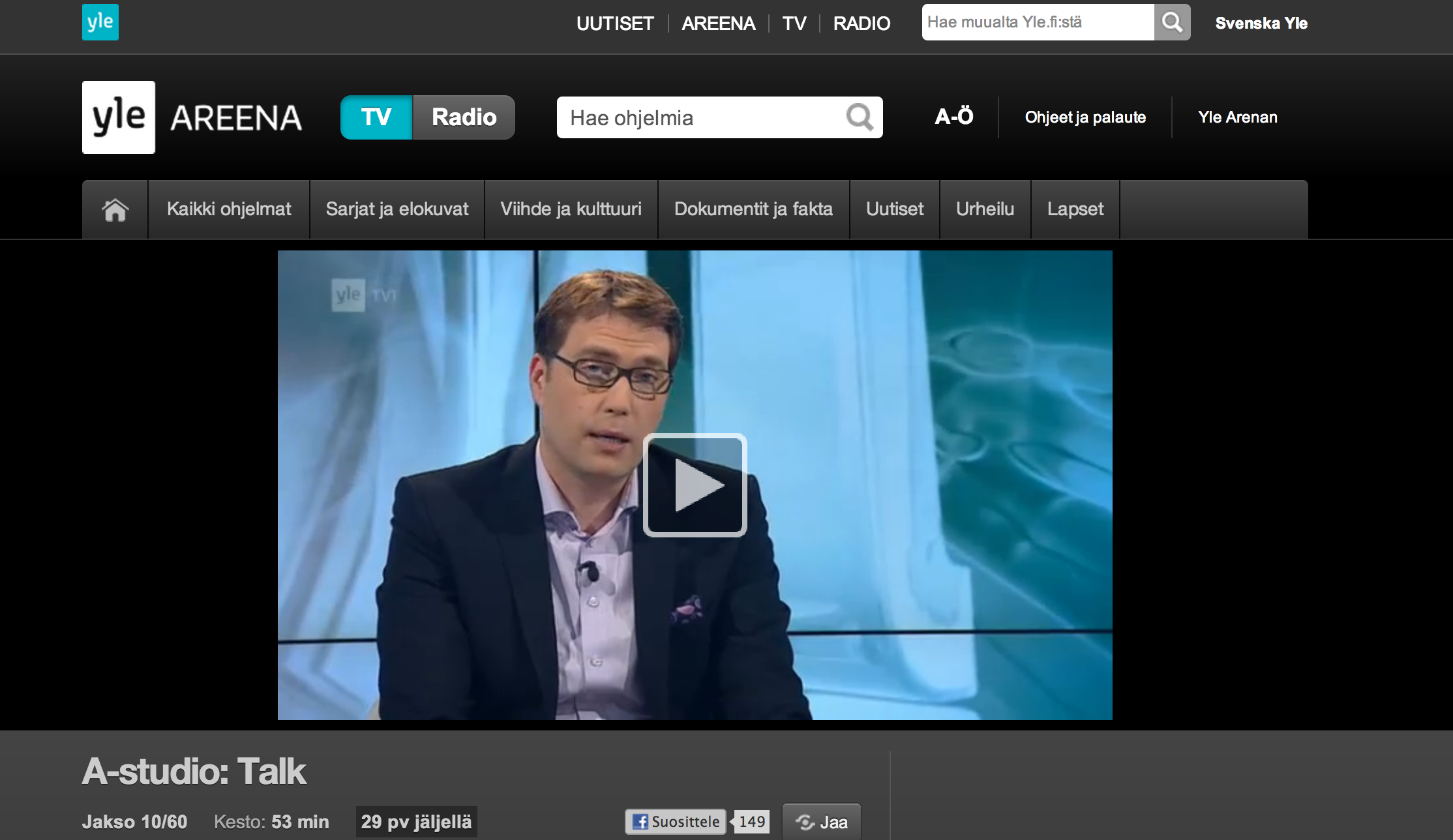
Cultural diversity: The key question that should have been asked on YLE’s A-Studio talk show

Posted on March 15, 2013 by Migrant Tales

YLE A-Studio had an interesting debate with Perussuomalaisiet (PS) MPs Olli Immonen, Jussi Halla-aho, Left Alliance Helsinki city councilman Dan Koivulaakso and Swedish-language daily HBL journalist Marianne Lydén. Despite assurances by Immonen, Suomen Sisu’s new president, that  the extremist anti-immigration association is against racism, they should their same colors by reinforcing over and over again their loathing for cultural diversity. 

No matter how much Immonen wants to “renew” Suomen Sisu, it will always be an association that has its roots in racism, which they won’t admit, but in their strong opposition to cultural diversity, which he admitted a number of times on the show. In plain English this means demonizing immigrants and visible immigrants.

Far right researcher Jussi Jalonen was interviewed at the start of the program. He made it very clear that Suomen Sisu is an extremist association that is no different from other European extremist groups.

Such groups, like Suomen Sisu, point out that certain ethnic groups  are incompatible with our culture and therefore should not  be allowed to live in Western Europe. It is an old argument used over and over again by those who oppose immigration and cultural diversity.

Kuvankaappaus 2013-3-15 kello 8.39.44

Watch full program here.

While few believe that Suomen Sisu is going to champion for more social equality in Finland, their agenda and their new program will be based on undermining cultural diversity and especially limiting immigration from outside Europe. This reinforces the association’s stand on diversity. What they are saying is that few “dark” people should move to Finland. They are, however, willing to accept white European immigrants because they believe they can integrate faster into our society.

The way that Halla-aho and Immonen spoke about how cultures must not mix (multiculturalism) hinges on myths. People have always moved and mixed with people from other groups.

When I hear what people like Immonen and Halla-aho say about diversity, their deep hatred and disregard shows for who I am and how I identify with Finland. According to them, my father, an Argentinean, should have never married my mother. My Jewish ancestors should have stayed where they came from instead of come to Finland in 1799.

In their Nazi- or far right spirited world, we are the so-called Rheinland bastards.

Finland has tens of thousands of so-called multicultural Finns that Suomen Sisu would like to wipe off the map.

Suomen Sisu’s ideology in a Finnish context is very much like the Ku Klux Klan’s and that of the American Nazi Party. They have the same opinions about cultural diversity as the extremist association headed by Immonen. One of the people Suomen Sisu recommends reading is by by Nazi war criminal Alfred Rosenberg.

Immonen and Halla-aho believe that the Garden of Eden was actually in Finland. According to them, people evolved and never mixed with anyone outside their group.

In their minds there is no such thing as black Finns or Finns from other ethnic and cultural backgrounds.


Halla-aho scandal in Finland: Leadership is now needed more than ever

Posted on June 14, 2012 by Migrant Tales

Finland’s political parties,  including the Perussuomalaiset (PS), have a golden opportunity to show leadership and make a clear break from Jussi Halla-aho and his Suomen Sisu association followers. We’ll be back, however, to square one if Halla-aho’s heir-apparent, Juho Eerola, becomes the new chairman of the administration committee of parliament. 

Suomen Sisu is an extremist association that discourages Finns from marrying foreigners, especially those with African or Muslim backgrounds.

Suomen Sisu discourages Finns from marrying foreigners. Source: Vallan vahtikoira.

What value can an anti-immigration politician like MP Eerola bring to the administration committee, which sets, among other matters, immigration policy?

Eerola claims that he has enough experience to be the chairman of such an important committee because he has worked at a refugee center in Kotka.  The PS MP is a practical nurse by profession who has done a number of odd jobs to survive before he was elected to parliament last year.

Apart from his unimpressive qualifications and experience to chair the administration committee, one of the matters that should set alarm bells ringing are Eerola’s extremist political views. These are well-known. He once wrote that he liked Benito Mussolini’s economic system because there was full employment.

His views of a dictator like Mussolini and the corporatist state that maintained him in power reveals more ignorance than anything else. How much employment was there in Italy after Mussolini’s policies and political world view brought so much devastation and suffering to the country?

Eerola wasn’t too concerned last year when his aide, Ulla Pyysalo, was found on a membership list of the Suomen Kansalinen Vastarinta, a neo-Nazi association.

There has been too much complacency by political parties to a small extremist group within the PS led by Halla-aho. Finland and its political parties have today the opportunity to offer leadership by giving a clear thumbs down to Eerola and begin the process of isolating Halla-aho and his cronies.

There is a clear message in our actions: Finland will not tolerate people who want to exclude others because of their ethnic background.


Debating Finland’s cultural diversity is opening up old wounds

Posted on July 10, 2011 by Migrant Tales

By Enrique Tessieri

Ever wonder why immigrants, multicultural Finns, immigration to Finland and refugees don’t have any history in Finland? If historical importance could be measured like a loaf of bread, the history of older minorities like the Saami, Roma, Tartars, Jews and others would be mere crumbs.   

The question why immigrants and minorities don’t have a history in Finland is like investigating the history of the exploited by the exploiters. By not having, or denying a group its history, you forsake them a place in society. Since they don’t exist they have no rights never mind the right to demand them.

In many respects, the social construct of the prototype Finns as the bonafide Finn in the last century was a pretext for steamrolling minorities and denying them their right to be Finns.  It explains why a large part of the population has today difficulty in accepting cultural diversity as natural in Finland.

If we look at the independence of the United States in 1776 or that of other Latin American countries during 1808-1826, there is a big difference with Finland’s independence in 1917. Even though the former loathed the political system that permitted their exploitation under colonialism, a large number of them were former inhabitants or descendants of these European kingdoms. They even spoke their languages as well as practiced their culture and religion.

In Finland, however, it was a different story. History teaches us that we sought independence because we didn’t want to be or were Russians. In order to build a national identity we amalgamated or “fennified” our culture through measures like changing our surnames into Finnish ones. Killing our cultural diversity was acceptable because of our hatred of groups like the Russians.

Does this same hatred affect our good judgement today as a modern twenty-first century nation?

Difficult questions about our history and cultural roots had to be conveniently forgotten by history in order for us to forge a near-monolithic Finnish national identity.

One group that were nearly forgotten were Finnish immigrants and their descendants.

Thanks to the over million immigrants that left this country from the 1860s, Finnish culture has evolved in many lands. Instead of accepting our rich cultural diversity that Finnish immigrants and their descendants gave this nation, we passed strict citizenship laws that disjointed them from us.

Debating what happened to our cultural diversity and why it was nearly erased would be questioning the whole essence of our reason for being as a nation in the twentieth century.

What will come out of such a debate in the future is a question mark. One matter is for certain, however: It should make us stronger at the end of the day because Finnish culture will be more acceptant of its diversity.

An immigrant call to change and Finnish society

Posted on January 23, 2010 by Migrant Tales

Some wrongfully accuse those of speaking up for cultural diversity in Finland of “whining” and being “ungrateful.” Apart from exercising one’s democratic right of free speech, bigger steps have to be taken by minorities in this country to drive home their message of greater equality and fair treatment.

If we wait for change it will never happen in our lifetimes.

In my opinion, the situation of immigrants in Finland is tragic and shameful. On the one hand, you have people who want to eagerly take part in this society but cannot due to a number of imagined and real factors such as language, while Finnish authorities simultaneously spend a lot of funds and good will on integrating these persons to our society.

The integration program, although well-intentioned, lacks one very important component in order for it to be successful: Immigrants’ input. The program is the majority’s view on how newcomers should integrate into our society.

On many occasions I have mentioned that we do not need any magic trick to integrate immigrants and refugees. Those very values that makeup our society would be enough. However, the problem is that these legal benchmarks enshrined in the Constitution and Non-Discrimination Act do not apply to minorities who don’t speak Finnish or Swedish as natives.

Real integration does not only mean job opportunities but, most importantly, a willingness by society to accept these people. Today unemployment among immigrants is officially 2-3 higher than the national level and by looking at the silence and lack of leadership of Finnish politicians, the closed view of institutions such as the police and the constant attacks by hardline “Finland for Finns” proponents, it is clear what a significant part of the population thinks.

We are still at such a diaper stage in the immigrant debate that some of our politicians and policy-makers do not even grasp why immigration is important for this country but prefer instead to stick their heads in the sand and hide behind nationalism.

Change will not come from the majority because there is a definite lack of leadership in this area. If this is so, we must spearhead change and make our voices heard and take part more vociferously than ever in the ongoing one-sided debate on immigrants in Finland. We must lobby politicians and use all the opportunities and channels offered by democratic society to make our voices heard.

That time has come now.

Read more about documentary film
Read more

Recent Posts

  • Lahti is the latest city to prohibit the niqab and burka
  • Finland’s tabloids Iltalehti and Ilta-Sanomat are the pits
  • Riikka Purra’s Dr Jekyll and Mr Hyde mask
  • Double standards
  • Perussuomalaiset: Uusi logo, sama vanha juttu

Recent Comments

  1. Absolutely Socking: Racist Finnish Facebook group against human rights gets flooded with socks on Musta Barbaari’s mother and sister charged by the police in “ethnic profiling” case
  2. Ilkka Nuotio on Pekka Myrskylä: “Tilastot kertovat toista kuin poliittinen keskustelu”
  3. Genrih Soinkara on The war in Ukraine and the Russian-Finnish border crisis are showing Finland’s ugly side
  4. Ahti Tolvanen on Comment by Ahti Tolvanen on the Helsinki +50 conference
  5. Angel Barrientos on Angel Barrientos is one of the kind beacons of Finland’s Chilean community

Archives

  • June 2026
  • May 2026
  • April 2026
  • March 2026
  • February 2026
  • January 2026
  • December 2025
  • November 2025
  • October 2025
  • September 2025
  • August 2025
  • July 2025
  • June 2025
  • May 2025
  • April 2025
  • March 2025
  • February 2025
  • January 2025
  • December 2024
  • November 2024
  • October 2024
  • September 2024
  • August 2024
  • July 2024
  • June 2024
  • May 2024
  • April 2024
  • March 2024
  • February 2024
  • January 2024
  • December 2023
  • November 2023
  • October 2023
  • September 2023
  • August 2023
  • July 2023
  • June 2023
  • May 2023
  • April 2023
  • March 2023
  • February 2023
  • January 2023
  • December 2022
  • November 2022
  • October 2022
  • September 2022
  • August 2022
  • July 2022
  • June 2022
  • May 2022
  • April 2022
  • March 2022
  • February 2022
  • January 2022
  • December 2021
  • November 2021
  • October 2021
  • September 2021
  • August 2021
  • July 2021
  • June 2021
  • May 2021
  • April 2021
  • March 2021
  • February 2021
  • January 2021
  • December 2020
  • November 2020
  • October 2020
  • September 2020
  • August 2020
  • July 2020
  • June 2020
  • May 2020
  • April 2020
  • March 2020
  • February 2020
  • January 2020
  • December 2019
  • November 2019
  • October 2019
  • September 2019
  • August 2019
  • July 2019
  • June 2019
  • May 2019
  • April 2019
  • March 2019
  • February 2019
  • January 2019
  • December 2018
  • November 2018
  • October 2018
  • September 2018
  • August 2018
  • July 2018
  • June 2018
  • May 2018
  • April 2018
  • March 2018
  • February 2018
  • January 2018
  • December 2017
  • November 2017
  • October 2017
  • September 2017
  • August 2017
  • July 2017
  • June 2017
  • May 2017
  • April 2017
  • March 2017
  • February 2017
  • January 2017
  • December 2016
  • November 2016
  • October 2016
  • September 2016
  • August 2016
  • July 2016
  • June 2016
  • May 2016
  • April 2016
  • March 2016
  • February 2016
  • January 2016
  • December 2015
  • November 2015
  • October 2015
  • September 2015
  • August 2015
  • July 2015
  • June 2015
  • May 2015
  • April 2015
  • March 2015
  • February 2015
  • January 2015
  • December 2014
  • November 2014
  • October 2014
  • September 2014
  • August 2014
  • July 2014
  • June 2014
  • May 2014
  • April 2014
  • March 2014
  • February 2014
  • January 2014
  • December 2013
  • November 2013
  • October 2013
  • September 2013
  • August 2013
  • July 2013
  • June 2013
  • May 2013
  • April 2013
  • March 2013
  • February 2013
  • January 2013
  • December 2012
  • November 2012
  • October 2012
  • September 2012
  • August 2012
  • July 2012
  • June 2012
  • May 2012
  • April 2012
  • March 2012
  • February 2012
  • January 2012
  • December 2011
  • November 2011
  • October 2011
  • September 2011
  • August 2011
  • July 2011
  • June 2011
  • May 2011
  • April 2011
  • March 2011
  • February 2011
  • January 2011
  • December 2010
  • November 2010
  • October 2010
  • September 2010
  • August 2010
  • July 2010
  • June 2010
  • May 2010
  • April 2010
  • March 2010
  • February 2010
  • January 2010
  • December 2009
  • November 2009
  • October 2009
  • September 2009
  • August 2009
  • July 2009
  • December 2008
  • November 2008
  • October 2008
  • September 2008
  • August 2008
  • July 2008
  • June 2008
  • May 2008
  • April 2008
  • March 2008
  • February 2008
  • January 2008
  • November 2007
  • October 2007
  • September 2007
  • August 2007
  • July 2007
  • June 2007
  • May 2007

Categories

  • ?? Gia L?c
  • ????? ?????? ????? ???????? ?? ??????
  • ???????
  • @HerraAhmed
  • @mondepasrond
  • @nohatefinland
  • @oula_silver
  • @Varathas
  • A Pakistani family
  • äärioikeisto
  • Abbas Bahmanpour
  • Abdi Muhis
  • Abdirahim Hussein Mohamed
  • Abdirahim Husu Hussein
  • Abdirisak Mahamed
  • About Migrant Tales
  • activism
  • Adam Al-Sawad
  • Adel Abidin
  • Afrofinland
  • Ahmed IJ
  • Ahti Tolvanen
  • Aino Pennanen
  • Aisha Maniar
  • Alan Ali
  • Alan Anstead
  • Alejandro Díaz Ortiz
  • Alekey Bulavsev
  • Aleksander Hemon
  • Aleksanterinliitto
  • Aleksanterinliitto ry
  • Aleksanterinliitto ry:n hallitus
  • Alex Alex
  • Alex Mckie
  • Alexander Nix
  • Alexandra Ayse Albayrak
  • Alexis Neuberg
  • Ali Asaad Hasan Alzuhairi
  • Ali Hossein Mir Ali
  • Ali Rashid
  • Ali Sagal Abdikarim
  • Alina Tsui
  • Aline Müller
  • All categories
  • Aman Heidari
  • Amiirah Salleh-Hoddin & Jana Turk
  • Amin A. Alem
  • Amir Zuhairi
  • Amkelwa Mbekeni
  • Ana María Gutiérrez Sorainen
  • Anachoma
  • Anders Adlecreutz
  • Angeliina Koskinen
  • Anna De Mutiis
  • Anna María Gutiérrez Sorainen
  • Anna-Kaisa Kuusisto ja Jaakko Tuominen
  • Annastiina Kallius
  • Anneli Juise Friman Lindeman
  • Announcement
  • Anonymous
  • Antero Leitzinger
  • anti-black racism
  • Anti-Hate Crime Organisation Finland
  • Anudari Boldbaatar
  • Arshiya Nasser
  • Aspergers Syndrome
  • Asylum Corner
  • Asylum seeker 406
  • Athena Griffin and Joe Feagin
  • Autism
  • Avaaz.org
  • Awale Olad
  • Ayan Said Mohamed
  • AYY
  • Barachiel
  • Bashy Quraishy
  • Beatrice Kabutakapua
  • Beri Jamal
  • Beri Jamal and Enrique Tessieri
  • Bertolt Brecht
  • Boiata
  • Boodi Kabbani
  • Bruno Gronow
  • Carmen Pekkarinen
  • Çelen Oben and Sheila Riikonen
  • Chiara Costa-Virtanen
  • Chiara Costa-Virtanen
  • Chiara Sorbello
  • Christian Thibault
  • Christopher Wylie
  • Clara Dublanc
  • Dana
  • Daniel Malpica
  • Danilo Canguçu
  • David Papineau
  • David Schneider
  • Dexter He
  • Don Flynn
  • Dr Masoud Kamali
  • Dr. Faith Mkwesha
  • Dr. Theodoros Fouskas
  • Edna Chun
  • Eeva Kilpi
  • Emanuela Susheela
  • En castellano
  • ENAR
  • Enrique
  • Enrique Tessieri
  • Enrique Tessieri & Raghad Mchawh
  • Enrique Tessieri & Yahya Rouissi
  • Enrique Tessieri and Muhammed Shire
  • Enrique Tessieri and Sira Moksi
  • Enrique Tessieri and Tom Vandenbosch
  • Enrique Tessieri and Wael Che
  • Enrique Tessieri and Yahya Rouissi
  • Enrique Tessieri and Zimema Mhone
  • Epäluottamusmies
  • EU
  • Europe
  • European Islamophobia Report
  • European Islamophobia Report 2019,
  • European Union
  • Eve Kyntäjä
  • Ezequiel Caldeiro
  • Facebook
  • Fadumo Dayib
  • Faisa Kahiye
  • Farhad Manjoo
  • Fasismi
  • Finland
  • Fizza Qureshi
  • Flyktingar och asyl
  • Foreign Student
  • Fozia Mir-Ali
  • Frances Webber
  • Frida Selim
  • Gareth Rice
  • Ghyslain Vedeaux
  • Global Art Point
  • Great Replacement
  • Habiba Ali
  • Hami Bahadori
  • Hami Bahdori
  • Hamid
  • Hamid Alsaameere
  • Hamid Bahdori
  • Handshake
  • Harmit Athwal
  • Hassan Abdi Ali
  • Hassan Muhumud
  • Heikki Huttunen
  • Heikki Wilenius
  • Helsingin Sanomat
  • Henning van der Hoeven
  • Henrika Mälmsröm
  • Hser Hser
  • Hser Hser ja Mustafa Isman
  • Husein Muhammed
  • Hussain Kazemian
  • Hussain Kazmenian
  • Ibrahim Khan
  • Ida
  • Ignacio Pérez Pérez
  • Iise Ali Hassan
  • Ilari Kaila & Tuomas Kaila
  • Imam Ka
  • inside-an-airport
  • Institute of Race Relations
  • Iraqi asylum seeker
  • IRR European News Team
  • IRR News Team
  • Islamic Society of Norhern FInland
  • Islamic Society of Northern Finland
  • Islamophobia
  • Jacobinmag.com
  • Jallow Momodou
  • Jan Holmberg
  • Jane Elliott
  • Jani Mäkelä
  • Jari Luoto
  • Jari Taponen
  • Jegor Nazarov
  • Jenni Stammeier
  • Jenny Bourne
  • Jessie Daniels
  • Joe Davidow
  • Johannes Koski
  • John D. Foster
  • John Grayson
  • John Marriott
  • Jon Burnett
  • Jorma Härkönen
  • Jos Schuurmans
  • José León Toro Mejías
  • Josue Tumayine
  • Jouni Karnasaari
  • Juan Camilo
  • Jukka Eräkare
  • Julian Abagond
  • Julie Pascoet
  • Jussi Halla-aho
  • Jussi Hallla-aho
  • Jussi Jalonen
  • JusticeDemon
  • Kadar Gelle
  • Kaksoiskansalaisuus
  • Kansainvälinen Mikkeli
  • Kansainvälinen Mikkeli ry
  • Katherine Tonkiss
  • Kati Lepistö
  • Kati van der Hoeven-Lepistö
  • Katie Bell
  • Kättely
  • Kerstin Ögård
  • Keshia Fredua-Mensah & Jamie Schearer
  • Khadidiatou Sylla
  • Khadra Abdirazak Sugulle
  • Kiihotus kansanryhmää vastaan
  • Kirsi Crowley
  • Koko Hubara
  • Kristiina Toivikko
  • Kubra Amini
  • KuRI
  • La Colectiva
  • La incitación al odio
  • Laura Huhtasaari
  • Lauri Finér
  • Leif Hagert
  • Léo Custódio
  • Leo Honka
  • Leontios Christodoulou
  • Lessie Branch
  • Lex Gaudius
  • Leyes de Finlandia
  • Liikkukaa!
  • Linda Hyökki
  • Liz Fekete
  • M. Blanc
  • Maarit Snellman
  • Mahad Sheikh Musse
  • Maija Vilkkumaa
  • Malmin Kebab Pizzeria Port Arthur
  • Marcell Lorincz
  • Mari Aaltola
  • María Paz López
  • Maria Rittis Ikola
  • Maria Tjader
  • Marja-Liisa Tolvanen
  • Mark
  • Markku Heikkinen
  • Marshall Niles
  • Martin Al-Laji
  • Maryan Siyad
  • Matt Carr
  • Mauricio Farah Gebara
  • Media Monitoring Group of Finland
  • Micah J. Christian
  • Michael McEachrane
  • Michele Levoy
  • Michelle Kaila
  • Migrant Tales
  • Migrant Tales Literary
  • Migrantes News
  • Migrants' Rights Network
  • MigriLeaks
  • Mikko Kapanen
  • Miriam Attias and Camila Haavisto
  • Mohamed Adan
  • Mohammad Javid
  • Mohammad M.
  • Monikulttuurisuus
  • Monisha Bhatia and Victoria Canning
  • Mor Ndiaye
  • Muh'ed
  • Muhamed Abdimajed Murshid
  • Muhammed Shire
  • Muhammed Shire and Enrique Tessieri
  • Muhis Azizi
  • Musimenta Dansila
  • Muslimiviha
  • Musulmanes
  • Namir al-Azzawi
  • Natsismi
  • Neurodiversity
  • New Women Connectors
  • Nils Muižnieks
  • No Labels No Walls
  • Noel Dandes
  • Nuor Dawood
  • Omar Khan
  • Otavanmedia
  • Oula Silvennoinen
  • Paco Diop
  • Pakistani family
  • Pentti Stranius
  • Perussuomalaiset
  • perustuslaki
  • Petra Laiti
  • Petri Cederlöf
  • Pia Grochowski
  • Podcast-lukija Bea Bergholm
  • Pohjois – Suomen Islamilainen Yhdyskunta
  • Pohjois Suomen Islamilainen Yhyskunta
  • Polina Kopylova
  • Race Files
  • racism
  • Racism Review
  • Raghad Mchawh
  • Ranska
  • Rashid H. and Migrant Tales
  • Rasismi
  • Raul Perez
  • Rebecka Holm
  • Reem Abu-Hayyeh
  • Refugees
  • Reija Härkönen
  • Remiel
  • Reza Nasri
  • Richard Gresswell
  • Riikka Purra
  • Risto Laakkonen
  • Rita Chahda
  • Ritva Kondi
  • Robito Ibrahim
  • Roble Bashir
  • Rockhaya Sylla
  • Rodolfo Walsh
  • Roger Casale
  • Rostam Atai
  • Roxana Crisólogo Correa
  • Ruth Grove-White
  • Ruth Waweru-Folabit
  • S-worldview
  • Sadio Ali Nuur
  • Sami Rusanen
  • Sandhu Bhamra
  • Sara de Jong
  • Sarah Crowther
  • Sari Alhariri
  • Sarkawt Khalil
  • Sasu
  • Scot Nakagawa
  • Shabana Ahmadzai
  • Shada Islam
  • Sharon Chang blogs
  • Shenita Ann McLean
  • Shirlene Green Newball
  • Sini Savolainen
  • Sira Moksi
  • Sonia K.
  • Sonia Maria Koo
  • Steverp
  • Stop Deportations
  • Suldaan Said Ahmed
  • Suomen mediaseurantakollektiivi
  • Suomen Muslimifoorumi ry
  • Suomen viharikosvastainen yhdistys
  • Suomen viharikosvastainen yhdistys ry
  • Suomi
  • Supermen
  • Susannah
  • Suva
  • Syrjintä
  • Talous
  • Tapio Tuomala
  • Taw Reh
  • Teivo Teivainen
  • The Daily Show
  • The Heino
  • The Supermen
  • Thomas Elfgren
  • Thulfiqar Abdulkarim
  • Tim McGettigan
  • Tino Singh
  • Tito Moustafa Sliem
  • Tobias Hübinette and L. Janelle Dance
  • Transport
  • Trica Danielle Keaton
  • Trilce Garcia
  • Trish Pääkkönen
  • Trish Pääkkönen and Enrique Tessieri
  • Tuulia Reponen
  • Uncategorized
  • UNITED
  • University of Eastern Finland
  • Uyi Osazee
  • Väkivalta
  • Vapaa Liikkuvuus
  • Venla-Sofia Saariaho
  • Vieraskynä
  • W. Che
  • W. Che an Enrique Tessieri
  • Wael Ch.
  • Wan Wei
  • Women for Refugee Women
  • Xaan Kaafi Maxamed Xalane
  • Xassan Kaafi Maxamed Xalane
  • Xassan-Kaafi Mohamed Halane & Enrique Tessieri
  • Yahya Rouissi
  • Yasmin Yusuf
  • Yassen Ghaleb
  • Yle Puhe
  • Yuliet Tresa
  • Yve Shepherd
  • Zahra Khavari
  • Zaker
  • Zalina Ametova
  • Zamzam Ahmed Ali
  • Zeinab Amini ja Soheila Khavari
  • Zimema Mahone and Enrique Tessieri
  • Zimema Mhone
  • Zoila Forss Crespo Moreyra
  • ZT
  • Zulma Sierra
  • Zuzeeko Tegha Abeng
© 2026 Migrant tales | Powered by Minimalist Blog WordPress Theme