
Two matters bothered me the most about the A2 Islam debate Tuesday night: how the cards were deliberately stacked against cultural diversity, and how Perussuomalaiset (PS) MP Olli Immonen and PS Espoo city councilman Simon Elo did their utmost to spread fear-mongering of Muslims.
You can watch the full debate here until the end of November.
Wille Rydman, former chairman of the Youth League of the National Coalition Party, showed as well that he’s still pretty much in the dark about cultural diversity.
Rydman, who has been christened by some as the Halla-aho of the Naitonal Coalition Party, tried to tell the audience that the best way to adapt to Finland is to become culturally invisible. Who you were and are isn’t important. Therefore, throw away your identity and lets forget all this multicultural nonsense.
Just like far-right anti-immigration politicians in Finland and in Europe, Rydman criticized immigration policy as the culprit.
It there was something positive about the debate, it was Abdirahim Hussein, Mohammad Azizi, Sahra Ali and Seida Sohrabi, who held their own and didn’t allow Immonen and Elo to steal the show.
While it’s a positive matter that we can debate about religions like Islam on a television program, it revealed our deep-rooted prejudices of Muslims and of other minorities living in this country.
The program was heavily into underscoring problems instead of finding solutions and ways to further acceptance and respect in our ever-growing culturally diverse society.
The A2 Islam debate revealed:
- That we still don’t understand Muslims never mind cultural diversity
- We still see immigrants, especially Muslims, as a threat
- We expect Muslims to pretty much assimilate (one-way adaption)
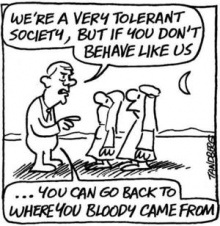
- The program used maassa maan tavalla, or in Rome do as the Romans do saying, which could be summed up in the cartoon below:
“how the cards were deliberately stacked against cultural diversity”
Maybe we watched a different show, but I think it was on the contrary. There were many people promoting cultural diversity and show that “hey, don’t be afraid of us – we are not so different from the majority”.
“how Perussuomalaiset (PS) MP Olli Immonen and PS Espoo city councilman Simon Elo did their utmost to spread fear-mongering of Muslims. Wille Rydman, former chairman of the Youth League of the National Coalition Party, showed as well that he’s still pretty much in the dark about cultural diversity.”
I agree Immonen’s views were outdated and I can’t agree with everything Simon Elo said, but I did not notice anything wrong what Wille Rydman said. But I have to admit, I might have missed few conversations because I was working on other things at the same time.
I found it strange that you criticize Immonen’s, Elo’s and Rydman’s performance, but you did not even mention Sadek Elwan or Ahmad Fadil. These two people are actually openly extremists and dangerous to this society, if they would have more power. One of them encourages trouble youth going to (religious) wars and other wants sharia law to Finland. Abbas Bahmanpour seemed to think punishing homosexuals is also acceptable.
“…Abdirahim Hussein, Mohammad Azizi, Sahra Ali and Seida Sohrabi…”
Not sure about Mohammad Azizi, but rest of them made a good impression. Also Suaad Onniselkä and Sara Bahmanpour made some good statements.
Joonas
Well, there was that little episode of staggering historical ignorance at around 19.30 in the video where Rydman finds fault with the idea that immigrants might return to their roots in order to fight, and suggests that this exposes a problem in immigration policy and the misuse of religion.
By this reasoning, there was something fundamentally improper in the work of Suomi-Seura and other agencies that sought to recruit USAmericans and Canadians of Finnish descent for military service in 1939 and 1940. The outcome was a fighting detachment called amerikansuomalaisten legioona. It’s a fairly safe bet that a good many members of this detachment were motivated by religious ideology and patriotic feeling for a country other than the USA/Canada.
So it’s OK for for the children and grandchildren of Finnish migrants in the USA to leave their homes for military training and active service in Finland, but there’s something scandalous going on when people in precisely analogous circumstances leave Finland for training and active service elsewhere? Rydman has not exactly made a point of criticising this element of official government policy in Finland during WW2.
Of course the truth is that he has desperately little real-life experience and has not really thought about the obvious implications of his views. He is fishing for cheap political soundbites, but has no meaningful engagement with the subject of debate.
Thanks, JusticeDemon. I actually watched this part on TV, but I still do not see much problems with his comment. I can understand why some people would like to go back to their homeland and keep defending it, but I also understand Rydman’s opinion.
It might feel strange for some if a person gets refuge from another country would like to go back to his country to fight. If the person wanted to fight, he could have staid in the country and not apply for refuge.
I think there were many other opinions (from various of people) that were more narrow-minded than Rydman’s comment.
Joonas
The narrative of suffering a defeat, finding refuge elsewhere, gathering strength and then returning to reclaim a perceived birthright recurs time and again in life and literature from Star Wars to the Lion King. There is hardly anything strange about this.
I think it is also worth of mentioning that imam Anas Hajjar defended amputation of the hands of thieves.
PS voter
It seems you only heard the introductory remark from Simon Elo caricaturing the views of Anas Hajjar. Then you switched off and didn’t listen to Hajjar at all. Or perhaps you found Hajjar’s views too difficult to understand, and so you let Simon Elo do your thinking for you.
Sloppy thinking either way. Go back and listen again.
He actually said that in Sharia law they will first make sure other aspects of the law are put in use and cutting the hand is the final solution. However, I do agree with you that Anas Hajjar failed in the explanation and should have objected this kind of action all together. I do support harder punishment for criminals, but I would never agree with an idea of mutilating people’s body parts.
Joonas
That is also a caricature of Hajjar’s response. You are omitting a very important point.
May we assume that you are absolutely opposed to the use of firearms by the police or explosive shells by the armed forces?
When I was a kid and before Islamaphobia had taken over from plain-old racism against Africans and Asians, people used to quote the punishments for theft in Saudi Arabia with conservative awe and longing, considering such harsh measures the answer to petty theft and burglary problems in the UK. 🙂
Oh how times change!
I do opposite lethal force by the police, but firearms can be used to sedate the person who is dangerous to himself or people around him and if other actions do not work. If the person is already arrested, I do not believe shooting him in the knee is necessary.
Joonas
I assumed in my ignorance that using explosives to force a small piece of metal into an imprecisely selected part of the human body would count as mutilating people’s body parts. Obviously I was wrong. You have somehow managed to accept something that you would never agree with.
Have you figured out the essential elements of Hajjar’s response that you omitted?
@JusticeDemon. Are you really saying these two things are the same thing:
1) The person is captured, sentenced and then his body part is mutilated
2) The person is not captured, is dangerous to himself/others and the police is forced to shoot him on the leg. His body part might not be as functional as before the shooting, but it might also heal fully.
Apparently not. Please, enlight me.
Joonas
It would seem that we cannot take you at face value when you say “I would never agree with an idea”. Obviously there are circumstances in which you even seek to justify the very idea with which you “would never agree”.
Anas Hajjar responded to this point with great care at 40.11 in the second half of the programme. The question is only relevant in societies that have already accepted and implemented Islamic canonical law based on the teachings of the Qur’an and the traditions of the Prophet, and it must be answered in the context of people who are individually and collectively endeavouring to be good Moslems.
It is hardly surprising that this response is unsatisfying to people with other fundamental concerns in life, but you might reflect on the question of whether bodily integrity is really the absolutely most important value.
Why don’t you just say it and stop harassing people?
Vesa
Why don’t you just say it and stop harassing people?
Harassing? lol. So, Joonas visits this site voluntarily to engage in discussion, and JD throws him a teaser in relation to a piece of important information being left out of his descriptions of the public debate, and you call that harassment?
No wonder you have little idea about the definitions of racism and prejudice!
Mark
Sorry. I just find this type of discussion annoying. If you have something to say, just say it. (It’s a trap anyway.)
Don’t mind me, I stay out.
I’m an old-timer guest in MT, so I have get used to all kind of discussion here. In some topics we might see outbursts or even ridiculing, but I think JD has not done that yet.
Vesa
I don’t think drawing attention to an important element left out of the discussion is a trap. Likewise, it’s more useful if JD succeeds in getting Joonas to arrive at the insight himself…the alternative tendency in these comments is simply to trade ideas and not actually engage in debate.
I’m still new here, seems I haven’t got used to it yet.
This site has quite a negative atmosphere. You seem to pick some people and then you attack them unfairly, you twist their words etc. Sometimes it’s funny: You mention for example Urpilainen, how she said: “maassa maan tavalla” – that was TWO or THREE years ago, but no, you never forget.
Wille Rydman seems to be one of your current enemies. I don’t understand, what he really said, that was in any way different what the others said in the conversation.
“truth is that he has desperately little real-life experience”
Well done JD.
I have new motto for this site. In finnish:
Epäsuvaitsevaisuudella kohti suvaitsevaisuutta.
(I don’t know how to translate that so well to english)
Or maybe this:
Towards tolerance – with one eye closed.
Vesa
It’s a lot better than it has been previously 🙂
Generally speaking, Enrique writes in a fairly sensationalist journalistic style, though he often makes excellent points about elements of the public debate on immigration. This sets the site up for various criticisms, occasionally justified, and in the course of those ‘attacks’, some immigration issues might perhaps get dealt with in typically superficial and biased way, thus illustrating why a site like Migrant Tales is actually desperately needed in Finland.
It is usually assumed that Migrant Tales has a particular agenda (liberal, leftie, softie, multiculti- etc.), against particular politicians or even in opposition to all Finns and anything Finnish – but that’s basically BS. The editors are all married to Finns and/or have children who are Finnish.
Many people who have visited to comment first attack Enrique for his excesses, usually with fake outrage, but very quickly cover themselves in foul-smelling manure of the various prejudicial kinds, thus their main beef with Enrique is not that he’s a bit sensationalist at times, but rather that he’s a pain in the arse to an otherwise emboldened ‘Far Right’ element that’s becoming ever more comfortably ensconced in Finnish public life.
🙂 We don’t like the political opportunism of politicians who exploit immigrants or the immigration debate for a few cheap votes. If criticising that makes enemies, then so be it.
Of course not. You haven’t shown any particular depth of understanding about these issues and the implications of ethnicising politics, so why would you be especially aware of the glaring inadequacies in the public statements made by politicians? The real question is what do you do when challenged to think a bit deeper? Your response has to been to redefine the definitions of the English dictionary – not a particularly promising start for expanding on these debates, is it?
“You seem to pick some people and then you attack them unfairly, you twist their words etc.”
Well, there is a genuine problem here in terms of political speak – politicians are often ridiculously ‘circumspect’ in public about exactly how far they go in expressing their prejudices – they need to toe a fine line between gaining votes and not appearing to be a complete xenophobe. But to seasoned watchers of this political discourse – much of the character of these bods is revealed in what they don’t say as much as in what they are very careful in saying. Hope that makes some sense.
Uncertain obedience to tolerating tolerance! Or something like that.
The problem as I see it is that some politicians are so not obviously interested in solutions, which they rarely talk about except in the strict terms of minimising immigration, which of course says nothing about how immigration that currently exists should work or how to protect the rights of immigrants.
The debate rarely rises above the level of grumpy neighbours banding together for a good old gossip, miffed about the stench of spices coming out of the kitchen of the ‘new’ neighbour across the street.
They pontificate about the superior nature of their home cuisine, remark how the smells are ‘polluting’ the purity of their neighbourhoods and also offending their very sensitive and refined nostrils.
This would be bad enough but for the fact this mean-spirited gossiping is actually played out IN FRONT OF the neighbour, with no regard for whether or not that makes the neighbour feel welcome. In every sense, that would normally be seen as ‘bad manners’, but strangely enough, these neighbours like to pat each other on the back for having the nerve to be so ‘honest’ about matters.
Sound familiar?
Yes, I’ve noticed. Not a right way towards tolerance. You just create more anger.
Actually, what i’ve learned by visiting this site is, that multiculturalism is very much an ideology, with all its faults.
An ideology can never include all of the complexity of life, so it needs mechanisms to keep the “unwanted” elements away from “polluting” it. There are several of these mechanisms found in Tessieri’s writings, some more clearly than others:
– closing one eye. The islam-discussion is a good example, any disturbing comments, that was said, was simply ignored.
– Shaming tactics. Shaming our culture, our history.
– The idea of rational humans. Disregard for human psychology. Seeing humans as “robots”, that can be lead by the ideology.
– Seeing the ideology as a purpose in itself, something bigger than humans.
– opinions, that any way criticise the ideology are not allowed, the person presenting these is attacked, their character is questioned for example by digging something he/she said in the past (Thanks internet).
– Racist – very handy word to morally judge all people presenting unwanted opinions.
– even attempts of censoring the anti-immigration opinions can be found in the posts on the basis it might increase racism etc.
Well you asked for it, so tell me then what was different and wrong in what Rydman said in the video (at around 19.30).
Vesa
You learnt that from visiting this website? I’m sorry, but now you are totally bullshitting people.
Is it worth once again giving you a dictionary definition and asking you to abide by its general meanings? Probably not, but here goes nothing:
So, where is the body of ideas? What is the political, economic or other system and what is the doctrine? Sorry, Vesa, but that comment is utter bull!
Sure. But what ‘unwanted’ elements are kept away in this website, I wonder? What is this ‘pollution’ you refer to in regard to this website?
I cannot speak for Enrique, but I have openly discussed several issues related to Islam that would typically cause discussion and concern, including the issues for which Allah-aho was convicted. Indeed, I have called for more debate, and more informed debate, rather than less. When you see that there are many elements in Islam, many interpretations, and individuals working for reform that fit with Western democracies, then you have a bigger perspective. It seems that you rather want to discuss a very narrow set of issues and only from the point of view of highlighting the extremists, as if every Muslim HAS to answer for those people and their extremism. Who has only ‘one eye open’, I wonder?
Not sure what this has to do with ideology, but then again, every culture or history has elements that SHOULD be understood as shameful. If we did not understand and accept our shameful mistakes, then how can we learn from them and avoid repeating them, I wonder? Shame is a powerful and useful emotion!
What utter rubbish. And you can give examples of this? What ‘human psychology’ are you speaking of? You are not talking about that reference you gave that you said showed ideology was not part of the basis of prejudice, but which it turns out ideology was extremely important as an intermediary in the process of prejudice formation?
Really – and where do you see this in this website I wonder? This website starts from the premise that immigrants are human beings like any other, who deserve respect, deserve a voice and deserve to have their own identity, and not to have that identity constantly shit all over by insecure and culturally authoritarian elements in the host nation. This is not about something ‘bigger’ than humans, this is simple human rights. Or is that the ‘ideology’ you object to?
If the comments made in the past are on the same topic and reflect a particular stance taken, then it is perfectly reasonable to quote those. Until that individual has publicly repudiated those comments, they stand as points of discussion. So, what ‘ideology’ has been criticised and in what way exactly was it ‘not allowed’? I’ll be very interested to see what you come up with on that point!!!
What unwanted opinions have we labelled racist? I want to know EXACTLY what opinions were labelled racist that were actually just ‘unwanted’.
What censorship? That sounds as ridiculous as it is – if it’s been ‘censored’, then you don’t get to see it, so how would you even know it exists? You do know what ‘censored’ actually means, or is this yet another concept that you throw around, like ‘harass’, and ‘discrimination’ for which you actually don’t understand the meaning?
As a work of fiction, your list only reflect on your own prejudices that you brought to this debate LONG BEFORE you visited Migrant Tales, Vesa. As two grown up people, let’s not fucking fool ourselves about that one!!!!
think it is also worth of mentioning that imam Anas Hajjar defended amputation of the hands of thieves
…..
And now my question to all please,
Do u know really? what does means role, religion and amputation of the hands of a human beings?
Just tell me u agree with this role in Islam or not?
easy question .
Yes or no?
U don’t stand for religion and roles, police and law, but stand for HUMANITY.
Its about hand, a very useful part of a body, attention it.
GOD cares a lot about human,GOD never make such a role.
This role has nothing to do with Muslims, Muslims are human beings like other humans on this planet earth, so don’t abuse Muslims and immigrants because there is such a law in Islam.
Muslim did not created role, but Islam made a human a Muslim
If you were born in a Muslim country now u were a Muslim too, so u should learn Muslims are ur brothers and neighbors on this earth and Finland.
Dont be agree with punishment, be careful.
Human is a worthy creature, don’t wish human punish.
I am not Muslim, i don’t believe in Islam, and am against This role and roles and punishment even for snakes and scorpions. I have no religion, i believe in GOD that is very beautiful and wise.
Muslims are your guests in Finland.
The only judge is GOD and GOD is kind and merciful.
Sorry, I didn’t want to angry you.
I am not against immigration, but I am starting to be against multiculturalism as an ideology (,let’s not get to the boring word-definition argument): The idea, that multiculturalism is good for all of us, something we should strive for.
I would really like more immigrants to join in the conversation, because I see, that the majority of them would also rather be with their own kind, if it would be possible, because that would be the best way to preserve their cultural identity. Some day wars, unemployment etc. will end (hopefully), many immigrants probably want to return to their home country. Tessieri sees multiculturalism as unavoidable, unstoppable: immigration will just grow and grow…I’m not buying it that easily.
I don’t see much benefit in mixing people with different cultural backgrounds together. Some people in their arrogance even suggest: hey, let’s take all these people of different cultures and make them live near each other, so they start to like each other. How naive thinking. If that isn’t ideological thinking, then what is!
Of course there are some people, that have no problems with living with strange people, actually they will like it, but I say they are minority and they are people ready for compromise, even prepared to loose some of their cultural identity (or they haven’t got it to begin with.)
But the MAJORITY will be very happy to live with the people, that are similar to them, maybe just travel to other countries for holidays, but that’s it.
I am not criticising you. You are vey well aware of the problems. One criticism though: You are only discussing them after you have been challenged.
The best part of this site is really the comments and discussions.
Yes, that was one example. I remember I was trying to challenge the thinking behind the post, that suggested we have racism, because our culture and our history is flawed. I thought we were on the same page with that.
–I am not against immigration, but I am starting to be against multiculturalism as an ideology (,let’s not get to the boring word-definition argument): The idea, that multiculturalism is good for all of us, something we should strive for.
Vesajarv, the only countries that have an official multicultural policy in the world in force are Canada, Australia and Britain. Finland speaks a lot about multiculturalism, but the word doesn’t appear or is mentioned in our most important laws never mind our Constitution. Multiculturalism was crucially important in Canada and Britain to keep these countries from breaking up.
Without getting into a complex discussion of what multiculturalism is, a good synonym could be cultural diversity. The question that we have to answer as our society becomes more culturally diverse, is how all these different groups are going to live side by side in a spirit of mutual acceptance, mutual respect, religious freedom, tolerance and so forth. Or should we change our laws and ensure that these newcomers give up their identity and culture and become like you?
The more extreme far-right politicians in Finland believe that the best way to keep Finland white is by restricting immigration on the base of ethnic background. If you read US and Canadian history, this was done before but later on such restrictions were lifted. You may ask why. How would you feel that you can’t move to a country because you are a Finn? That’s a pretty racist immigration policy if you ask me.
People should not be judged by their ethnic background but by the skills they bring to a society.
What are your thoughts on this?
@Enrique, you probably missed my question directed to you, but could you tell me why you criticized Immonen, Elo and Rydman (and you are entitled to criticize them), but left out Sadek Elwan or Ahmad Fadil (and the people who supported punishments for homosexuals)? You had perfect opportunity to show you condemn all extremist views, but now you only focused on “anti-immigrant” front. This has always been my biggest gripe I have with MT.
Vesa
Fair enough, but don’t come here thinking that you can start to attack us as on that basis. This site does not push ‘multiculturalism’ as an ideology, and in fact, even in the political sphere, multiculturalism is a much abused term. For example, it has been observed that there is no evidence that ‘multiculturalism’ is pursued by any political establishments ‘as an ideology’, which prescribes a form of multicultural policy. What governments have tried to do is adapt their policies to the ‘multicultural’ realities of the population, ensuring for example that individuals of different ethnicities are given similar protection, which takes account of varieties, in terms of languages, religious needs, or educational needs. There is very little ‘ideology’ in this kind of policy making, but rather an attempt to provide strong ‘hate speech laws’, provide educational freedoms, protect religious freedoms, provide language services where it’s practical to do so etc. This is government seeking to serve its entire population, in its growing diversity.
An excellent exercise to do whenever you hear the word ‘multiculturalism’ is to replace it with ‘culturalism’, and see if it has lost any meaning. If it hasn’t, then the idea of ‘multi-‘ part of culturalism being the problem is an obvious red herring. Indeed, it would be very unusual to imagine that there would be no conflicts WITHIN a culture based on citizens having different values. It is inevitable. So, ‘culturalism’ would not be ‘good’ for everybody: not in practical terms, and not in terms of matching everyone’s values to the letter. If you wouldn’t expect that perfect state for ‘culturalism’, why would you expect it for ‘multiculturalism’? It’s a false expectation.
‘Being with your own kind’ is a rather horrible way to express this opinion. In English, that phrase would have you labelled as a classical racist who thinks of different ethnic groups as being essential a different form of ‘human kind’, and invariably as being of lesser kind. However, to take the point up, you can ‘be’ with your own ethnic group in many different ways that do not preclude also being with people from different groups. You can mix with them socially even if they live in different neighbourhoods, you can mix with them through family links, you can mix with them through work and cultural events, you can mix with them through congregations. As none of this precludes mixing with natives, I hardly see how you would find this a problem.
Migration is inevitable. Finns originated from the Ural mountain regions of Russia, for example. It would be unusual in today’s world to imagine that somehow the invention of the ‘nation state’ would suddenly cast human demographics forever into concrete, and why would we want that anyway? Other people practicing their culture for the most part will not impact on you in any way, unless we go back to the smell of spices problem mentioned earlier.
Why don’t you head over NationMaster website and have a look at the ethnic make up of the world’s nations. You will find that ethnic and cultural diversity is absolutely the NORM in most parts of the world. Only areas like Japan and in Europe also Finland would be described as still homogenous, and that this is actually an exception to the normal patterns of migration and ethnic diversity. Having said that, Finland IS diverse to an extent, albeit a lesser extent – the Swedish speaking, Sami- and Russian populations are significant and historical. Indeed, I would argue with you Vesa that a belief in cultural homogeneity and its benefits is actually much more of an ideology than a reality!
This is not a policy justification that I have ever seen, so it appears just to be some anecdotal musing over the possible benefits of different groups living together. I put as much store on that as the statement that putting any group of humans together will inevitably lead to peace and harmony. Humans typically find a way to argue about something – with their wives, husbands, children, parents, neighbours and their work colleagues, before we even start on people not even in that close circle.
Your view of people who are comfortable with ethnic diversity is wooden and stiff, lifeless and just a tad insulting. You assume that they would have to ‘lose’ something to be comfortable with that. All this reveals is that your notion of ‘culture’ is stiff and lifeless. Culture in the broad sense refers to music, entertainment, media, literature, food, drink, dress, architecture, language, and arts. It is about the flow of ideas and feelings. Now it is a simple fact that in ALL these domains, cultures have constantly mixed, ideas constantly been stolen or borrowed from different, even global, sources and are always falling into something of a vast melting pot. Ideas and stories travel the world, with sailors and traders, travellers, with migrants, and with just from being passed from person to person over time. THAT is the core reality of culture and cultural mixing.
Our philosophies are influenced by Greeks, Italians, Chinese, Egyptians, etc, etc, etc. Of course, you can pick out some very fixed notions of culture, such as the Finnish Independence Day, and understand it as something unique to Finland, but then in reality it’s very clear that other countries have their ‘independence day’, or some such equivalent celebration of national sovereignty. You could argue Finland’s love of sauna is unique, but when you understand it as a ‘bathing ritual’, it’s easy to see that all cultures have their bathing rituals and that these are generally important and mostly pleasurable, and even a little bit holy.
I have no idea what you mean by living with ‘strange’ people. I can only imagine that these are people you don’t know, don’t want to know, but who have some visible cultural difference. They are therefore only ‘strange’ to the extent that you hide from them and refuse to accept or see them as people with 95% of their make up in common with yourself. They have families who they likely love and want to protect. They want to work and live in peace. They want to do something productive. They want to be entertained. They want to learn, to have interests, to express themselves, to develop their friendships. It takes a very special kind of narrow-mindedness to imagine that people from different cultures are really that ‘strange’. It means selecting only the most ‘alien’ elements of their culture, such as language or perhaps a dress code or food preference, and then ignoring that they are human, and everything that we know that that entails. In fact, it was that same kind of ignorance that once justified slavery!!!
As an example, I have thought to do a proper breakdown on Allah-oho’s conviction and the subject matter, but though I have written up notes on it, I haven’t gone ahead with it yet. Otherwise, I’m not here to criticise elements of Islam or to discuss, as an outsider, where I think Islam should go, or even where Christianity should go. For the most part, I am reactionary in these comments, in that I react to what people write. That’s not to say I’m reactionary as a person, because I am not – I have my opinions and work actively and daily to test them and develop them. But I’m not usually standing up on this blog and presenting them as any kind of ‘system’ or ‘ideology’ for how I think people should understand society.
The reason I write here is because I think that for the most part, elements of culture are irrelevant to debates about immigration, which should be specifically about logistic and practical matters like how to support, enable, and empower immigrants so that they can actively contribute to society and flourish as people. I also hope for the same for the native population, and my work takes in both elements. I want to see immigrants treated with a degree of equality, that extends to seeing and understanding our similarities as human beings and as right-bearing citizens. This means not getting bogged down in superficial differences, or of trying to make individuals within a groups somehow responsible for every crazy or extremist thing done by every other member of that group.
And yet your comment on that conversation was this:
…when the reality was that I went to the original research, gave you a breakdown of what it ACTUALLY dealt with and described in some detail some of the problems, both from a psychological point of view and a philosophical point of view (I did study psychology at undergraduate level in the distant past and nowadays work regularly with doctoral research in psychology). How was that ‘disregarding’ psychology, I wonder? Where on earth did you get the ‘seeing humans as robots’ idea from that discussion? Nevertheless, there is a phenomenon well-known to the world called ‘brainwashing’, and seeing as this effectively means diminished agency as a result of prior ideological commitments, I cannot see how you can imagine that some people are not behaving like robots at times???
I was very surprised at how you presented this site and based on the way you have been engaged, I would say the vast majority of your criticisms were utter hogwash!! 🙂
Except you take my sentence out of context. My sentence was about punishments “I do support harder punishment for criminals, but I would never agree with an idea of mutilating people’s body parts”. And I believe you are well aware of this. However, I play along and rephrase myself: “I would never agree mutilating people’s body parts as an official punishment”. I know you can probably find something to gripe about that as well, but I would like to hear what is your stance on the subject? Do you think there could be a reason why we should cut off a body part as a punishment from the criminal?
Joonas
Legal principles should ideally be a socially distributed reflection of correct moral choices, but we also have to remember the reflexive aspect. Legal principles emerge from a social context and legal judgements must be applied in a social context.
Like all attempts to justify an absolute rule, your reformulation includes a tacit ceteris paribus premiss in this regard. You assume that the definition of a criminal offence emerges from a social vacuum and that the prescribed sanction will have no consequences reaching beyond the individual and the penal system.
Your reformulation also uses morally charged expressions: “mutilating”, “official” and “punishment” that call to mind an episode of House MD that aired in Finland last year. The episode eventually concluded that a prison inmate was suffering from an operable pheochromocytoma that explained his offences. Now applying your reformulated principle, would you countenance “mutilating” that offender’s body as an “official” “punishment”?
Absolute moral principles are an open invitation to counterexamples. Moral reality is exceedingly complex, and I tend towards Fletcherian situation ethics as the most flexible and practical explanation of moral choices.
Enrique
No. Nobody has suggested, that we change our laws. We offer a lot of freedom here, religious freedom etc. They don’t have to become like us, whatever that ‘us’ even means. (You know, you don’t have to come to the sauna if you don’t like to.)
Of course the minority culture is at risk here, for example the younger generation easily adopts certain ways of thinking, habits, that might clash with their background culture causing conflicts, rebellious behaviour and so on. But this is more spontaneous than forced.
This I don’t have an answer, except religious freedom we have here. Islam is problematic, because for many it’s more than a religion, it’s not something you can practice privately in your own home. There are lots of rules: Men and women are not allowed to swim together etc.
I am currently quite pessimistic about the other things: mutual acceptance, mutual respect, tolerance having read about the situation in other countries, reading studies about prejudice. So if you asked me, I’d say we should first try to help refugees in their own countries and do as much as we can there.
I agree and I’m glad we don’t have that kind of policy here.
I feed up, its 3 days i get insult on MT.
Anger, attack and blame was on me in these last 3 days
Calling me a racist one and telling me ur against a nation and u do prejudice was not my right.
And my comment about Islam got deleted.
My comment was about humanity and was against wild roles.
Mark
Good, that you pointed this out, so I won’t accidentally use it any more. My dictionary didn’t reveal this. It was not my intention. I meant of course ‘people with the same cultural backgrounds’ or ‘culturally similar’ could work also.
There has been talk about arranging housing so that natives will mix with immigrants from different backgrounds. It’s not just my imagination or did I understand you correctly. I don’t see this as a working solution, perhaps I was bit too cynical though (didn’t find a better word), but I can see a certain comical aspect in this kind of thinking. (I think it’s because of the ‘superiority’ position, they are taking there.)
Yes, I linked one research. There are many others I’ve studied, this was just one example, that was close to the original post.
Yes I know. I know the Greeks influences and so on. To enjoy other cultures, music, arts doesn’t require, that they necessarily need to live next door. (I don’t mean that I wouldn’t like them to live next door, maybe you understand.)
Don’t over-analyze me with just one word: ‘strange’, by that I meant culturally different (I understand it’s a vague term). Try to understand, that my vocabulary is limited.
Mark
I am not really talking about myself, I am trying to see this from the wider perspective. In case you are thinking, that my writing seems cruel and cold.
That’s amazing, JusticeDemon. How it is, that you WIN every debate. What’s your secret?
But I am also interested.
Which do YOU prefer, shooting at the knee, or cutting of persons hands?
There is punishment as well in Finland that is Christian country for me was on my body and spirit both and in Finland atmosphere is just a punishment for me a refugee.
Those racists made down me and parents were Christians yes?
But Jesus is laughing to those who abuse his name, who call him GOD and who make money with his name.
So This is human who make it a religion to be alive or not, u human give power to religion, religion is some words, cant punish, but abusers make it alive because they have benefits from religion.
And
Racist is a punishment for human beings, dont forget that.