Migrant tales
Menu
  • #MakeRacismHistory “In Your Eyes”
  • About Migrant Tales
  • It’s all about Human Rights
  • Literary
  • Migrant Tales Media Monitoring
  • NoHateFinland.org
  • Tales from Europe
Menu

Tag: undocumented immigrants

Migrants’ Rights Network: What is driving the ‘hostile environment’ idea (in the UK)?

Posted on November 14, 2013 by Migrant Tales

By Don Flynn*

Don_web_0


The announcement of yet more changes to the immigration rules will cause anxiety to run down the spine of many a legal migrant as they struggle to understand whether it has implications for them.

The government has declared that the intention behind the new Immigration Bill currently being considered by Parliament is to create a ‘hostile environment’ for the people it describes as ‘illegal’.

There is a tendency to think of this group of people as being entirely distinct from the larger body of legal migrants, who live their lives in accordance with the rules and regulations and never come into contact with the ‘illegals’.

It was this thought which encouraged the view set out by the Advertising Standards Agency (ASA) a few weeks back in its ruling as to whether the wording of the posters on the ‘Go Home or Face Arrest Vans’ used by the Home Office Border Force as a part of its Operation Vaken exercise in the summer was likely to give rise to anxiety or offence to settled people of recent immigrant origin.

The ASA expressed the view that it would not, since the legal migrant knows that she lives an existence that is vastly removed from that of those who have chosen to break the law. The sight of one of these vans trundling down her local high street was not something that she ought to worry about at all.

But the truth is that many so-called legal migrants spend a great deal of time worrying that they might end up as illegal migrants, or at least (and this would be just as bad) that other people will think that they might be illegal migrants.

This happens precisely because the worlds of the ‘legal’ and ‘illegal’ are not hermetically sealed off from one another but instead separated by a porous membrane of regulations which reach out and touch many aspects of everyday life, as well the big issues relating to border crossings and controls.

The truth is that migrants can become illegal for many reasons, including losing their jobs, or a row in the family that causes them to be excluded from the home. The precarious tightrope existence faced by many migrants means that their status often depends not just on their good behaviour, but on the conduct of family members, employers or college authorities.

The announcement of yet more changes to the immigration rules causes anxiety to run down the spine of many a legal migrant as they struggle to understand whether it has implications for them and if they ought to consider consulting a lawyer to double-check that they are still ‘legal’. Many will recall the HSMP Forum court case a few years ago, when a group of highly skilled migrants found themselves involved in expensive litigation with the Home Office after changes to the points-based system suddenly plunged them into an undesirable category.

Migrants can be denounced, traduced and trashed before the authorities for reasons that run from petty spite to outright racism. The Home Affairs Select Committee only last week expressed its concern that the Border Force didn’t seem to be doing enough to follow up tip-offs from members of the public who had phoned in to report a unwanted migrant in their neighbourhood. For all of these reasons and more, migrants will tell you that they often feel like they live in a suspicious society, with assessments made at every turn to establish whether they are the illegal immigrants we keep hearing about…

This is the reality of the ‘hostile environment’ that currently exists for migrants. It is a terrain of hidden crevices where one foot put wrong can send the individual into a world of uncertainty which can only be challenged by further rounds of legal representation, form-filling, evidence gathering, the payment of extortionately expensive fees and, if you are lucky, the opportunity to state your case before an independent immigration tribunal.

The Immigration Bill going through Parliament has to be condemned for the precise reason that it will make things worse, not just for the ‘illegals’, but for the much larger group of legal migrants who are already anxious that they might make an inadvertent slip and find themselves in a whole new world of insecurity.

The opportunity to ramp up the pressures on migrants will come from the increased involvement of yet more third parties – private landlords, bank staff, people issuing driving licences – in the business of checking immigration status. The facts that there will be many mistakes is an absolute certainty: the immigration officials now charged with this job make mistakes which run into the tens of thousands each year, so how can we expect a better standard of performance from other authorities even less well-equipped to properly interpret the immigration rules as they apply to individuals?

Perhaps the worst aspect of the Bill is the proposal to drastically reduce appeal rights against Home Office decisions on immigration applications. Poor decision-making is widespread amongst the immigration authorities, but at least those who can afford a decent solicitor to make their case against incompetence know that they currently have good chances of success. The latest figures show that up to 50% of appeals against Home Office decisions are supported by judges of the independent appeal authorities.

Will the Bill provide the government with the means to deter the types of immigrants who live outside the rules? We doubt it. The deterrence of illegal migration depends heavily on there being a common belief that the rules as they stand embody basic principles of justice, and that it is in the interests of the vast majority, including those subject to the rules, to uphold them.

The danger is that, with changes such as those in the Bill, the connections with fairness and justice are severed so that ever more migrants come to believe that the rules, rather than providing them with security, are intended to withhold precisely this from them and in its place offer a ‘hostile environment’. In this case we can be confident that more and more immigrants will steel themselves against such laws and their unfair effects, and learn instead how they might build resilience and survivability into the business of living and getting by in Britain.

If politicians are careless enough to allow that to happen, then rather than achieving better immigration management, we can expect instead to find ourselves living in an era of escalating loss of any semblance of control.

Read original story here.

This piece was reprinted by Migrant Tales with permission.

*Don Flynn, the MRN Director, leads the organisation’s strategic development and coordinates MRN’s policy and project work. He is a regular and sought-after speaker at conferences, seminars and lectures on behalf of MRN.
Julian Abagond: The term “illegal immigrant”

Posted on April 14, 2013 by Migrant Tales

By Julian Abagond

The term “illegal immigrant” (1930s- ) means an undocumented immigrant, one without papers to stay in the country. The older term was ”illegal alien”, common in English in the 1970s and 1980s, rare in American news stories since 2003.

An illegal immigrant can mean someone who:

  1. crossed the border illegally,
  2. overstayed a student or tourist visa,
  3. was brought to the country as a child,
  4. is waiting for a green card,

Etc.

It was first applied to Jews in Palestine in the 1930s. In America it first appeared in the Republican platform in 1986, in the Democratic one in 1996.

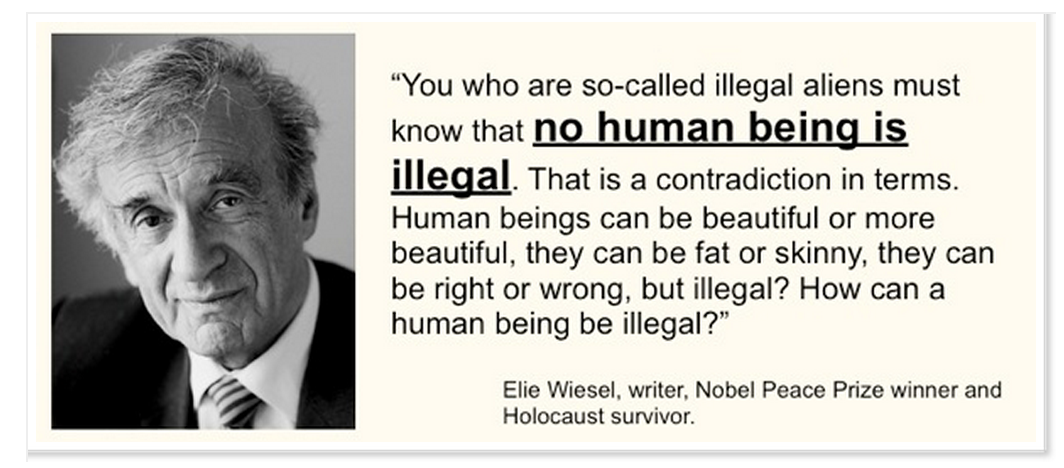
Since the 1980s there has been a push to get rid of it: actions are illegal, not people. Huffington Post got rid of it in 2008. The Miami Herald and MSNBC no longer use it. Then, on April 2nd 2013, the Associated Press (AP) stylebook got rid of it, saying in part:

illegal immigration Entering or residing in a country in violation of civil or criminal law. Except in direct quotes essential to the story, use illegal only to refer to an action, not a person: illegal immigration, but not illegal immigrant. Acceptable variations include living in or entering a country illegally or without legal permission.

That is huge: most American news reporters and editors follow the AP stylebook. The Los Angeles Times and the New York Times, two of the country’s biggest newspapers, are now thinking of getting rid of the term.

Why get rid of it:

  1. It makes racism respectable. It dehumanizes not just the 11 million people in America who are without papers, who are mostly people of colour (3 million are black), but 52 million Latinos, whom many assume to be undocumented even though most are American citizens. It has become a slur: Just before Marcelo Lucero was killed in a hate crime on Long Island he was called a “fucking illegal”. Yet, as Touré points out, no one calls Martha Stewart an “illegal business woman” – even though she was found guilty of insider trading in a court of law.
  2. It frames the debate on immigration: It pins the blame on immigrants, not those who employ them and often take advantage of them, whom no one ever seems to call “illegal employers”. Nor does it blame the American government’s immigration policy, which is at least 11 million cases behind in meeting the country’s labour needs. It makes it seem like the answer is to punish immigrants – even though some are undocumented through no fault of their own. It makes police raids on Latino neighbourhoods seem reasonable – as well as racial profiling (Arizona SB 1070). It makes it easy for Republicans to kill reasonable reform by calling it “amnesty for illegals”, as they did in 2006. And, worst of all, it makes it seem like undocumented immigrants should have no rights at all.

Linguist John McWhorter of Columbia University says in ten years “undocumented immigrant” will seem just as dismissive as “illegal immigrant”.

Linguist George Lakoff of UC Berkeley says that in debating and making laws framing is huge: words matter.

Kuvankaappaus 2013-4-14 kello 15.06.28


Read original story here.

 This piece was reprinted by Migrant Tales with permission.


Former undocumented immigrant Edgar Ortega: A true survivor

Posted on February 18, 2013 by Migrant Tales

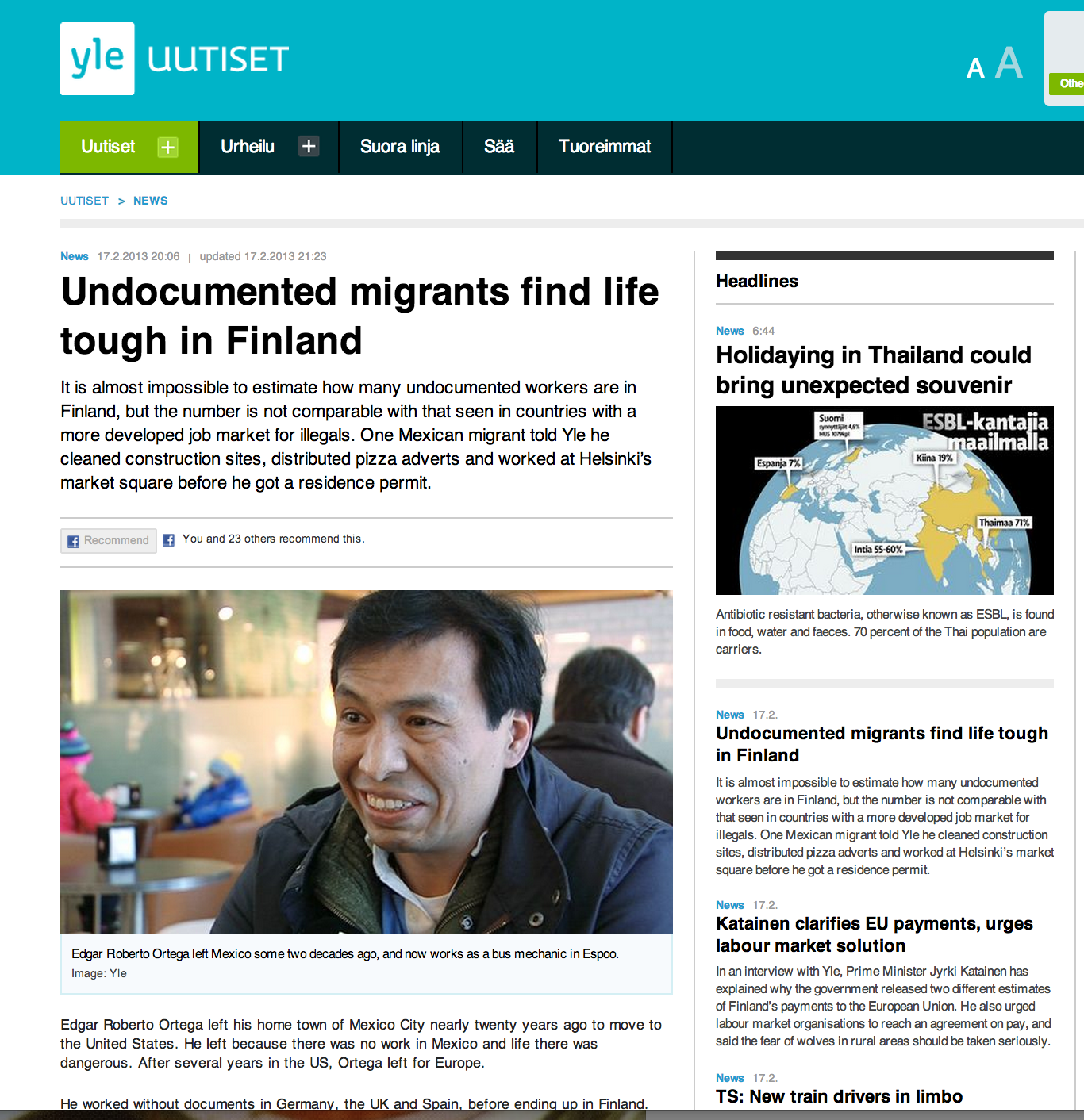
I read a fascinating story on YLE in English about a former undocumented immigrant in Finland, Edgar Ortega of Mexico. He’s a true survivor. Ortega would clean construction sites, distribute pizza adverts and engage in other work before he got a residence permit. 

Ortega made 4-5 euros an hour as an undocumented immigrant, according to him.

“Yes, it was difficult,” he was quoted as saying on YLE in English. “When I got married and went for interviews with the police, I was asked many, many questions over several days. It was a little bit like a psychological test.”

He works today for Veolia bus company in Espoo.

Kuvankaappaus 2013-2-18 kello 9.37.15

If many matters are distorted in the ongoing debate on immigration, immigrants and our ever-growing cultural diversity,  there are some politicians and journalists who blame these newcomers for taking jobs and lowering salaries.

It should be remembered, however, that immigrants want to get paid the same wages and have the same rights as other workers. They may work for lower prices like Ortega, but this is due to the employer who is exploiting them.

Unions in this country should take steps to educate and protect immigrant workers in Finland so they won’t be exploited by greedy companies.

It’s a positive matter that YLE uses on the story the term undocumented as opposed to illegal immigrant.

There’s been a big debate in the United States about which term is correct.

On a New York Times article on the growing Hispanic population of California, Scott Baugh, Republican chairman of Orange County, doesn’t use the term illegal immigrant.

“To constantly refer to undocumented immigrants as illegals is very hostile and self-righteous,” he said.  “Let’s point out that while crossing the border without documents is illegal, a federal misdemeanor, being in this country as an immigrant isn’t a criminal act.”

The Republican Party has paid a high price with voters in California because it has been identified with anti-immigration legislation. Orange County is the most conservative county in California.

The first undocumented immigrant I ever met in Finland was in the 1980s. He was working for one of Helsinki’s first Mexican restaurants, Mexicana. The cook from Mexico complained about the low pay, long hours and that he had to sleep in the kitchen. 

According to the police, there are between 2,000 and 4,000 undocumented immigrants residing in Finland.

Finnish police to have new anti-ethnic profiling guidelines in force in 2013

Posted on December 18, 2012 by Migrant Tales

Rainer Hiltunen, Ombudsman for Minorities head of office, told Migrant Tales that talks have taken place with the Finnish police to draft new guidelines and more effective monitoring to ensure that ethnic profiling doesn’t happen. The new guidelines are expected to be in force in 2013. 

Kuva 106

The Ombudsman for Minorities office expressed concern in spring about higher-than-average complaints from foreigners that they were being indiscriminately stopped by the police for spot checks.

Interior Minister Päivi Räsänen confirmed in April that the Finnish police doesn’t ethnically profile anyone.

Foreigners are sometimes stopped in Finland by the police when looking for undocumented immigrants, according to Räsänen.

“One of the problems [concerning ethnic profiling] is that when the police stop a person, they sometimes forget to tell them clearly why they have been stopped,” he said. “Better monitoring of the police in this respect is crucial to discourage ethnic profiling from happening.”

The Ombudsman for Minorities official saw England as a good example for the Finnish police to follow.

“The Stephen Lawrence case is a good case in point that shows how institutional racism can undermine the effectiveness of the Metropolitan Police of London,” he said.


Alina Tsui: Immigration Reform – The Xenophobic Crisis in Greece

Posted on August 27, 2012 by Migrant Tales

By Alina Tsui

Illegal immigrants are tearing apart the social fabric of Greek society. They’ve been blamed for the spike in crimes and the cause of Greece’s economic woes. At least this is the narrative that’s repeated by the far-right and accepted by most Greeks.  

With no end in sight of the economic crisis and punishing austerity measures, Greeks are feeling the squeeze. This week’s meeting with Germany and France to discuss the terms for the third round of bailouts will without a doubt renew class tensions between locals and immigrants.

At the same time, Golden Dawn, a far-right political group notorious for its hateful and xenophobic rhetoric, has blamed illegal immigrants. Their success in winning 18 seats in June’s parliamentary elections demonstrates at least some level of their views resonating with the masses. This group creates a hostile environment complete with its swastika-like logo and ran on the platform slogan, “Greece for Greeks.” There has been some demonstrations against Golden Dawn, but the scapegoating of illegal immigrants have been somewhat accepted by the masses.

Illegal immigrants make up 10% of the Greek population, and locals view this problem as a scourge. Efforts are being made to demonstrate that Greece is serious about deporting illegal immigrants and tightening its borders.

Several human-rights NGOs have denounced Greece for violating international law in its mass raids of immigrants without making any efforts to check the legal status of the migrants. Furthermore, it was reported on Saturday that Greek police were accused of dumping hundreds of illegal immigrants in the middle of the night in neighboring Macedonia. Locals have grown weary of immigrants and multiculturalism in general. Certainly the economy has played a part. In a Human Rights Watch report, an Athens resident expressed, “I was never a racist but I’ve become one. Why can’t we send them all home?”

Yet illegal immigrants without papers, work, or a place to live are finding their stay in Greece to be very unwelcoming. In the past five months it’s been estimated that 500 people were the victims of racially-motivated attacks. The typical m.o. of these attacks are similar in nature: they typically occur late at night, involving a gang of thugs wielding weapons such as sticks, iron bars and wooden bats. Their intention is to induce fear in their victims. Instances of attacks at home by Golden Dawn members have been reported in the media. Keep in mind that this is in the same network of white supremacist groups that Wisconsin Sikh shooter Wade Michael Page was a member of.

In August during Operation Xenios Zeus (ironically, the god of hospitality), approximately 6,000 migrants were rounded up and detained in Athens resulting in 1,500 people being deported for illegal entry. It seemed the only criteria for being detained was being guilty of having a dark complexion or looking “foreign.” The “success” of this event prompted officials to plan similar raids to other cities in Greece. Six detention centers are already in the works to house the increasing numbers of illegal immigrants.

The rise of the far-right has been accelerating for the past ten years says Jamie Bartlett of UK think tank, Demos. It’s a trend that’s seen all across Europe.  Cultural and national identity remains a  sensitive issue.

The problem that mainstream political parties in Greece face is that they aren’t able to combat the rise of the far-left/right because they’re trying to retain party support, so they’re powerless to change the situation, which leads to greater conflict between an increasingly polarized left-right political spectrum.

The above picture is one taken in a Greek train station of police waiting for an arriving train as part of the raid on illegal immigrants. This YouTube video details the same.

Read original blog entry here.

This piece was reprinted by Migrant Tales with permission.

Massive Greek police clampdown on immigrants

Posted on August 7, 2012 by Migrant Tales

Cash-strapped Greece showed its dark side over the weekend when some 2,000 police in Athens and surroundings arrested 1,100 undocumented immigrants and held another 4,900 for questioning, according to Clandestina blog. The action is a disturbing example of how the Greek government is trying to blame immigrants for the country’s financial problems.  

It is estimated that Greece has close to one million undocumented immigrants mostly from Asian countries like Afghanistan, Pakistan and others.

Apart from having no legal protection, one of the most worrying aspects of the clampdown by Greek police is the silence of European politicians. This is not only shameful but a clear indication that matters are going to get worse in Europe for immigrants before they improve.

Adding salt to injury, the police named the operation Xenios Zeus, which was the ancient Greek god of hospitality.

Two thousand police were mobilized in Athens and 2,500 on Greece’s eastern border with long-time enemy Turkey.

The massive crackdown, which will continue, took place before the International Monetary Fund, the European Union and European Central Bank representatives were set to meet Greek officials concerning a 31.5-billion-euro tranche of aid next month.

Writes the Los Angeles Times: “Public Order and Citizens’ Protection Minister Nikos Dendias defended the roundups as necessary to keep Greece from unraveling, arguing that the country faced the biggest “invasion” since the influx of the ancient Dorians thousands of years ago. Dendias had earlier claimed that “unbelievably high” numbers of immigrants were involved in crime, according to Greek news reports.”

PBS documentary: U.S. Border Patrol, an example we should avoid

Posted on July 28, 2012 by Migrant Tales

When I grew up in Southern California, the object of racist insults weren’t only blacks but especially Mexicans. Even if there were no Mexicans never mind blacks at our elementary school in Hollywood, some students – if not all – had very strong prejudices against them. 

An investigative documentary by PBS shows that not only is the treatment of Mexicans and other Latin Americans a widespread problem in the United States, it has risen to endemic proportions if we look at the actions of the U.S. Border Patrol.

Here is a link to the PBS website to the investigative report titled, Crossing the line. Here’s Part I.

Writes PBS: “In the rush to stem the tide of undocumented immigrants, has Border Patrol committed widespread abuse on [US]American soil? A former Border Patrol agent blows the whistle on unacceptable conditions in detention centers, including massive over-crowding and detainees who claim they were deprived of food and water.”

One part of the PBS documentary caught my eye with respect to Finland. It claimed that in 2010, there were only three complaints by detainees and 21 over treatment in general by Border Patrol officials.

If so few complaints have been filed against the U.S. Border Patrol against thousands of complaints by former Mexican detainees that suggest abuse, torture and even sexual harassment, the single- and double-digit figures above are highly revealing.

In Finland, there were questions raised by the Ombudsman for Minorities concerning ethnic profiling by the police. The police responded that there weren’t any such cases.

Such a claim in April, which was backed Christian Democrat (KD) Interior Minister Päivi Räsänen,  shows in my opinion that ethic profiling by the police is an issue just like the mistreatment of undocumented immigrants is by the U.S. Border Patrol.

Take a look at the PBS documentary. It will shock you.

When any institution like the U.S. Border Patrol is out of control and not accountable for its actions, the biggest loser are the very values that these agents claim to defend and uphold. It is indeed a slippery slope.

Who are the real enemies threatening the United States: undocumented immigrants or a U.S. Border Patrol that appears to be out of control and acts with impunity?

Thanks go to Community Village Daily Activist for the heads-up. 

Räsänen sees no wrongdoing, ethnic profiling by police with spot identity checks

Posted on April 13, 2012 by Migrant Tales

By Enrique Tessieri

Christian Democrat (KD) Finnish interior minister, Päivi Räsänen,  didn’t see any abuses nor ethnic profiling with spot identity checks of foreigners by the police, according to YLE. The statement follows a story on Wednesday after the office of the Ombudsman for Minorities expressing concern about the large number of complaints that foreigners are being arbitrarily stopped on the basis of their ethnic background. 

Räsänen said that while she hasn’t received any complaints of ethnic profiling, the present methods prove to be effective in clamping down on undocumented immigrants.

“The vast majority of foreigners look just like the natives, so it’s not even a very sensible way to supervise aliens,” she said.

JusticeDemon said in a comment on Migrant Tales:  “The idea that members of visible minorities should be disproportionately stopped while going about their daily business in order to catch illegal aliens makes no sense whatsoever in terms of intelligent policing priorities.”

He states that the overwhelming majority of undocumented immigrants in Finland are visa or visa-extempt overstayers. “Their typical profile is likely to match that of a visitor, not an immigrant,” he said.

While some analysts believe that Räsänen was appointed to head the interior ministry to calm the anti-immigration Perussuomalaiset (PS) party, for some she is the last person to approach in government to tackle a problem like ethnic profiling by the police.

Räsänen uses the adjective “illegal”  when speaking of undocumented workers.

“In fact, Finland acts rather efficiently in the matter of illegal immigration and there is no reason to weaken this efficiency [by not carrying out spot checks], because it is our strength and in this we can set an example for other Schengen countries.”

Digital Journal: Swiss Government Bans Video On Execution-Style Deportation

Posted on October 23, 2011 by Migrant Tales

Comment: Ever thought what it feels to be caught and deported from a country as an undocumented immigrant? The reconstruction of how people are deported from Switzerland these days was made by humanitarian group Augenauf (Open Your Eyes). The video clip was shortly banned after it was broadcast on Swiss television, according to Digital journal. 

After passage of a referendum in November, Swiss authorities can deport today foreigners if they are undocumented immigrants or foreign residents convicted of certain offenses. 

The humiliating way people are deported from Switzerland looks like a convict who placed on an electric chair. The Digital Journal continues:  “The procedure involves the shackling and gagging of deportees, presumably to prevent any effort to escape or protest or to make it as unpleasant as possible to return to Switzerland.”

 Augenauf claims that a Nigerian refugee died of heart attack when he was shackled. 

[youtube=http://www.youtube.com/watch?v=16He1I274Xk&feature=player_embedded]

_______________

Digital Journal: Swiss Government Bans Video On Execution-Style Deportation

A documentary by humanitarian organisation Augenauf was banned shortly after it was broadcast on Swiss television. It depicts a reconstruction of the execution-style deportation practiced by Swiss Government.

Read whole story.

Read more about documentary film
Read more

Recent Posts

  • Finland’s tabloids Iltalehti and Ilta-Sanomat are the pits
  • Riikka Purra’s Dr Jekyll and Mr Hyde mask
  • Double standards
  • Perussuomalaiset: Uusi logo, sama vanha juttu
  • Taco Trump

Recent Comments

  1. Absolutely Socking: Racist Finnish Facebook group against human rights gets flooded with socks on Musta Barbaari’s mother and sister charged by the police in “ethnic profiling” case
  2. Ilkka Nuotio on Pekka Myrskylä: “Tilastot kertovat toista kuin poliittinen keskustelu”
  3. Genrih Soinkara on The war in Ukraine and the Russian-Finnish border crisis are showing Finland’s ugly side
  4. Ahti Tolvanen on Comment by Ahti Tolvanen on the Helsinki +50 conference
  5. Angel Barrientos on Angel Barrientos is one of the kind beacons of Finland’s Chilean community

Archives

  • June 2026
  • May 2026
  • April 2026
  • March 2026
  • February 2026
  • January 2026
  • December 2025
  • November 2025
  • October 2025
  • September 2025
  • August 2025
  • July 2025
  • June 2025
  • May 2025
  • April 2025
  • March 2025
  • February 2025
  • January 2025
  • December 2024
  • November 2024
  • October 2024
  • September 2024
  • August 2024
  • July 2024
  • June 2024
  • May 2024
  • April 2024
  • March 2024
  • February 2024
  • January 2024
  • December 2023
  • November 2023
  • October 2023
  • September 2023
  • August 2023
  • July 2023
  • June 2023
  • May 2023
  • April 2023
  • March 2023
  • February 2023
  • January 2023
  • December 2022
  • November 2022
  • October 2022
  • September 2022
  • August 2022
  • July 2022
  • June 2022
  • May 2022
  • April 2022
  • March 2022
  • February 2022
  • January 2022
  • December 2021
  • November 2021
  • October 2021
  • September 2021
  • August 2021
  • July 2021
  • June 2021
  • May 2021
  • April 2021
  • March 2021
  • February 2021
  • January 2021
  • December 2020
  • November 2020
  • October 2020
  • September 2020
  • August 2020
  • July 2020
  • June 2020
  • May 2020
  • April 2020
  • March 2020
  • February 2020
  • January 2020
  • December 2019
  • November 2019
  • October 2019
  • September 2019
  • August 2019
  • July 2019
  • June 2019
  • May 2019
  • April 2019
  • March 2019
  • February 2019
  • January 2019
  • December 2018
  • November 2018
  • October 2018
  • September 2018
  • August 2018
  • July 2018
  • June 2018
  • May 2018
  • April 2018
  • March 2018
  • February 2018
  • January 2018
  • December 2017
  • November 2017
  • October 2017
  • September 2017
  • August 2017
  • July 2017
  • June 2017
  • May 2017
  • April 2017
  • March 2017
  • February 2017
  • January 2017
  • December 2016
  • November 2016
  • October 2016
  • September 2016
  • August 2016
  • July 2016
  • June 2016
  • May 2016
  • April 2016
  • March 2016
  • February 2016
  • January 2016
  • December 2015
  • November 2015
  • October 2015
  • September 2015
  • August 2015
  • July 2015
  • June 2015
  • May 2015
  • April 2015
  • March 2015
  • February 2015
  • January 2015
  • December 2014
  • November 2014
  • October 2014
  • September 2014
  • August 2014
  • July 2014
  • June 2014
  • May 2014
  • April 2014
  • March 2014
  • February 2014
  • January 2014
  • December 2013
  • November 2013
  • October 2013
  • September 2013
  • August 2013
  • July 2013
  • June 2013
  • May 2013
  • April 2013
  • March 2013
  • February 2013
  • January 2013
  • December 2012
  • November 2012
  • October 2012
  • September 2012
  • August 2012
  • July 2012
  • June 2012
  • May 2012
  • April 2012
  • March 2012
  • February 2012
  • January 2012
  • December 2011
  • November 2011
  • October 2011
  • September 2011
  • August 2011
  • July 2011
  • June 2011
  • May 2011
  • April 2011
  • March 2011
  • February 2011
  • January 2011
  • December 2010
  • November 2010
  • October 2010
  • September 2010
  • August 2010
  • July 2010
  • June 2010
  • May 2010
  • April 2010
  • March 2010
  • February 2010
  • January 2010
  • December 2009
  • November 2009
  • October 2009
  • September 2009
  • August 2009
  • July 2009
  • December 2008
  • November 2008
  • October 2008
  • September 2008
  • August 2008
  • July 2008
  • June 2008
  • May 2008
  • April 2008
  • March 2008
  • February 2008
  • January 2008
  • November 2007
  • October 2007
  • September 2007
  • August 2007
  • July 2007
  • June 2007
  • May 2007

Categories

  • ?? Gia L?c
  • ????? ?????? ????? ???????? ?? ??????
  • ???????
  • @HerraAhmed
  • @mondepasrond
  • @nohatefinland
  • @oula_silver
  • @Varathas
  • A Pakistani family
  • äärioikeisto
  • Abbas Bahmanpour
  • Abdi Muhis
  • Abdirahim Hussein Mohamed
  • Abdirahim Husu Hussein
  • Abdirisak Mahamed
  • About Migrant Tales
  • activism
  • Adam Al-Sawad
  • Adel Abidin
  • Afrofinland
  • Ahmed IJ
  • Ahti Tolvanen
  • Aino Pennanen
  • Aisha Maniar
  • Alan Ali
  • Alan Anstead
  • Alejandro Díaz Ortiz
  • Alekey Bulavsev
  • Aleksander Hemon
  • Aleksanterinliitto
  • Aleksanterinliitto ry
  • Aleksanterinliitto ry:n hallitus
  • Alex Alex
  • Alex Mckie
  • Alexander Nix
  • Alexandra Ayse Albayrak
  • Alexis Neuberg
  • Ali Asaad Hasan Alzuhairi
  • Ali Hossein Mir Ali
  • Ali Rashid
  • Ali Sagal Abdikarim
  • Alina Tsui
  • Aline Müller
  • All categories
  • Aman Heidari
  • Amiirah Salleh-Hoddin & Jana Turk
  • Amin A. Alem
  • Amir Zuhairi
  • Amkelwa Mbekeni
  • Ana María Gutiérrez Sorainen
  • Anachoma
  • Anders Adlecreutz
  • Angeliina Koskinen
  • Anna De Mutiis
  • Anna María Gutiérrez Sorainen
  • Anna-Kaisa Kuusisto ja Jaakko Tuominen
  • Annastiina Kallius
  • Anneli Juise Friman Lindeman
  • Announcement
  • Anonymous
  • Antero Leitzinger
  • anti-black racism
  • Anti-Hate Crime Organisation Finland
  • Anudari Boldbaatar
  • Arshiya Nasser
  • Aspergers Syndrome
  • Asylum Corner
  • Asylum seeker 406
  • Athena Griffin and Joe Feagin
  • Autism
  • Avaaz.org
  • Awale Olad
  • Ayan Said Mohamed
  • AYY
  • Barachiel
  • Bashy Quraishy
  • Beatrice Kabutakapua
  • Beri Jamal
  • Beri Jamal and Enrique Tessieri
  • Bertolt Brecht
  • Boiata
  • Boodi Kabbani
  • Bruno Gronow
  • Carmen Pekkarinen
  • Çelen Oben and Sheila Riikonen
  • Chiara Costa-Virtanen
  • Chiara Costa-Virtanen
  • Chiara Sorbello
  • Christian Thibault
  • Christopher Wylie
  • Clara Dublanc
  • Dana
  • Daniel Malpica
  • Danilo Canguçu
  • David Papineau
  • David Schneider
  • Dexter He
  • Don Flynn
  • Dr Masoud Kamali
  • Dr. Faith Mkwesha
  • Dr. Theodoros Fouskas
  • Edna Chun
  • Eeva Kilpi
  • Emanuela Susheela
  • En castellano
  • ENAR
  • Enrique
  • Enrique Tessieri
  • Enrique Tessieri & Raghad Mchawh
  • Enrique Tessieri & Yahya Rouissi
  • Enrique Tessieri and Muhammed Shire
  • Enrique Tessieri and Sira Moksi
  • Enrique Tessieri and Tom Vandenbosch
  • Enrique Tessieri and Wael Che
  • Enrique Tessieri and Yahya Rouissi
  • Enrique Tessieri and Zimema Mhone
  • Epäluottamusmies
  • EU
  • Europe
  • European Islamophobia Report
  • European Islamophobia Report 2019,
  • European Union
  • Eve Kyntäjä
  • Ezequiel Caldeiro
  • Facebook
  • Fadumo Dayib
  • Faisa Kahiye
  • Farhad Manjoo
  • Fasismi
  • Finland
  • Fizza Qureshi
  • Flyktingar och asyl
  • Foreign Student
  • Fozia Mir-Ali
  • Frances Webber
  • Frida Selim
  • Gareth Rice
  • Ghyslain Vedeaux
  • Global Art Point
  • Great Replacement
  • Habiba Ali
  • Hami Bahadori
  • Hami Bahdori
  • Hamid
  • Hamid Alsaameere
  • Hamid Bahdori
  • Handshake
  • Harmit Athwal
  • Hassan Abdi Ali
  • Hassan Muhumud
  • Heikki Huttunen
  • Heikki Wilenius
  • Helsingin Sanomat
  • Henning van der Hoeven
  • Henrika Mälmsröm
  • Hser Hser
  • Hser Hser ja Mustafa Isman
  • Husein Muhammed
  • Hussain Kazemian
  • Hussain Kazmenian
  • Ibrahim Khan
  • Ida
  • Ignacio Pérez Pérez
  • Iise Ali Hassan
  • Ilari Kaila & Tuomas Kaila
  • Imam Ka
  • inside-an-airport
  • Institute of Race Relations
  • Iraqi asylum seeker
  • IRR European News Team
  • IRR News Team
  • Islamic Society of Norhern FInland
  • Islamic Society of Northern Finland
  • Islamophobia
  • Jacobinmag.com
  • Jallow Momodou
  • Jan Holmberg
  • Jane Elliott
  • Jani Mäkelä
  • Jari Luoto
  • Jari Taponen
  • Jegor Nazarov
  • Jenni Stammeier
  • Jenny Bourne
  • Jessie Daniels
  • Joe Davidow
  • Johannes Koski
  • John D. Foster
  • John Grayson
  • John Marriott
  • Jon Burnett
  • Jorma Härkönen
  • Jos Schuurmans
  • José León Toro Mejías
  • Josue Tumayine
  • Jouni Karnasaari
  • Juan Camilo
  • Jukka Eräkare
  • Julian Abagond
  • Julie Pascoet
  • Jussi Halla-aho
  • Jussi Hallla-aho
  • Jussi Jalonen
  • JusticeDemon
  • Kadar Gelle
  • Kaksoiskansalaisuus
  • Kansainvälinen Mikkeli
  • Kansainvälinen Mikkeli ry
  • Katherine Tonkiss
  • Kati Lepistö
  • Kati van der Hoeven-Lepistö
  • Katie Bell
  • Kättely
  • Kerstin Ögård
  • Keshia Fredua-Mensah & Jamie Schearer
  • Khadidiatou Sylla
  • Khadra Abdirazak Sugulle
  • Kiihotus kansanryhmää vastaan
  • Kirsi Crowley
  • Koko Hubara
  • Kristiina Toivikko
  • Kubra Amini
  • KuRI
  • La Colectiva
  • La incitación al odio
  • Laura Huhtasaari
  • Lauri Finér
  • Leif Hagert
  • Léo Custódio
  • Leo Honka
  • Leontios Christodoulou
  • Lessie Branch
  • Lex Gaudius
  • Leyes de Finlandia
  • Liikkukaa!
  • Linda Hyökki
  • Liz Fekete
  • M. Blanc
  • Maarit Snellman
  • Mahad Sheikh Musse
  • Maija Vilkkumaa
  • Malmin Kebab Pizzeria Port Arthur
  • Marcell Lorincz
  • Mari Aaltola
  • María Paz López
  • Maria Rittis Ikola
  • Maria Tjader
  • Marja-Liisa Tolvanen
  • Mark
  • Markku Heikkinen
  • Marshall Niles
  • Martin Al-Laji
  • Maryan Siyad
  • Matt Carr
  • Mauricio Farah Gebara
  • Media Monitoring Group of Finland
  • Micah J. Christian
  • Michael McEachrane
  • Michele Levoy
  • Michelle Kaila
  • Migrant Tales
  • Migrant Tales Literary
  • Migrantes News
  • Migrants' Rights Network
  • MigriLeaks
  • Mikko Kapanen
  • Miriam Attias and Camila Haavisto
  • Mohamed Adan
  • Mohammad Javid
  • Mohammad M.
  • Monikulttuurisuus
  • Monisha Bhatia and Victoria Canning
  • Mor Ndiaye
  • Muh'ed
  • Muhamed Abdimajed Murshid
  • Muhammed Shire
  • Muhammed Shire and Enrique Tessieri
  • Muhis Azizi
  • Musimenta Dansila
  • Muslimiviha
  • Musulmanes
  • Namir al-Azzawi
  • Natsismi
  • Neurodiversity
  • New Women Connectors
  • Nils Muižnieks
  • No Labels No Walls
  • Noel Dandes
  • Nuor Dawood
  • Omar Khan
  • Otavanmedia
  • Oula Silvennoinen
  • Paco Diop
  • Pakistani family
  • Pentti Stranius
  • Perussuomalaiset
  • perustuslaki
  • Petra Laiti
  • Petri Cederlöf
  • Pia Grochowski
  • Podcast-lukija Bea Bergholm
  • Pohjois – Suomen Islamilainen Yhdyskunta
  • Pohjois Suomen Islamilainen Yhyskunta
  • Polina Kopylova
  • Race Files
  • racism
  • Racism Review
  • Raghad Mchawh
  • Ranska
  • Rashid H. and Migrant Tales
  • Rasismi
  • Raul Perez
  • Rebecka Holm
  • Reem Abu-Hayyeh
  • Refugees
  • Reija Härkönen
  • Remiel
  • Reza Nasri
  • Richard Gresswell
  • Riikka Purra
  • Risto Laakkonen
  • Rita Chahda
  • Ritva Kondi
  • Robito Ibrahim
  • Roble Bashir
  • Rockhaya Sylla
  • Rodolfo Walsh
  • Roger Casale
  • Rostam Atai
  • Roxana Crisólogo Correa
  • Ruth Grove-White
  • Ruth Waweru-Folabit
  • S-worldview
  • Sadio Ali Nuur
  • Sami Rusanen
  • Sandhu Bhamra
  • Sara de Jong
  • Sarah Crowther
  • Sari Alhariri
  • Sarkawt Khalil
  • Sasu
  • Scot Nakagawa
  • Shabana Ahmadzai
  • Shada Islam
  • Sharon Chang blogs
  • Shenita Ann McLean
  • Shirlene Green Newball
  • Sini Savolainen
  • Sira Moksi
  • Sonia K.
  • Sonia Maria Koo
  • Steverp
  • Stop Deportations
  • Suldaan Said Ahmed
  • Suomen mediaseurantakollektiivi
  • Suomen Muslimifoorumi ry
  • Suomen viharikosvastainen yhdistys
  • Suomen viharikosvastainen yhdistys ry
  • Suomi
  • Supermen
  • Susannah
  • Suva
  • Syrjintä
  • Talous
  • Tapio Tuomala
  • Taw Reh
  • Teivo Teivainen
  • The Daily Show
  • The Heino
  • The Supermen
  • Thomas Elfgren
  • Thulfiqar Abdulkarim
  • Tim McGettigan
  • Tino Singh
  • Tito Moustafa Sliem
  • Tobias Hübinette and L. Janelle Dance
  • Transport
  • Trica Danielle Keaton
  • Trilce Garcia
  • Trish Pääkkönen
  • Trish Pääkkönen and Enrique Tessieri
  • Tuulia Reponen
  • Uncategorized
  • UNITED
  • University of Eastern Finland
  • Uyi Osazee
  • Väkivalta
  • Vapaa Liikkuvuus
  • Venla-Sofia Saariaho
  • Vieraskynä
  • W. Che
  • W. Che an Enrique Tessieri
  • Wael Ch.
  • Wan Wei
  • Women for Refugee Women
  • Xaan Kaafi Maxamed Xalane
  • Xassan Kaafi Maxamed Xalane
  • Xassan-Kaafi Mohamed Halane & Enrique Tessieri
  • Yahya Rouissi
  • Yasmin Yusuf
  • Yassen Ghaleb
  • Yle Puhe
  • Yuliet Tresa
  • Yve Shepherd
  • Zahra Khavari
  • Zaker
  • Zalina Ametova
  • Zamzam Ahmed Ali
  • Zeinab Amini ja Soheila Khavari
  • Zimema Mahone and Enrique Tessieri
  • Zimema Mhone
  • Zoila Forss Crespo Moreyra
  • ZT
  • Zulma Sierra
  • Zuzeeko Tegha Abeng
© 2026 Migrant tales | Powered by Minimalist Blog WordPress Theme