Migrant tales
Menu
  • #MakeRacismHistory “In Your Eyes”
  • About Migrant Tales
  • It’s all about Human Rights
  • Literary
  • Migrant Tales Media Monitoring
  • NoHateFinland.org
  • Tales from Europe
Menu

Tag: Somalis

The fired bus driver who seeks fame with his racist videos will end up forsaken, jobless

Posted on July 14, 2017 by Migrant Tales

Racism is a sickness, and as a disorder, it has consequences for the victim and the perpetrator. We learned about a bus driver and Peurssuomalaiset (PS)* politician called Gleb Simanov, who thought up the “bright” idea to videotape and insult Somalis while at work in three videos that he posted.  

On Thursday Simonov’s fortunes changed when he was fired from Nobina, a bus company.

His sacking reminds me of what happened in 2015 to a woman called Martta Petman, who worked at the Tikkurila congregation. She was fired after she wrote on Facebook that she spat in the porridge that she served asylum seekers.

Petman might have raised some attention with her questionable actions, but she was quickly forgotten. Nobody came to her rescue never mind helped her find a new job. Sakari Timonen, one of Finland’s best bloggers, said that racists are the last people to come to another racist’s rescue.

The same is happening to Simonov. He may have caught the attention of the anti-immigration Perussuomalaiset (PS)* and other xenophobic groups, but he too like Petman will be forgotten and left without a job.

In the Facebook posting below, Simanov thanks his supporters. He even thanks a person for giving him 10 euros.

For a single father with two children, ten euros isn’t going to take you very far.


One of the interesting questions to arise from what happened is Paavo Tajukangas’ role. Tajukangas is a far-right white supremacist and a member of Suomen Sisu, an association that wants to keep Finland white.  Continue reading “The fired bus driver who seeks fame with his racist videos will end up forsaken, jobless”

A Helsinki bus driver who publishes video tapes of Somali clients he’s insulted

Posted on July 13, 2017 by Migrant Tales

What would you say if a bus driver, who only video tapes Somalis, starts calling them liars and forces them off the bus even after one of them wanted to pay for the bus fare? Ethnic profiling? Racist or all of the above? 

Add to the latter a story authored by Paavo Tajukangas and the message and intent of the story is clear.

Tajukangas is a member of the far-right white supremacist Suomen Sisu association. His trademark is making up stories to suit his racist writings.

We won’t publish the videos because we don’t want to bring more suffering to the victims.

According to a Facebook posting, the bus driver of Russian origin seeks a lawyer because he found out that he cannot videotape customers and publish them.

Migrant Tales got in touch with the company, which promised to call back.

Continue reading “A Helsinki bus driver who publishes video tapes of Somali clients he’s insulted”

Ilta-Sanomat continues to publish racist stories even today

Posted on June 27, 2016 by Migrant Tales

It’s disingenuous of tabloid Ilta-Sanomat to publish a story on Monday about legendary Finnish sports television commentator Raimo “Höyry” Häyrinen’s racist comments without taking a long look at itself in the mirror. 

The story prints in full the racist comments made by Häyrinen when he talked about the black players on the Colombian and Cameroonian team during a 1990 FIFA World Cup match.  

Ilta-Sanomat pulls a fast one on the reader: it publishes something racist, which some readers will appreciate, but pins the blame on the television sportscaster for making the racist comments in the first place.

Shoddy journalism at its worst.

In 1990, or during the early 1990s, Ilta-Sanomat was busy publishing its own racist stories about groups like the Somalis.

Na?ytto?kuva 2016-6-27 kello 17.38.00

Read full story (in Finnish) here.

Below are some shameful examples of ads about Somalis published by Ilta-Sanomat in the early 1990s.

Continue reading “Ilta-Sanomat continues to publish racist stories even today”

Writer Nura Farah is one of the bright hopes of multicultural Finland

Posted on December 26, 2015September 30, 2025 by Migrant Tales

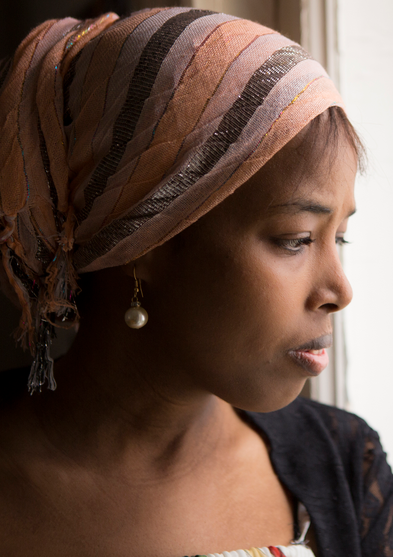
Nura Farah is Finland’s first published writer with Somali roots. She moved to Finland as a refugee in the early 1990s when she was 13 years old and when one of her countries became absorbed in a costly and painful civil war that continues to date.

Her first book, Aavikon tyttäret (Daughters of the desert), published by Otava last year, gives a glimpse of the lives of women in Somalia during that country’s struggle for independence in 1940-60.


Nura Farah. Kuva: Kustannusosakeyhtiö Otava.

Apart from being the first “Somali” writer to publish in the Finnish language, her latest milestone as a writer was winning in December the 2015 Suomi-palkkinnon award, which is given by the ministry of education to aspiring and established artists and writers.

This year’s prize was 24,700 euros.

“I’m not the only one who’s got the award there were others [like writer and film director Hassan Blasim and artist Abdel Abidin],” said Farah with a hint of humility. “This year’s [Suomi-palkinnon] awards reflect support by the ministry of education for multiculturalism.”

Farah said that there are many challenges as Finnish society becomes ever-culturally diverse. She believes that multiculturalism can work, but it’s important that migrants and minorities don’t isolate themselves from the rest of society.

“We live in difficult times these days,” she continued. “It’s even scary and I sometimes feel that we’ve returned back to the 1990s [when racism was more public].”

According to Farah, one of the problems that Finland should acknowledge today is that social exclusion is a problem we must challenge. She said that even if you were born in this country to non-Finnish parents you’re still not accepted as an equal member of society never mind as a “real” Finn.

Continue reading “Writer Nura Farah is one of the bright hopes of multicultural Finland”

Nura Farah: A blooming flower with a pen that many aimed to destroy

Posted on October 21, 2014 by Migrant Tales

There is an interesting interview of Nura Farah, Finland’s first Somali-born writer, who speaks openly about growing up as a black person in this country from the 1990s, when even middle-school teachers took part in the racist bullying of non-white Finns.

Racist bullying and racism are white privilege weapons used by this society to destroy another person by wiping out his or her self-esteem.

Migrant Tales has published a number of stories about racist bullying at Finnish schools. While it’s clear that some Finnish teachers didn’t take part in this type of school vigilante behavior, those who did are a shame to our school system and society, especially those who remained silent.

One of the problems of the 1990s concerning racism and racist bullying was that it wasn’t even seen as a problem at schools. If it occurred, it was given low priority by the teacher, school and society.

A story by YLE (in Finnish) tells about how hostile this society was to some non-white Finns and migrants during the 1990s, when our migrant population started to grow rapidly.

Racist bullying doesn’t end after you leave the school but can continue in the town where the victim grew up. And why shouldn’t racist bullying continue to be a problem at our schools and society? Aren’t National Coalition Party MP Pia Kauma and Perussuomalaiset (PS)* MP Tom Packalén unfortunate recent examples of this type of behavior?

It should be made clear that racism and racist bullying at school are hostile acts that aim to destroy the victim’s self-esteem and shatter him or her into tiny pieces. You’re not supposed to ever pick up those pieces of your shattered self.

But you can be defiant and strong and do something bold like accepting yourself.

This is what Farah did when she was 20.


Näyttökuva 2014-10-21 kello 8.21.18

Read full story (in Finnish) here.


Farah’s family moved to the eastern Helsinki neighborhood of Kontula in the 1990s. She was 13 years old.

According to her, racism in the 1990s was terrible. Even some middle-school teachers took part in the bullying using the n-word freely and even asking in class why don’t Somalis go back to where they came from.

Somalia has been gripped by a terrible civil war since 1991, when then de facto President Siad Barre was toppled and fled the country.

Another very important message that Farah gives is that children born in Finland, irrespective if they come from different ethnic and cultural backgrounds,  shouldn’t be made to feel like outsiders. She said that the most important matter for third-culture children is to learn the language well and to get involved.

One important step in the latter direction is, in my opinion, to stop using terms like ‘pupil with migrant background,’ or maahanmuuttajataustainen,  to label non-white or third-culture students at school. In today’s strong anti-Otherness context, such labels have a tendency to remind the pupil that he or she is an outsider.

It’s clear that with writers like Farah we’re taking those first important steps in ensuring that our children and grandchildren don’t get treated in the same way as some of us did at school.

* The Finnish name for the Finns Party is the Perussuomalaiset (PS). The English names of the party adopted by the PS, like True Finns or Finns Party, promote in our opinion nativist nationalism and xenophobia. We therefore prefer to use the Finnish name of the party on our postings.

Finnish tabloid media’s dubious “achievment” is spreading intolerance

Posted on April 6, 2014 by Migrant Tales

The Finnish tabloid media has the dubious “honor” for having spread intolerance in Finland by giving populists and racists inflated respectability and importance. If we look at some of the billboards that tabloids published in the 1990s, it’s clear that they were responsible for spreading racism and prejudice in Finland.  

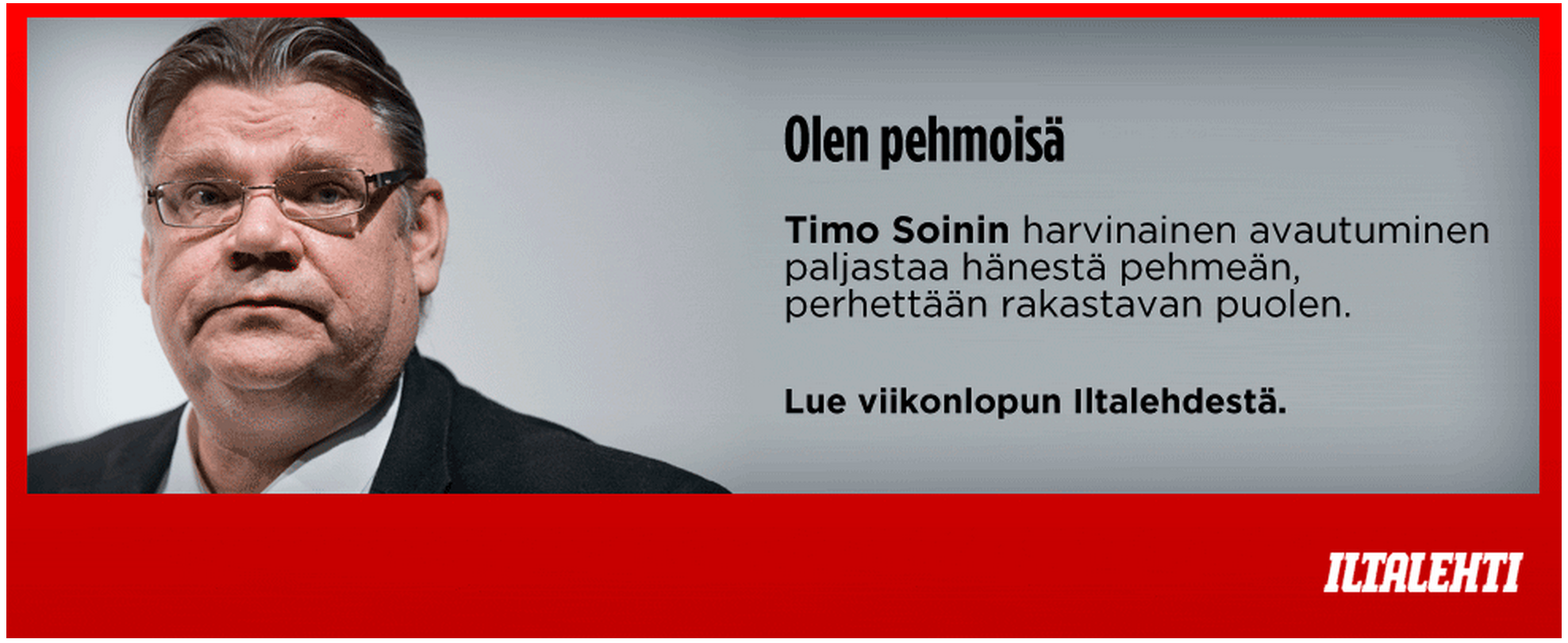
Take for instance the most recent ad on Iltalehti’s website about Timo Soini, the right-wing populist leader of the Perussuomalaiset (PS) party who is hostile to migrants and minorities. The ad asks readers to buy the weekend edition to read about Soini’s “opening up” and soft loving dad side.

Soft loving dad side? Certainly everyone loves his family. But when it comes to loving others that’s where clear lines are drawn.

Soini, who likes to portray himself as a political leader who has not helped racists and ultra-nationalists to get political power, makes it clear that he is against gay marriage and abortion. This fact speaks volumes about what kind of a hell Finland would be if he ever became prime minister.

Näyttökuva 2014-4-6 kello 11.18.38

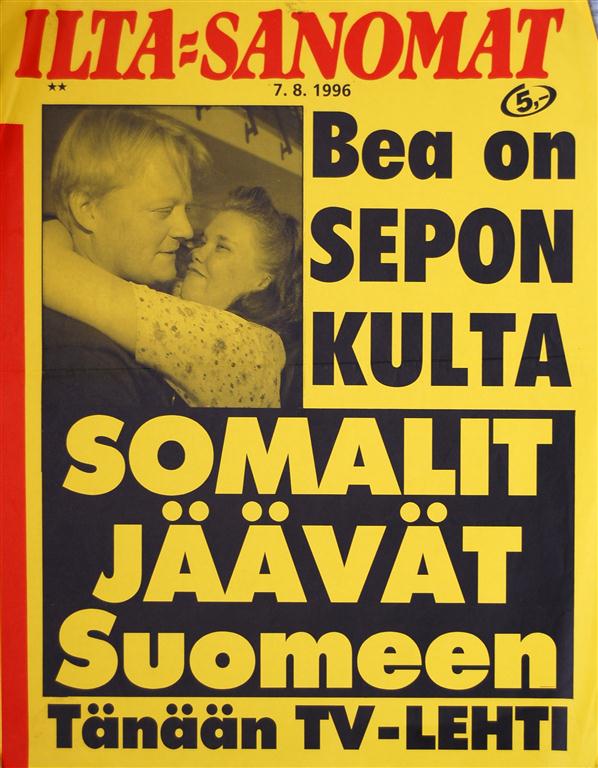
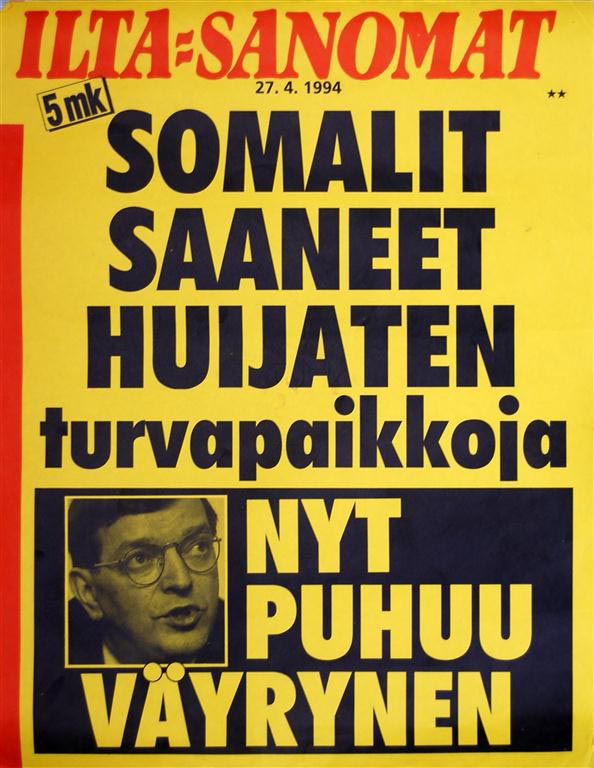
What about if I posted the following billboards below to contrast with the one above? How do two from 1994 and 1996 contrast with what Iltalehti claims about Soini?

Tabloids may have a short memory but many in this country, especially migrants and visible minorities, remember many of the insults and outright hostility against them. Such intolerance is daily and not difficult to forget.

l_1084-medium1

This billboard from 1996 by Iltalehti’s rival, Ilta-Sanomat, claims that those Somalis that got asylum in Finland in the early 1990s will remain permanently in Finland.

L_1062-Medium

This billboard claims that Somalis conned authorities into giving them asylum. In 1994, Somali was absorbed in a terrible civil war that has been going on to date.

.

Fadumo Dayib: To research, or not to research Somalis, is the question

Posted on February 24, 2014 by Migrant Tales

I am here today to reflect on being the other, on othering. I am not here as a PhD student from this University but as an activist, a blogger and as your research object.

Kuvankaappaus 2014-2-24 kello 10.10.30

Read full essay here.

The previous presenter raised a very important point that activism does not put bread on your table. I concur with her.

In fact, I want to expound further on that point by arguing that one cannot be paid and be an activist at the same time. By that I mean, if I was receiving funding from an entity that is unethical, could I be an activist? Would I have the freedom, the backbone to question their unethical practices knowing the repercussions? What if they claimed to work on equality but never hired minorities? If they claimed to fight racism while having a white board? Could I be involved in these institutions and claim to be an activist? Can a colonialist be an anti-colonialist while still in the colonialist establishment? My answer is no.

I came to Finland, as a fleeing refugee, with a battered suitcase and a chunk of halwa in my kiondo in 1990. While I slept soundlessly in a motel called Matkakoti in Helsinki, dreaming of cardamom tea in Xamar, the Finnish press was busy selling mass hysteria. A man saw the opportunities the newcomers brought with them and quickly sat down to write. As a result, the first descriptive text on Somalis, or rather their invasion of Finland, was penned. That text was aptly titled “Somali Shock”. I stumbled upon it years after I’d arrived, dazed from all the racist slurs but still desperate to belong. I sought answers, comprehension but never got any.

Somalis became an interesting phenomenon to study. Why would all these young, mostly good looking young men want to come to Finland? Why were they all coming through Russia? Why were they not malnourished, with flies buzzing over their runny noses? Why Finland when thousands are migrating elsewhere? These questions woke a few hibernating researchers who then devoted their time to their new pets. After all, the Somalis looked, smelled and acted differently. They mistreated their women, neglected their children, ran away from fighting in Somali, were loud and had a fetish for Finnish women. In addition, they also had a liking for extravagance, shiny stuff, perky breasts, driving in BMWs, and at the cost of the generous welfare system. This was a phenomenon worthy of a study. I never had the pleasure of meeting these researchers personally but followed their activities through the grapevine.

Fast forward to 1995, a Finnish woman married to a Somali man is in our house, asking questions about death and studying how we deal with grief. She is doing a PhD on Somalis, is dressed as a Somali, henna on her hands, gold bangles jiggling. She is more Somali than I am. You see, this is very important. A researcher must resemble the natives, must eat as they do, must be part of them and must behave like them. After all, this is an ethnographic research. But does that mean she knows what I am feeling? What it is to be me? What it is to be a Somali woman, a Muslim from Africa? No. She is a privileged white woman. The power dynamics are skewed in her favor. No amount of dressing, mannerisms, is going to change that reality.

She shoots her Finnish questions relentlessly, her tongue darting in and out of her mouth. I don’t hear her, my mind is on my mother, the only solid foundation in my life, crumpling under my feet. My mother who is slowly dying in her sterile hospital room. My mother who has always been by my side, is going on a long journey, alone. The persistent chatter from the researcher never ceases. It floats above the community din, overwhelming my dulled senses.

As death went about his business, I tried to negotiate for a few days, hours, minutes. He shook his head, stood above her, and coaxed her soul to depart. I kissed her face, wiping away her sweat and my tears. Death, the only certainty in life, had accomplished his mission. The researcher hovered about, notebook in hand. She asked me something, pink mouth moving silently. I looked away, ear cocked, head turned to the side, listening for any sounds from my mother. I heard someone explaining something to her. No, you cannot take pictures. No, you cannot go to the grave. No, because women are not allowed to.

The next day, she stayed with us at home, observing our grief. As my brother was putting my mother’s head in the grave, kilometers away, her husband came out with his camera and started snapping away. The camera was wrestled from his grip and taken away.

Years later, I read her PhD research and could not place myself in her writings. That is not what happened on that day, at that hour, I fumed. I should know, that is when my mother died. We were never presented with the findings and were never involved with her research in any way. However, her research, her participatory research, claims otherwise.

Now fast forward to 1999, the start of the research avalanche. The Somali communities had researcher commandos coming through their front doors, back doors, windows and even through their roofs. You could hire a Somali to open their community for you, rush in and pick your research objects. If you were a feminist, you’d pick the Somali woman with her pregnant forehead. If you were a youth activist, you’d pick her adolescents with their protruding teeth. If you were a social worker, you’d pick her children with their swollen bellies. For some strange reason, the Somali man, lucky bastard, was never picked on as a study subject. As a researcher, you’d work your way up from a novice researcher to an expert, to a specialist on Somalis. This was the golden era in Somali research.

Now fast forward to 2002, the research specialists linked up with associations/NGOs and put their drinking straws into the blood of the Somalis. The trend was to publish your research, then set up an EU-funded project and call it a name like “half-an ass”, your momma”, “save a skinny Somali” or something like that. To gain legitimacy, you’d scrawl Somalis on your cover page and disregard any ethical considerations. It did not matter that you did not interview all the Somalis; that you only interviewed a handful. It did not matter whether you consulted your target group, what they thought of the labels attached to them, of your findings. All that mattered was gaining recognition and making a livelihood. Once you had that project which allowed you to overnight in Mogadishu, dine in Nairobi and drink in New York, you were set for at least four years or more.

Now fast forward to 2006, I am a development expert and planning a project for a certain country. I fled Finland as a refugee, fled from xenophobia, to faraway sunny places. Obsessed with doing good deeds, I spent endless hours working on plans, calling meetings the next day and getting signatures from the parties involved by that evening. The plan was given to them for implementation, along with funding. When the reporting time neared, the implementing party sat and churned out a report to my liking. Instead of teaching them how to fish, I taught them how to relay on donors. I bought the ingredients, cooked the food, invited them over, offered it to them and even told them how to eat it. And so life went on. My point here is that I know what it feels like to plan for people, to take away their agency instead of planning with them.

Now fast forward to 2014, I am a PhD researcher. As I embark on my research, I am mindful of my two roles, of being a researcher as well as the researched. I sit with you, not as an object but as an equal being and challenge you to think outside of the box. As I stand here, I know that there are some here who think that I don’t belong. You’d rather exclude me. Perhaps you believe that exclusion and inclusion are only concepts? You would rather continue seeing me as the other, the exotic, the victim. You want to silence me so that you can continue to speak for me, speak over me. Do you think you can tell my story better than me?

I also know that there are some here who are offended by what I am saying. But as you’re stewing in your indignation, please remember that it is not about you. It isn’t and has never been about you. It is about the other, the communities that have been researched to death. It is about producing the same bull year in and year out.

Then there are those from these communities who cry wolf, who blame others for entering and researching these communities. I understand their views. Like them, I want the researchers to stop focusing on producing disempowering narratives on Somalis. I want them to stop generalizing their findings to all the Somalis: to the Farah and Farhiyo eating peanuts peacefully in Puijonlaakso. However, my response to them has been that as long as there are people among us who let in these researchers, then they should also be blamed. It takes two to tango. The reasons for letting in these researchers are various. Some of us let in these researchers, hoping to get something out of it. But when that does not materialize beyond consultancy fees, salary,  acknowledgement or a career as a used fiddle in the hands of your fiddler, what then?

If your research has nothing new to add, then please don’t do it. It does not help that you recruit assistants from these communities, that the gates have been opened to you, that your team has people from these communities. If the end result is the same as your findings in 2001, then it is time to call it quits. Or is it?

Thank you.

Read original column here.

This piece was reprinted by Migrant Tales with permission.
So a PS councilman of Lieksa, Finland, wants a “Somali-free” room…

Posted on February 12, 2014 by Migrant Tales

Roble Bashir

We need a Somali-free meeting room today in the eastern Finnish town of Lieksa, according to a Perussuomalaiset (PS) councilman Esko Saastamoinen. Somali-free town tomorrow or Somali- free country after tomorrow?  Why do they hate us so much?

1903132_10152141362013971_795394869_n

Illustration by Sebastian L. Jackson for Migrant Tales.

Many times I wonder what is wrong with the PS? Why do they make near-constant ludicrous comments to the media about Somalis in Finland? It makes me sad to read what they say but it gives me power and awareness at the same time.

The PS has put a large sign over its head: We hate everything about you Somalis, your skin color and the fact that you live in this Finland.

Why do they hate us so much if we don’t hold any grudges against them? What’s wrong? Are we invaders to this land? Actually not, because some of us were not only born here but grew up in this country as well. Despite this fact, we’re treated like strangers, even as outcasts.

How can immigrants integrate into Finland if politicians create a climate of intolerance and hatred with their racist speeches to the public and sound bites to the media?

It’s a pretty normal day in Finland when you wake up in a morning, read a newspaper or start surfing the internet, when you eventually read about a politician saying something negative and hostile about immigrants. It’s extremely sad that an MP, who represents this country, uses his power for fear-mongering.

One of these MPs is Jussi Halla-aho of the PS, who visited the town of Lieksa over the weekend.  If he gets elected to the European Parliament in May, he will do everything possible to make our lives more difficult in Europe.

Even so, I’m certain he won’t succeed.


Meet the Somalis – the illustrated stories of Somalis in seven cities in Europe

Posted on November 17, 2013 by Mark

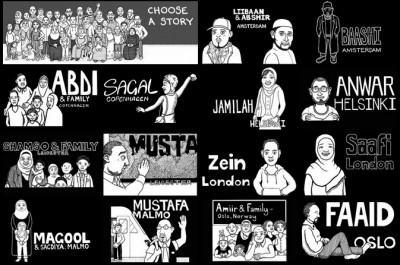
The Open Society Foundations have recently published a fascinating set of seven illustrated stories, called ‘meet the Somalis‘, covering the experiences of Somalis living in cities across Europe.

On November 21, this will coincide with the publishing of the Foundations’ research report “Somalis in Helsinki”.

Meet the somalis

To quote the Foundation’s website: “The Somali community in Europe is a vibrant, diverse minority group, including people of Somali origin born in Europe, Somali refugees and asylum seekers, and Somalis who have migrated from one country in Europe to another. There are no accurate figures for the number of Somalis in Europe, but on the whole they are among one of the largest minority groups.

The illustrated stories focus on challenges faced by Somalis in their respective cities in Europe and issues raised in the Somalis in European Cities research, including education, housing, the media, employment, political participation, and identity.”

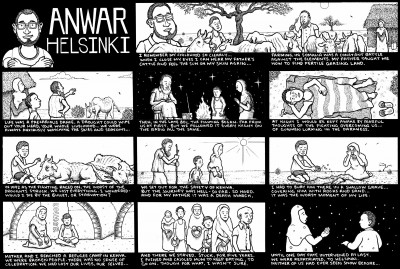
One of the featured illustrated stories is about Anwar from Helsinki.

Meet the Somalis

The Open Society Foundations work to build vibrant and tolerant democracies whose governments are accountable to their citizens.

Illustrations reproduced by permission.

How tabloids like Ilta-Sanomat reinforce our prejudices against immigrants and refugees

Posted on July 31, 2013 by Migrant Tales

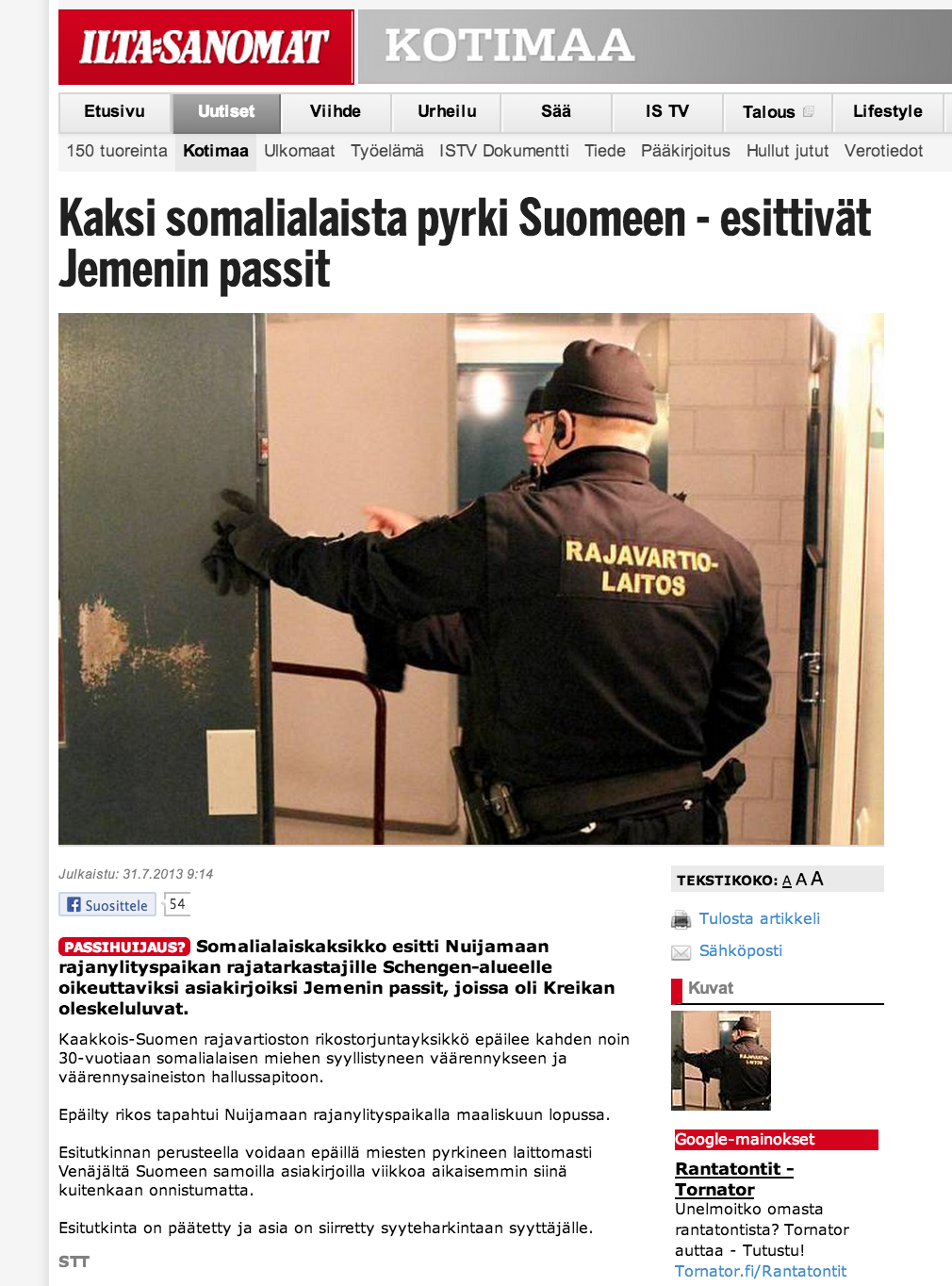
Tabloids like Ilta-Sanomat have a lot to learn about fairness, which is the cornerstone of all good news reporting. But tabloids aren’t interested in fairness but in sensationalism. A story by Ilta-Sanomat is headlined: ”Two Somalis use [fake] Yemeni passports to travel to Finland.” 

Even if the story suggests that these Somalis are committing a crime because they travel with false passports, there is much more to the case than meets the eye. If the reporters would have bothered to read a related story on 4 News in the UK, the angle of their story would have probably been different.

According to 4 News, hundreds of asylum seekers who used false passports to travel to the UK in the past ten years were abused and wrongly convicted.  As a result, the court of appeal quashed the convictions of five victims because they were denied a justifiable defense of the charge.

None of the lawyers told one of the victims like “Jonathan,” who appears on the program, any chance of defending himself. The lawyers advised Jonathan to plead guilty to the charges, which landed him a conviction and a six-month prison sentence.

Apart from having a criminal record, which worsened his chances of finding employment, he was denied for seven years the right to see his wife and child in the U.S. His conviction denied him a visa.

Go here to see the 4 News report.

Kuvankaappaus 2013-7-31 kello 15.12.24

Read full story here.

Migrant Tales has published numerous Ilta-Sanomat’s racist billboard ads from the 1990s, when Finland’s foreign population started to grow rapidly.

images (1)

Here’s a tabloid ad from 1992 where then MP Liisa Kulhia wants to put the Russian mafia and Somalis in their places.

The Finnish media reports near-constantly stories that reinforce intolerance of certain ethnic groups. But what can you expect if they don’t know better? If they don’t know better, any self-respecting reporter would get the facts right and rely as less as possible on his prejudices.

Anssi Honkanen’s and Renne Korppila’s Aamupoika radio program on NRJ, one of Finland’s most popular private radio stations, is one recent example of how hostility and intolerance of immigrants is promoted in Finland. The radio commentators claimed that there was a direct link to between crime rates/human trafficking and the Bulgarian and Romanian Roma who come to Finland to beg. 

I sent an email to the program challenging their urban tales but never got a reply from either Honkanen or Korppila never mind NRJ.

I wonder if NRJ paid any attention to an official police report in mid-July that Roma beggars aren’t victims of human trafficking or linked to organized crime?

As long as people like Honkanen and Korppila can get away with such racist statements, very little can change.

  • 1
  • 2
  • 3
  • Next
Read more about documentary film
Read more

Recent Posts

  • Finland’s tabloids Iltalehti and Ilta-Sanomat are the pits
  • Riikka Purra’s Dr Jekyll and Mr Hyde mask
  • Double standards
  • Perussuomalaiset: Uusi logo, sama vanha juttu
  • Taco Trump

Recent Comments

  1. Absolutely Socking: Racist Finnish Facebook group against human rights gets flooded with socks on Musta Barbaari’s mother and sister charged by the police in “ethnic profiling” case
  2. Ilkka Nuotio on Pekka Myrskylä: “Tilastot kertovat toista kuin poliittinen keskustelu”
  3. Genrih Soinkara on The war in Ukraine and the Russian-Finnish border crisis are showing Finland’s ugly side
  4. Ahti Tolvanen on Comment by Ahti Tolvanen on the Helsinki +50 conference
  5. Angel Barrientos on Angel Barrientos is one of the kind beacons of Finland’s Chilean community

Archives

  • June 2026
  • May 2026
  • April 2026
  • March 2026
  • February 2026
  • January 2026
  • December 2025
  • November 2025
  • October 2025
  • September 2025
  • August 2025
  • July 2025
  • June 2025
  • May 2025
  • April 2025
  • March 2025
  • February 2025
  • January 2025
  • December 2024
  • November 2024
  • October 2024
  • September 2024
  • August 2024
  • July 2024
  • June 2024
  • May 2024
  • April 2024
  • March 2024
  • February 2024
  • January 2024
  • December 2023
  • November 2023
  • October 2023
  • September 2023
  • August 2023
  • July 2023
  • June 2023
  • May 2023
  • April 2023
  • March 2023
  • February 2023
  • January 2023
  • December 2022
  • November 2022
  • October 2022
  • September 2022
  • August 2022
  • July 2022
  • June 2022
  • May 2022
  • April 2022
  • March 2022
  • February 2022
  • January 2022
  • December 2021
  • November 2021
  • October 2021
  • September 2021
  • August 2021
  • July 2021
  • June 2021
  • May 2021
  • April 2021
  • March 2021
  • February 2021
  • January 2021
  • December 2020
  • November 2020
  • October 2020
  • September 2020
  • August 2020
  • July 2020
  • June 2020
  • May 2020
  • April 2020
  • March 2020
  • February 2020
  • January 2020
  • December 2019
  • November 2019
  • October 2019
  • September 2019
  • August 2019
  • July 2019
  • June 2019
  • May 2019
  • April 2019
  • March 2019
  • February 2019
  • January 2019
  • December 2018
  • November 2018
  • October 2018
  • September 2018
  • August 2018
  • July 2018
  • June 2018
  • May 2018
  • April 2018
  • March 2018
  • February 2018
  • January 2018
  • December 2017
  • November 2017
  • October 2017
  • September 2017
  • August 2017
  • July 2017
  • June 2017
  • May 2017
  • April 2017
  • March 2017
  • February 2017
  • January 2017
  • December 2016
  • November 2016
  • October 2016
  • September 2016
  • August 2016
  • July 2016
  • June 2016
  • May 2016
  • April 2016
  • March 2016
  • February 2016
  • January 2016
  • December 2015
  • November 2015
  • October 2015
  • September 2015
  • August 2015
  • July 2015
  • June 2015
  • May 2015
  • April 2015
  • March 2015
  • February 2015
  • January 2015
  • December 2014
  • November 2014
  • October 2014
  • September 2014
  • August 2014
  • July 2014
  • June 2014
  • May 2014
  • April 2014
  • March 2014
  • February 2014
  • January 2014
  • December 2013
  • November 2013
  • October 2013
  • September 2013
  • August 2013
  • July 2013
  • June 2013
  • May 2013
  • April 2013
  • March 2013
  • February 2013
  • January 2013
  • December 2012
  • November 2012
  • October 2012
  • September 2012
  • August 2012
  • July 2012
  • June 2012
  • May 2012
  • April 2012
  • March 2012
  • February 2012
  • January 2012
  • December 2011
  • November 2011
  • October 2011
  • September 2011
  • August 2011
  • July 2011
  • June 2011
  • May 2011
  • April 2011
  • March 2011
  • February 2011
  • January 2011
  • December 2010
  • November 2010
  • October 2010
  • September 2010
  • August 2010
  • July 2010
  • June 2010
  • May 2010
  • April 2010
  • March 2010
  • February 2010
  • January 2010
  • December 2009
  • November 2009
  • October 2009
  • September 2009
  • August 2009
  • July 2009
  • December 2008
  • November 2008
  • October 2008
  • September 2008
  • August 2008
  • July 2008
  • June 2008
  • May 2008
  • April 2008
  • March 2008
  • February 2008
  • January 2008
  • November 2007
  • October 2007
  • September 2007
  • August 2007
  • July 2007
  • June 2007
  • May 2007

Categories

  • ?? Gia L?c
  • ????? ?????? ????? ???????? ?? ??????
  • ???????
  • @HerraAhmed
  • @mondepasrond
  • @nohatefinland
  • @oula_silver
  • @Varathas
  • A Pakistani family
  • äärioikeisto
  • Abbas Bahmanpour
  • Abdi Muhis
  • Abdirahim Hussein Mohamed
  • Abdirahim Husu Hussein
  • Abdirisak Mahamed
  • About Migrant Tales
  • activism
  • Adam Al-Sawad
  • Adel Abidin
  • Afrofinland
  • Ahmed IJ
  • Ahti Tolvanen
  • Aino Pennanen
  • Aisha Maniar
  • Alan Ali
  • Alan Anstead
  • Alejandro Díaz Ortiz
  • Alekey Bulavsev
  • Aleksander Hemon
  • Aleksanterinliitto
  • Aleksanterinliitto ry
  • Aleksanterinliitto ry:n hallitus
  • Alex Alex
  • Alex Mckie
  • Alexander Nix
  • Alexandra Ayse Albayrak
  • Alexis Neuberg
  • Ali Asaad Hasan Alzuhairi
  • Ali Hossein Mir Ali
  • Ali Rashid
  • Ali Sagal Abdikarim
  • Alina Tsui
  • Aline Müller
  • All categories
  • Aman Heidari
  • Amiirah Salleh-Hoddin & Jana Turk
  • Amin A. Alem
  • Amir Zuhairi
  • Amkelwa Mbekeni
  • Ana María Gutiérrez Sorainen
  • Anachoma
  • Anders Adlecreutz
  • Angeliina Koskinen
  • Anna De Mutiis
  • Anna María Gutiérrez Sorainen
  • Anna-Kaisa Kuusisto ja Jaakko Tuominen
  • Annastiina Kallius
  • Anneli Juise Friman Lindeman
  • Announcement
  • Anonymous
  • Antero Leitzinger
  • anti-black racism
  • Anti-Hate Crime Organisation Finland
  • Anudari Boldbaatar
  • Arshiya Nasser
  • Aspergers Syndrome
  • Asylum Corner
  • Asylum seeker 406
  • Athena Griffin and Joe Feagin
  • Autism
  • Avaaz.org
  • Awale Olad
  • Ayan Said Mohamed
  • AYY
  • Barachiel
  • Bashy Quraishy
  • Beatrice Kabutakapua
  • Beri Jamal
  • Beri Jamal and Enrique Tessieri
  • Bertolt Brecht
  • Boiata
  • Boodi Kabbani
  • Bruno Gronow
  • Carmen Pekkarinen
  • Çelen Oben and Sheila Riikonen
  • Chiara Costa-Virtanen
  • Chiara Costa-Virtanen
  • Chiara Sorbello
  • Christian Thibault
  • Christopher Wylie
  • Clara Dublanc
  • Dana
  • Daniel Malpica
  • Danilo Canguçu
  • David Papineau
  • David Schneider
  • Dexter He
  • Don Flynn
  • Dr Masoud Kamali
  • Dr. Faith Mkwesha
  • Dr. Theodoros Fouskas
  • Edna Chun
  • Eeva Kilpi
  • Emanuela Susheela
  • En castellano
  • ENAR
  • Enrique
  • Enrique Tessieri
  • Enrique Tessieri & Raghad Mchawh
  • Enrique Tessieri & Yahya Rouissi
  • Enrique Tessieri and Muhammed Shire
  • Enrique Tessieri and Sira Moksi
  • Enrique Tessieri and Tom Vandenbosch
  • Enrique Tessieri and Wael Che
  • Enrique Tessieri and Yahya Rouissi
  • Enrique Tessieri and Zimema Mhone
  • Epäluottamusmies
  • EU
  • Europe
  • European Islamophobia Report
  • European Islamophobia Report 2019,
  • European Union
  • Eve Kyntäjä
  • Ezequiel Caldeiro
  • Facebook
  • Fadumo Dayib
  • Faisa Kahiye
  • Farhad Manjoo
  • Fasismi
  • Finland
  • Fizza Qureshi
  • Flyktingar och asyl
  • Foreign Student
  • Fozia Mir-Ali
  • Frances Webber
  • Frida Selim
  • Gareth Rice
  • Ghyslain Vedeaux
  • Global Art Point
  • Great Replacement
  • Habiba Ali
  • Hami Bahadori
  • Hami Bahdori
  • Hamid
  • Hamid Alsaameere
  • Hamid Bahdori
  • Handshake
  • Harmit Athwal
  • Hassan Abdi Ali
  • Hassan Muhumud
  • Heikki Huttunen
  • Heikki Wilenius
  • Helsingin Sanomat
  • Henning van der Hoeven
  • Henrika Mälmsröm
  • Hser Hser
  • Hser Hser ja Mustafa Isman
  • Husein Muhammed
  • Hussain Kazemian
  • Hussain Kazmenian
  • Ibrahim Khan
  • Ida
  • Ignacio Pérez Pérez
  • Iise Ali Hassan
  • Ilari Kaila & Tuomas Kaila
  • Imam Ka
  • inside-an-airport
  • Institute of Race Relations
  • Iraqi asylum seeker
  • IRR European News Team
  • IRR News Team
  • Islamic Society of Norhern FInland
  • Islamic Society of Northern Finland
  • Islamophobia
  • Jacobinmag.com
  • Jallow Momodou
  • Jan Holmberg
  • Jane Elliott
  • Jani Mäkelä
  • Jari Luoto
  • Jari Taponen
  • Jegor Nazarov
  • Jenni Stammeier
  • Jenny Bourne
  • Jessie Daniels
  • Joe Davidow
  • Johannes Koski
  • John D. Foster
  • John Grayson
  • John Marriott
  • Jon Burnett
  • Jorma Härkönen
  • Jos Schuurmans
  • José León Toro Mejías
  • Josue Tumayine
  • Jouni Karnasaari
  • Juan Camilo
  • Jukka Eräkare
  • Julian Abagond
  • Julie Pascoet
  • Jussi Halla-aho
  • Jussi Hallla-aho
  • Jussi Jalonen
  • JusticeDemon
  • Kadar Gelle
  • Kaksoiskansalaisuus
  • Kansainvälinen Mikkeli
  • Kansainvälinen Mikkeli ry
  • Katherine Tonkiss
  • Kati Lepistö
  • Kati van der Hoeven-Lepistö
  • Katie Bell
  • Kättely
  • Kerstin Ögård
  • Keshia Fredua-Mensah & Jamie Schearer
  • Khadidiatou Sylla
  • Khadra Abdirazak Sugulle
  • Kiihotus kansanryhmää vastaan
  • Kirsi Crowley
  • Koko Hubara
  • Kristiina Toivikko
  • Kubra Amini
  • KuRI
  • La Colectiva
  • La incitación al odio
  • Laura Huhtasaari
  • Lauri Finér
  • Leif Hagert
  • Léo Custódio
  • Leo Honka
  • Leontios Christodoulou
  • Lessie Branch
  • Lex Gaudius
  • Leyes de Finlandia
  • Liikkukaa!
  • Linda Hyökki
  • Liz Fekete
  • M. Blanc
  • Maarit Snellman
  • Mahad Sheikh Musse
  • Maija Vilkkumaa
  • Malmin Kebab Pizzeria Port Arthur
  • Marcell Lorincz
  • Mari Aaltola
  • María Paz López
  • Maria Rittis Ikola
  • Maria Tjader
  • Marja-Liisa Tolvanen
  • Mark
  • Markku Heikkinen
  • Marshall Niles
  • Martin Al-Laji
  • Maryan Siyad
  • Matt Carr
  • Mauricio Farah Gebara
  • Media Monitoring Group of Finland
  • Micah J. Christian
  • Michael McEachrane
  • Michele Levoy
  • Michelle Kaila
  • Migrant Tales
  • Migrant Tales Literary
  • Migrantes News
  • Migrants' Rights Network
  • MigriLeaks
  • Mikko Kapanen
  • Miriam Attias and Camila Haavisto
  • Mohamed Adan
  • Mohammad Javid
  • Mohammad M.
  • Monikulttuurisuus
  • Monisha Bhatia and Victoria Canning
  • Mor Ndiaye
  • Muh'ed
  • Muhamed Abdimajed Murshid
  • Muhammed Shire
  • Muhammed Shire and Enrique Tessieri
  • Muhis Azizi
  • Musimenta Dansila
  • Muslimiviha
  • Musulmanes
  • Namir al-Azzawi
  • Natsismi
  • Neurodiversity
  • New Women Connectors
  • Nils Muižnieks
  • No Labels No Walls
  • Noel Dandes
  • Nuor Dawood
  • Omar Khan
  • Otavanmedia
  • Oula Silvennoinen
  • Paco Diop
  • Pakistani family
  • Pentti Stranius
  • Perussuomalaiset
  • perustuslaki
  • Petra Laiti
  • Petri Cederlöf
  • Pia Grochowski
  • Podcast-lukija Bea Bergholm
  • Pohjois – Suomen Islamilainen Yhdyskunta
  • Pohjois Suomen Islamilainen Yhyskunta
  • Polina Kopylova
  • Race Files
  • racism
  • Racism Review
  • Raghad Mchawh
  • Ranska
  • Rashid H. and Migrant Tales
  • Rasismi
  • Raul Perez
  • Rebecka Holm
  • Reem Abu-Hayyeh
  • Refugees
  • Reija Härkönen
  • Remiel
  • Reza Nasri
  • Richard Gresswell
  • Riikka Purra
  • Risto Laakkonen
  • Rita Chahda
  • Ritva Kondi
  • Robito Ibrahim
  • Roble Bashir
  • Rockhaya Sylla
  • Rodolfo Walsh
  • Roger Casale
  • Rostam Atai
  • Roxana Crisólogo Correa
  • Ruth Grove-White
  • Ruth Waweru-Folabit
  • S-worldview
  • Sadio Ali Nuur
  • Sami Rusanen
  • Sandhu Bhamra
  • Sara de Jong
  • Sarah Crowther
  • Sari Alhariri
  • Sarkawt Khalil
  • Sasu
  • Scot Nakagawa
  • Shabana Ahmadzai
  • Shada Islam
  • Sharon Chang blogs
  • Shenita Ann McLean
  • Shirlene Green Newball
  • Sini Savolainen
  • Sira Moksi
  • Sonia K.
  • Sonia Maria Koo
  • Steverp
  • Stop Deportations
  • Suldaan Said Ahmed
  • Suomen mediaseurantakollektiivi
  • Suomen Muslimifoorumi ry
  • Suomen viharikosvastainen yhdistys
  • Suomen viharikosvastainen yhdistys ry
  • Suomi
  • Supermen
  • Susannah
  • Suva
  • Syrjintä
  • Talous
  • Tapio Tuomala
  • Taw Reh
  • Teivo Teivainen
  • The Daily Show
  • The Heino
  • The Supermen
  • Thomas Elfgren
  • Thulfiqar Abdulkarim
  • Tim McGettigan
  • Tino Singh
  • Tito Moustafa Sliem
  • Tobias Hübinette and L. Janelle Dance
  • Transport
  • Trica Danielle Keaton
  • Trilce Garcia
  • Trish Pääkkönen
  • Trish Pääkkönen and Enrique Tessieri
  • Tuulia Reponen
  • Uncategorized
  • UNITED
  • University of Eastern Finland
  • Uyi Osazee
  • Väkivalta
  • Vapaa Liikkuvuus
  • Venla-Sofia Saariaho
  • Vieraskynä
  • W. Che
  • W. Che an Enrique Tessieri
  • Wael Ch.
  • Wan Wei
  • Women for Refugee Women
  • Xaan Kaafi Maxamed Xalane
  • Xassan Kaafi Maxamed Xalane
  • Xassan-Kaafi Mohamed Halane & Enrique Tessieri
  • Yahya Rouissi
  • Yasmin Yusuf
  • Yassen Ghaleb
  • Yle Puhe
  • Yuliet Tresa
  • Yve Shepherd
  • Zahra Khavari
  • Zaker
  • Zalina Ametova
  • Zamzam Ahmed Ali
  • Zeinab Amini ja Soheila Khavari
  • Zimema Mahone and Enrique Tessieri
  • Zimema Mhone
  • Zoila Forss Crespo Moreyra
  • ZT
  • Zulma Sierra
  • Zuzeeko Tegha Abeng
© 2026 Migrant tales | Powered by Minimalist Blog WordPress Theme