
Migrant tales
Menu
  • #MakeRacismHistory “In Your Eyes”
  • About Migrant Tales
  • It’s all about Human Rights
  • Literary
  • Migrant Tales Media Monitoring
  • NoHateFinland.org
  • Tales from Europe
Menu

Tag: Immigration debate

Fatbardhe Hetemaj: Who will speak up for us if you don’t?

Posted on January 17, 2015 by Migrant Tales

Fatbardhe Hetemaj is a promising National Coalition Party Helsinki city councilwoman who moved to Finland at the age of seven. Since people like Hetemaj are becoming more common in Finland as we become a more culturally and ethnically diverse society, it is important that they speak out against discrimination and promote tolerance and respect for other groups.   

Hetemaj came to Finland with her family as a quota refugee from Kosovo. She was named in 2009 as the Refugee Woman of the Year.

In a letter to the editor on Helsingin Sanomat, Hetemaj unfortunately uses the same arguments and language that anti-immigration politicians use and which she criticizes in her piece.

The headline, which claims that immigration is “a problem,” is the first matter that catch’s your eye. While Helsingin Sanomat decides on the headline, it does represent pretty well what Hetemaj wrote.

For those who have been following the debate on immigration and migrants in this country know that it revolves too much around the assumption that immigration and immigrants are “problems” instead of an asset. Even if unemployment is two- to three-times higher among immigrants than the national average, the vast majority of migrants that live in this country work, pay taxes and lead normal lives.

Fueling such an urban tale, that migrants should be treated as a problem, does tremendous harm to the whole migrant and New Finn community. How can you resolve a problem if those judging you see you in almost the same light as an illness?
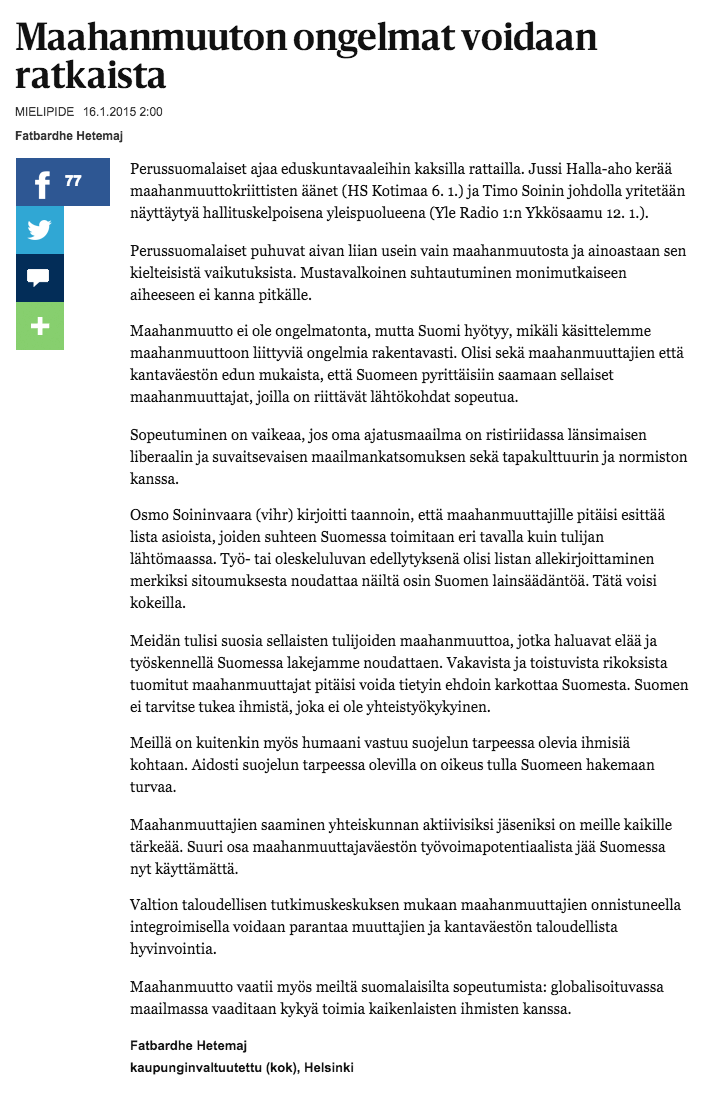
Näyttökuva 2015-1-16 kello 22.48.35


Read full letter to the editor here.


Probably the most incredible statement made by the National Coalition Party councilwoman is that migrants that move to Finland should sign a contract to ensure they’ll respect our laws. She also claims that we should only accept those types of migrants that respect our laws and have a good chance of adapting to our country.

Apart from suggesting that migrants are prone not respect our laws and therefore must sign a contract, in which countries is such a contract mandatory? The contract for migrants that Hetemaj supports reveals more her prejudices and simplistic views about migrants.

Migrant Tales has great respect for all those who excel in our society. Hetemaj is a good example that second-generation Finns or third-culture members of our society can succeed as well.

One of the important matters to remember as our society becomes more culturally and ethnically diverse is that we do not forget our own roots and identity. Moreover, our country is a Nordic welfare state that speaks of two-way not one-way adaption, or assimilation.

We hope that Hetemaj won’t forget to speak up for those who don’t have and are in need of a voice in this society.


Finland’s distorted immigration debate is damaging our country

Posted on January 3, 2014 by Migrant Tales

My son asked me Friday an interesting question that revealed what is wrong concerning the present debate on immigration and immigrants in Finland. He asked me to show how does immigration fuel economic growth. His question, which is a valid one, reveals some of the perceptions that some have about immigration. 

Due to the attention that anti-immigration politicians have received in the media, coupled by the silence and lack of leadership from the majority of politicians, many actually believe that the majority of foreigners in this country are refugees, Muslims, from Africa and here only to live off welfare.

Some, like MPs of the Perussuomalaiset (PS) party, play on our worst prejudices and fears by claiming that Muslims are invading Finland and Europe in Trojan horses. It’s only a question of time when ghettos will be set alight by ethnic strife, according to them.

L_0995-Medium-223x300

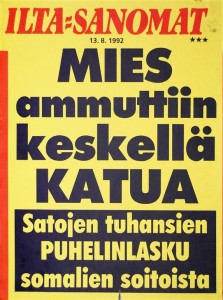
Tabloids like Ilta-Sanomat continue to spread racism in Finland. This billboard of 1992 claimed that Somalis “tricked” authorities to pay phone bills costing hundreds of thousands of Finnish marks. In that period, you could buy a row house in Helsinki for 500,000 marks. Billboard source: Institute of Migration

Facts reveal a very different picture, however. Finland has today fewer refugees than in the 1920s, when some 35,000 refugees from Russia lived in our country. In 2012, a mere 3,219 refugees applied for asylum but only 1,601 were accepted versus 43,900 in Sweden, according to the Finnish Immigration Service.

Moreover, 9.1% of all people who were born abroad and are residents of Finland are from Africa (25,895). The majority, or 64% (182,696), are from a European country.

A news story by Helsingin Sanomat on Friday showed how lopsided the present debate on immigration and immigrants is in Finland. The story revealed that our country accepted 149 Syrian refugees last year compared with 14,600 in Sweden.

There is nothing wrong with immigration from Africa as there is nothing wrong with immigration from Latin America, Asia, North America or from other European countries. What is wrong and unacceptable, however, is how such a distorted picture of immigration continues to be maintained.

This proves, in my opinion, that the media has been led more by its prejudices than its journalistic standards, politicians by their opportunism than leadership, and the general public by their apathy on the topic. The most shameful matter is that few are doing anything to bust such myths.

It’s possible to understand this situation from a historic perspective since Finland did everything possible up to 1995, when we became an EU member, to hinder as much as possible immigration and foreign investment to this country.

This suspicion of the outside world can be explained in part by our difficult relations with the former Soviet Union. Even so, it can’t suffice as the whole answer. How can a nation that lost over 1.2 million of its countrymen to emigration during 1860-1999 house such suspicious attitudes towards immigrants?

Going back to the question that my son asked Friday, I told him that it’s highly doubtful that his father, grandfather, great grandfather and great great grandfather, who were all immigrants, ever discussed how negative or harmful immigration is to society. On the contrary. Immigration is a positive phenomenon that brings new blood, new ideas and new strength to a country.

“The fact is simple,” I continued, “the whole idea of migrating from one country to another is opportunity and the search for a better life. This is the case irrespective if you migrate for political or economic reasons.”

Recent calls by the head of the Government Institute for Economic Research (VATT), Juhanna Vartiainen, and the Confederation of Finnish Industries (EK), that Finland needs more labor immigrants, has been met with skepticism by SAK, the central organization of Finnish trade unions.

According to SAK, immigration isn’t a solution to labor shortages because it would lead to two labor markets, according to YLE in English.

Any sensible person understands that the aim of immigration shouldn’t be to drive down salaries and rollback  important gains and rights achieved for employees by our labor market. If Finland’s immigrant population grows in the future, as it will, it should be the job of the labor unions and authorities to ensure that the rights of every employee, including immigrants, aren’t compromised by abusive employers.

A recent article published by Forbes magazine, offers us sobering advice on what to avoid in Finland and Europe on the immigration front.

“Attempting to fence off the country is no answer to anything.  It would be difficult for a generally free society with extensive borders to close out the rest of the world.  Worse, to be effective such controls as ID cards, citizenship checks, workplace raids, employer sanctions, and more would undermine domestic liberties.”

Kuvankaappaus 2014-1-4 kello 1.08.18

Read full story here.

One important step that we must take in order to debate fairly and in a proactive manner about our ever-growing cultural diversity, is bust those terrible and destructive myths that distort the debate on immigration and immigrants.

Maintaining alive such myths is damaging to our country economically, politically and socially. We will end up paying a hefty price if we don’t in the form of lower living standards and loss of competitiveness.

We welcome Finnish and Swedish on Migrant Tales

Posted on March 27, 2012 by Migrant Tales

By Enrique Tessieri

Some may ask why Migrant Tales is a blog written in English. When I started this blog in May 2007, I thought that English would be an effective filter to leave out the knee-jerk and sometimes openly hostile attacks from Hommaforum and Scripta. 

In the past year, especially after the April election, Migrant Tales has seen record growth and we feel pretty strong today. We have gone through many debates and situations during our short existence.

As we’ve grown into that “humble voice” we have become stronger and more convinced about our convictions.

As editor of Migrant Tales, I welcome more blog entries and comments in Finnish and Swedish. People can in theory respond in any language they please. Google translator makes it possible.

Another language that we’ve used on and off on this blog is Spanish.

Why don’t Finnish politicians challenge urban myths hard enough?

Posted on August 25, 2011 by Migrant Tales

By Enrique Tessieri

In Ireland, where the immigrant population has grown very rapidly in a span of ten years, there are concrete steps to address urban myths about migrants, refugees and Muslims. In Finland it appears to be a totally different story. 

Below are some myths that a brochure about migrant workers and their families. Why isn’t there a similar campaign in Finland by the government?

As far as we are concerned, the term Ireland below could be replaced by Finland.

01 Do Migrant Workers take jobs from Irish people?

  • There is always the possibility of displacement in a competitive economy but most available research shows that migrant workers replace rather than displace workers in Ireland.
  • There are many reasons why it can be hard for unemployed people to find work, e.g. lack of childcare, and disability access, discrimination, racism, deskilling, educational disadvantage.
02 Are Migrant Workers a drain on the economy?
  • Migrant workers expand the economy by allowing businesses to grow and by investing their own skills and money in enterprises.
  • Of the 162,200 additional jobs created in the Irish economy from 2004 to 2006, non-Irish national entrepreneurs and companies accounted for 53% of these jobs.

03 Do Migrant Workers bring down wages?

  • Wage levels including the minimum wage have consistently risen over the past decade.
  • Migrant workers should not be blamed for employers who do not pay minimum wage and who violate employment legislation for their own profit.

04 Are Migrant Workers a burden on public services?

  • Migrant workers tend to pay more in taxes than they receive in benefits. It is estimated that around 200,000 migrant workers provide an annual surplus in income taxes of around half a billion Euro.
  • Despite unfounded fears of “welfare tourism”, less than 1% of the country’s migrant workers are dependent on social welfare. Social welfare is important for any worker as a safety net in times of illness and unemployment.

At the beginning of the brochure reads: “Migration is the mother of progress and invention. (…) Our world today is shaped by the industry of immigrants.”


YLE Turku: Malttia maahanmuuttokeskusteluun

Posted on January 19, 2011 by Migrant Tales

Comment: Here is an interesting story in Yle Turku where Ismo Söderling, the head of the Migration Institute, recommends that parties in Finland should not inflame debate on immigration to new heights as the April election nears. He suggests that all of the parties should meet and discuss in earnest the challenges our aging population and immigration pose on the country.

What do you think?

______________

Turussa toimivan Siirtolaisuusinstituutin johtaja Ismo Söderling toivoo, että puolueet välttäisivät kärjistyksiä siirtolaisuuskysymyksissä tulevien eduskuntavaalien alla. Puolueiden johtohenkilöiden olisi hyvä pitää pienimuotoinen Korpilampi-tapaaminen, jossa keskusteltaisiin avoimesti Suomen tulevista väestö- ja maahanmuuttohaasteista, ehdottaa Söderling.

Hän varoittaa Suomea kopioimasta Ruotsin menettelyä, jossa perinteiset isot puolueet kieltäytyivät etukäteen tekemästä vaalien jälkeen yhteistyötä maahanmuuttokriittisen puolueen kanssa.

– Kaikilla parlamenttiin valituilla puolueilla on oltava osallistumismahdollisuus yhteisiin asioihin. Jos esimerkiksi perussuomalaiset keräävät yli 10 prosentin äänipotin, niin heidän eristämisensä vain lisää katkeruutta ja pahaa mieltä. Nämä äänenpainot on saatava mukaan yhteiskunnalliseen päätöksentekoon, sanoo Söderling.

Turun buddhalaistemppelin tuhopoltto huolestuttaa

Söderlingin mielestä syyskuussa Turussa tapahtunut buddhalaistemppelin tuhopoltto oli huolestuttava signaali siitä, että Ruotsissa jo yleistynyt muukalaisvastaisuus saattaa levitä myös Suomeen.

– Me suomalaisetkin olemme rakentaneet esimerkiksi Amerikan mantereelle työväentaloja, raittiustaloja ja kirkkoja. Ne olivat paikkoja, joissa siirtolaiset tapasivat toisiaan. Ei tällaisissa Turun buddhalaistemppeleiden tapaisissa rakennuksissa ole tämän kummemmasta kyse, Söderling painottaa.

Suomi on löydetty

Söderling muistuttaa, että Suomi tarvitsee enenevässä määrin siirtolaisia. Heitä on jo 200 000 ja lisää tulee.

– Me tarvitsemme lisää siirtolaisia ensi vuosikymmenellä. Vielä kymmenen vuotta me pärjäämme, mutta kun nykyisestä hoivahenkilökunnastakin iso prosentti eläköityy seuraavalla vuosikymmenellä, niin kuka tämän vanhusväestön hoitaa, pohtii Söderling.

Korpilammen henkeä tarvitaan

Söderling perää Suomeen tässä tilanteessa 1970-luvun Korpilammen kokouksen kaltaista keskustelutilaisuutta. Vuonna 1977 tämä seminaari luotsasi Suomea selviämään ensimmäisen öljykriisin aiheuttamasta talousahdingosta. Yhteisen sävelen löytyminen siivitti Suomen 1980-luvun taloudellista nousua.

– Maahanmuuttoon liittyvät työllistämiskysymykset. Suosimmeko työperäistä muuttoa? Meillä on eduskunnassa käsittelyssä uusi kotouttamislaki. Se on aika haasteellinen, koska kunnille tulee uusia vaateita, mutta ei uusia resursseja. Meneekö se läpi esitetyssä muodossa? Kyllä seminaarille aiheita piisaa, luettelee Söderling.

– Jos tällaisessa kokouskutsussa olisi rauhannobelisti, presidentti Martti Ahtisaaren, ulkoministeri Aleksander Stubbin, pääministeri Mari Kiviniemen ja vaikkapa vuoden pakolaisnaisen Nasima Razmyarin allekirjoitukset, niin kutsu kannattaisi ottaa tosissaan, päätää Söderling.

YLE Turku

Hyvä Homma: Suomalainen Unelma

Posted on January 15, 2011 by Migrant Tales

Comment: The Green Party has started a rival website to  Hommaforum called Hyvä Homma. It is supposed to be a forum where immigrants and refugees can give their point of view. This is an excellent idea considering that the overwhelming majority taking part in the ongoing debate are Finns and the True Finns with very reactive ideas on foreigners.

The contribution below, Suomalainen unelma, was published by Hyvä Homma. It is going to shatter a lot of people’s perceptions of Somalis in Finland because there are many success stories out there.

Why not pay Hyvä Homma a visit and contribute?

_______________

M. Abdulkarim

Suomi on hieno maa, luonto on kuvankaunis, sosiaaliturva pelaa ja koulutuskin on vailla vertaansa. Suomeen ovat tervetulleita työtä tekevät maahanmuuttajat tai rakkauden tänne vetämät, ja humanitäärisistä syistä tänne voivat tulla myös vainotut ja vailla turvaa olevat. Suomessa on myös hieno lainsäädäntö joka takaa jokaiselle perusihmisoikeudet. Unelmien Suomi on maahanmuuttajalle kuitenkin vaikea maa. Suomessa pitäisi osata kieli, kulttuuri ja pelisäännöt, mielellään heti kun tänne saapuu, viimeistään kolmen vuoden kuluttua siitä kun on rekisteröity kunnan asukkaaksi. Kolme vuotta on lyhyt aika monelle integroitua ja työllistyä nykyisillä integraatiotoimilla.

Suurin paine tuntuu kohdistuvan tällä hetkellä maahanmuuttajien parissa työskenteleville sosiaalialan ammattilaisille, joiden pitäisi tuottaa parempaa tulosta eli paremmin kotoutuneita maahanmuuttajia, juuri tämä ammattiryhmä jonka resurssit ovat puutteelliset ja joille ei suoda aikaa tehdä perusteellista työtä. Toinen ryhmä johon paineita kohdistetaan, ovat maahanmuuttajat itse. On helppo ihmetellä sitä, että miten on mahdollista maahanmuuttajan olla oppimatta suomenkieltä ja työllistyä kun on kerta päässyt tähän unelmien Suomeen. Sitä miten siihen vaikuttavat kansaihmiset joilta ei irtoa hymy eikä tervehdys ei sovi ihmetellä, ei ainakaan ääneen eikä mamun. Kiitollinen tulisi olla.

Samaan aikaan Suomessa elää iso määrä maahanmuuttajia, jotka ovat integroituneet ja työllistyneet ja elävät suomalaista unelmaa: Vakituinen työ ja asuntolaina, joka motivoi pitämään sen. Media ei kuitenkaan tätä suurta mamu-ryhmää huomioi, medialla on kiire kertoa miten vaikeaa on maahanmuuttajan arki, miten vaikeaa maahanmuuttajan on työllistyä ja kuinka yleistä rasismi on. Ei tarvitse olla tohtoritason tutkija huomatakseen tässä itseään toteuttavan profetian aineksia. Kantasuomalaisten on helpompi suhtautua syrjivästi maahanmuuttajiin, ”kun muutkin tekee niin”, työnantajan on helppo olla ottamatta maahanmuuttajaa töihin ”eihän muutkaan työnantajat” ja vuokranantajan on myös samoin perustein helppo olla ottamatta vuokralaisekseen maahanmuuttajaa. Tällaisella uutisoinnilla saattaa olla vaikutuksia myös maahanmuuttajiin, kyllähän uussuomalainen nyt Hesariin luottaa. Ei ehkä kannata edes yrittää hakeutua töihin kun ei minua oteta töihin, en uskalla lähestyä suomalaista naapuriani, mitä jos se on rasisti, jäinkö vailla koulupaikkaa ihonvärini tähden? Media muokkaa asenteita, tästä ei valitettavasti pääse yli eikä ympäri. Ei maahanmuuttaja eikä kantasuomalainen.

Helsingin kaupunki on esimerkillinen työnantaja siinä mielessä että heille pääsee töihin huivi päässä ja suomea aksentilla puhuen. He työllistävät ammattitaitoiset maahanmuuttajat siinä missä kantasuomalaisiakin. S-ryhmä on myös lähtenyt tähän mukaan, tosin heillä huivi ei edelleenkään kuulu työasuun. Se miten huivi, jonka helman saa työpaidan alle, vaikuttaa työturvallisuuteen sen enempää kuin pitkä tukka, joka on vapaana, on minulle mysteeri. S-kauppiaat eivät tässä kannassaan ole yksin, Stockmann kuuluu myös tähän ryhmään työnantajia joiden näkemys huivista on se että se ei ole edustava eikä näin ollen kuulu työasuun, pieni ihme on se että myyjät saavat sielläkin värjätä tukkaansa tästä huolimatta.

Medialla on vastuunsa yhteiskunnassa ja se vastuu ulottuu yhteiskunnan kaikkiin jäseniin, kantaako media vastuunsa? Ehkä minäkin joku päivä tilaan uudestaan Hesarin ilman pelkoa siitä mitä saan itsestäni lukea seuraavaksi. Olen syntynyt Mogadishussa, mutta elän tässä yhteiskunnassa.

Polls are polls in Finland

Posted on November 14, 2010 by Migrant Tales

The recent rise of the anti-immigration True Finns in the polls should be taken with a generous dose of salt. Does it represent the will of the people and how much of it will translate into MPs for the True Finns in the April 2011 elections is another story.

What is interesting, however, is how the other parties are reacting to the poll results.

In many respects the polls have helped a lot of extremist views to get out of the closet. Such people mistakenly believe that it is now normal to have far-right views on matters such as immigration since the “polls tell us that we are no longer a small minority.”

Some members of the left are labelling the True Finns a fascist party while those in the right like to call them populists.  What about if we called them an anti-immigration party that does not like anything foreign? By foreign I mean the EU, immigrants, diversity etc. Is that the type of Finland Finns want to build in the future? I doubt it.

There are many reasons why the True Finns have fared well in the polls. The recession is a key factor as well as the scandals that have ridden Finland’s ruling political parties.

Should we be worried about the rise of xenophobia in Finland? Certainly yes. Is it a problem? Not really but could become one if we continue to give it more attention than is necessary. In every society there will be extremists. The best defense against these radical groups is our democratic liberal system that permits freedom of speech no matter how outrageous their message is.

A lot of things can happen until the April elections. One matter is for certain: The extremists of the True Finns party are a minority in every sense of the word.

Their dubious success does not depend on their message but on our reaction to it.

Keep a cool head, Finland.

Immigration reveals what Finnish political parties are made of

Posted on September 9, 2010 by Migrant Tales

The political field is pretty lopsided in this country these days: left-wing parties that were “progressive” in their approach to society have now become conservative and those that were on the “right” appear to be more open to the outside world.

If one looks at the recent statements on immigration by Social Democratic Party MP Eero Heinäluoma and  Kokoomus’ Foreign Minister Alexander Stubb one can conclude that the ideological tables have turned quite radically.

Even the Center Party, which has tradictionally been nationalistic and conservative in its view of the outside world, has under the leadership of Prime Minister Mari Kiviniemi become a more middle-of-the-road party.

Even though the Social Democrats have open-minded people such as Liisa Jaakonsaari and Erkki Tuomioja, the anti-immigrant hardliners like MP Kari Rajamäki spoil the day. Rajamäki’s stance on immigrants and refugees is on the same wave length as the True Finns.

Certainly one cannot conclude that all of the members of Kokoomus want to make immigration work for Finland.  Wille Rydman and Kai Pönttinen are sore examples of how  some politicians want to use the immigration card for political gain.

Read more about documentary film
Read more

Recent Posts

  • Finland’s tabloids Iltalehti and Ilta-Sanomat are the pits
  • Riikka Purra’s Dr Jekyll and Mr Hyde mask
  • Double standards
  • Perussuomalaiset: Uusi logo, sama vanha juttu
  • Taco Trump

Recent Comments

  1. Absolutely Socking: Racist Finnish Facebook group against human rights gets flooded with socks on Musta Barbaari’s mother and sister charged by the police in “ethnic profiling” case
  2. Ilkka Nuotio on Pekka Myrskylä: “Tilastot kertovat toista kuin poliittinen keskustelu”
  3. Genrih Soinkara on The war in Ukraine and the Russian-Finnish border crisis are showing Finland’s ugly side
  4. Ahti Tolvanen on Comment by Ahti Tolvanen on the Helsinki +50 conference
  5. Angel Barrientos on Angel Barrientos is one of the kind beacons of Finland’s Chilean community

Archives

  • June 2026
  • May 2026
  • April 2026
  • March 2026
  • February 2026
  • January 2026
  • December 2025
  • November 2025
  • October 2025
  • September 2025
  • August 2025
  • July 2025
  • June 2025
  • May 2025
  • April 2025
  • March 2025
  • February 2025
  • January 2025
  • December 2024
  • November 2024
  • October 2024
  • September 2024
  • August 2024
  • July 2024
  • June 2024
  • May 2024
  • April 2024
  • March 2024
  • February 2024
  • January 2024
  • December 2023
  • November 2023
  • October 2023
  • September 2023
  • August 2023
  • July 2023
  • June 2023
  • May 2023
  • April 2023
  • March 2023
  • February 2023
  • January 2023
  • December 2022
  • November 2022
  • October 2022
  • September 2022
  • August 2022
  • July 2022
  • June 2022
  • May 2022
  • April 2022
  • March 2022
  • February 2022
  • January 2022
  • December 2021
  • November 2021
  • October 2021
  • September 2021
  • August 2021
  • July 2021
  • June 2021
  • May 2021
  • April 2021
  • March 2021
  • February 2021
  • January 2021
  • December 2020
  • November 2020
  • October 2020
  • September 2020
  • August 2020
  • July 2020
  • June 2020
  • May 2020
  • April 2020
  • March 2020
  • February 2020
  • January 2020
  • December 2019
  • November 2019
  • October 2019
  • September 2019
  • August 2019
  • July 2019
  • June 2019
  • May 2019
  • April 2019
  • March 2019
  • February 2019
  • January 2019
  • December 2018
  • November 2018
  • October 2018
  • September 2018
  • August 2018
  • July 2018
  • June 2018
  • May 2018
  • April 2018
  • March 2018
  • February 2018
  • January 2018
  • December 2017
  • November 2017
  • October 2017
  • September 2017
  • August 2017
  • July 2017
  • June 2017
  • May 2017
  • April 2017
  • March 2017
  • February 2017
  • January 2017
  • December 2016
  • November 2016
  • October 2016
  • September 2016
  • August 2016
  • July 2016
  • June 2016
  • May 2016
  • April 2016
  • March 2016
  • February 2016
  • January 2016
  • December 2015
  • November 2015
  • October 2015
  • September 2015
  • August 2015
  • July 2015
  • June 2015
  • May 2015
  • April 2015
  • March 2015
  • February 2015
  • January 2015
  • December 2014
  • November 2014
  • October 2014
  • September 2014
  • August 2014
  • July 2014
  • June 2014
  • May 2014
  • April 2014
  • March 2014
  • February 2014
  • January 2014
  • December 2013
  • November 2013
  • October 2013
  • September 2013
  • August 2013
  • July 2013
  • June 2013
  • May 2013
  • April 2013
  • March 2013
  • February 2013
  • January 2013
  • December 2012
  • November 2012
  • October 2012
  • September 2012
  • August 2012
  • July 2012
  • June 2012
  • May 2012
  • April 2012
  • March 2012
  • February 2012
  • January 2012
  • December 2011
  • November 2011
  • October 2011
  • September 2011
  • August 2011
  • July 2011
  • June 2011
  • May 2011
  • April 2011
  • March 2011
  • February 2011
  • January 2011
  • December 2010
  • November 2010
  • October 2010
  • September 2010
  • August 2010
  • July 2010
  • June 2010
  • May 2010
  • April 2010
  • March 2010
  • February 2010
  • January 2010
  • December 2009
  • November 2009
  • October 2009
  • September 2009
  • August 2009
  • July 2009
  • December 2008
  • November 2008
  • October 2008
  • September 2008
  • August 2008
  • July 2008
  • June 2008
  • May 2008
  • April 2008
  • March 2008
  • February 2008
  • January 2008
  • November 2007
  • October 2007
  • September 2007
  • August 2007
  • July 2007
  • June 2007
  • May 2007

Categories

  • ?? Gia L?c
  • ????? ?????? ????? ???????? ?? ??????
  • ???????
  • @HerraAhmed
  • @mondepasrond
  • @nohatefinland
  • @oula_silver
  • @Varathas
  • A Pakistani family
  • äärioikeisto
  • Abbas Bahmanpour
  • Abdi Muhis
  • Abdirahim Hussein Mohamed
  • Abdirahim Husu Hussein
  • Abdirisak Mahamed
  • About Migrant Tales
  • activism
  • Adam Al-Sawad
  • Adel Abidin
  • Afrofinland
  • Ahmed IJ
  • Ahti Tolvanen
  • Aino Pennanen
  • Aisha Maniar
  • Alan Ali
  • Alan Anstead
  • Alejandro Díaz Ortiz
  • Alekey Bulavsev
  • Aleksander Hemon
  • Aleksanterinliitto
  • Aleksanterinliitto ry
  • Aleksanterinliitto ry:n hallitus
  • Alex Alex
  • Alex Mckie
  • Alexander Nix
  • Alexandra Ayse Albayrak
  • Alexis Neuberg
  • Ali Asaad Hasan Alzuhairi
  • Ali Hossein Mir Ali
  • Ali Rashid
  • Ali Sagal Abdikarim
  • Alina Tsui
  • Aline Müller
  • All categories
  • Aman Heidari
  • Amiirah Salleh-Hoddin & Jana Turk
  • Amin A. Alem
  • Amir Zuhairi
  • Amkelwa Mbekeni
  • Ana María Gutiérrez Sorainen
  • Anachoma
  • Anders Adlecreutz
  • Angeliina Koskinen
  • Anna De Mutiis
  • Anna María Gutiérrez Sorainen
  • Anna-Kaisa Kuusisto ja Jaakko Tuominen
  • Annastiina Kallius
  • Anneli Juise Friman Lindeman
  • Announcement
  • Anonymous
  • Antero Leitzinger
  • anti-black racism
  • Anti-Hate Crime Organisation Finland
  • Anudari Boldbaatar
  • Arshiya Nasser
  • Aspergers Syndrome
  • Asylum Corner
  • Asylum seeker 406
  • Athena Griffin and Joe Feagin
  • Autism
  • Avaaz.org
  • Awale Olad
  • Ayan Said Mohamed
  • AYY
  • Barachiel
  • Bashy Quraishy
  • Beatrice Kabutakapua
  • Beri Jamal
  • Beri Jamal and Enrique Tessieri
  • Bertolt Brecht
  • Boiata
  • Boodi Kabbani
  • Bruno Gronow
  • Carmen Pekkarinen
  • Çelen Oben and Sheila Riikonen
  • Chiara Costa-Virtanen
  • Chiara Costa-Virtanen
  • Chiara Sorbello
  • Christian Thibault
  • Christopher Wylie
  • Clara Dublanc
  • Dana
  • Daniel Malpica
  • Danilo Canguçu
  • David Papineau
  • David Schneider
  • Dexter He
  • Don Flynn
  • Dr Masoud Kamali
  • Dr. Faith Mkwesha
  • Dr. Theodoros Fouskas
  • Edna Chun
  • Eeva Kilpi
  • Emanuela Susheela
  • En castellano
  • ENAR
  • Enrique
  • Enrique Tessieri
  • Enrique Tessieri & Raghad Mchawh
  • Enrique Tessieri & Yahya Rouissi
  • Enrique Tessieri and Muhammed Shire
  • Enrique Tessieri and Sira Moksi
  • Enrique Tessieri and Tom Vandenbosch
  • Enrique Tessieri and Wael Che
  • Enrique Tessieri and Yahya Rouissi
  • Enrique Tessieri and Zimema Mhone
  • Epäluottamusmies
  • EU
  • Europe
  • European Islamophobia Report
  • European Islamophobia Report 2019,
  • European Union
  • Eve Kyntäjä
  • Ezequiel Caldeiro
  • Facebook
  • Fadumo Dayib
  • Faisa Kahiye
  • Farhad Manjoo
  • Fasismi
  • Finland
  • Fizza Qureshi
  • Flyktingar och asyl
  • Foreign Student
  • Fozia Mir-Ali
  • Frances Webber
  • Frida Selim
  • Gareth Rice
  • Ghyslain Vedeaux
  • Global Art Point
  • Great Replacement
  • Habiba Ali
  • Hami Bahadori
  • Hami Bahdori
  • Hamid
  • Hamid Alsaameere
  • Hamid Bahdori
  • Handshake
  • Harmit Athwal
  • Hassan Abdi Ali
  • Hassan Muhumud
  • Heikki Huttunen
  • Heikki Wilenius
  • Helsingin Sanomat
  • Henning van der Hoeven
  • Henrika Mälmsröm
  • Hser Hser
  • Hser Hser ja Mustafa Isman
  • Husein Muhammed
  • Hussain Kazemian
  • Hussain Kazmenian
  • Ibrahim Khan
  • Ida
  • Ignacio Pérez Pérez
  • Iise Ali Hassan
  • Ilari Kaila & Tuomas Kaila
  • Imam Ka
  • inside-an-airport
  • Institute of Race Relations
  • Iraqi asylum seeker
  • IRR European News Team
  • IRR News Team
  • Islamic Society of Norhern FInland
  • Islamic Society of Northern Finland
  • Islamophobia
  • Jacobinmag.com
  • Jallow Momodou
  • Jan Holmberg
  • Jane Elliott
  • Jani Mäkelä
  • Jari Luoto
  • Jari Taponen
  • Jegor Nazarov
  • Jenni Stammeier
  • Jenny Bourne
  • Jessie Daniels
  • Joe Davidow
  • Johannes Koski
  • John D. Foster
  • John Grayson
  • John Marriott
  • Jon Burnett
  • Jorma Härkönen
  • Jos Schuurmans
  • José León Toro Mejías
  • Josue Tumayine
  • Jouni Karnasaari
  • Juan Camilo
  • Jukka Eräkare
  • Julian Abagond
  • Julie Pascoet
  • Jussi Halla-aho
  • Jussi Hallla-aho
  • Jussi Jalonen
  • JusticeDemon
  • Kadar Gelle
  • Kaksoiskansalaisuus
  • Kansainvälinen Mikkeli
  • Kansainvälinen Mikkeli ry
  • Katherine Tonkiss
  • Kati Lepistö
  • Kati van der Hoeven-Lepistö
  • Katie Bell
  • Kättely
  • Kerstin Ögård
  • Keshia Fredua-Mensah & Jamie Schearer
  • Khadidiatou Sylla
  • Khadra Abdirazak Sugulle
  • Kiihotus kansanryhmää vastaan
  • Kirsi Crowley
  • Koko Hubara
  • Kristiina Toivikko
  • Kubra Amini
  • KuRI
  • La Colectiva
  • La incitación al odio
  • Laura Huhtasaari
  • Lauri Finér
  • Leif Hagert
  • Léo Custódio
  • Leo Honka
  • Leontios Christodoulou
  • Lessie Branch
  • Lex Gaudius
  • Leyes de Finlandia
  • Liikkukaa!
  • Linda Hyökki
  • Liz Fekete
  • M. Blanc
  • Maarit Snellman
  • Mahad Sheikh Musse
  • Maija Vilkkumaa
  • Malmin Kebab Pizzeria Port Arthur
  • Marcell Lorincz
  • Mari Aaltola
  • María Paz López
  • Maria Rittis Ikola
  • Maria Tjader
  • Marja-Liisa Tolvanen
  • Mark
  • Markku Heikkinen
  • Marshall Niles
  • Martin Al-Laji
  • Maryan Siyad
  • Matt Carr
  • Mauricio Farah Gebara
  • Media Monitoring Group of Finland
  • Micah J. Christian
  • Michael McEachrane
  • Michele Levoy
  • Michelle Kaila
  • Migrant Tales
  • Migrant Tales Literary
  • Migrantes News
  • Migrants' Rights Network
  • MigriLeaks
  • Mikko Kapanen
  • Miriam Attias and Camila Haavisto
  • Mohamed Adan
  • Mohammad Javid
  • Mohammad M.
  • Monikulttuurisuus
  • Monisha Bhatia and Victoria Canning
  • Mor Ndiaye
  • Muh'ed
  • Muhamed Abdimajed Murshid
  • Muhammed Shire
  • Muhammed Shire and Enrique Tessieri
  • Muhis Azizi
  • Musimenta Dansila
  • Muslimiviha
  • Musulmanes
  • Namir al-Azzawi
  • Natsismi
  • Neurodiversity
  • New Women Connectors
  • Nils Muižnieks
  • No Labels No Walls
  • Noel Dandes
  • Nuor Dawood
  • Omar Khan
  • Otavanmedia
  • Oula Silvennoinen
  • Paco Diop
  • Pakistani family
  • Pentti Stranius
  • Perussuomalaiset
  • perustuslaki
  • Petra Laiti
  • Petri Cederlöf
  • Pia Grochowski
  • Podcast-lukija Bea Bergholm
  • Pohjois – Suomen Islamilainen Yhdyskunta
  • Pohjois Suomen Islamilainen Yhyskunta
  • Polina Kopylova
  • Race Files
  • racism
  • Racism Review
  • Raghad Mchawh
  • Ranska
  • Rashid H. and Migrant Tales
  • Rasismi
  • Raul Perez
  • Rebecka Holm
  • Reem Abu-Hayyeh
  • Refugees
  • Reija Härkönen
  • Remiel
  • Reza Nasri
  • Richard Gresswell
  • Riikka Purra
  • Risto Laakkonen
  • Rita Chahda
  • Ritva Kondi
  • Robito Ibrahim
  • Roble Bashir
  • Rockhaya Sylla
  • Rodolfo Walsh
  • Roger Casale
  • Rostam Atai
  • Roxana Crisólogo Correa
  • Ruth Grove-White
  • Ruth Waweru-Folabit
  • S-worldview
  • Sadio Ali Nuur
  • Sami Rusanen
  • Sandhu Bhamra
  • Sara de Jong
  • Sarah Crowther
  • Sari Alhariri
  • Sarkawt Khalil
  • Sasu
  • Scot Nakagawa
  • Shabana Ahmadzai
  • Shada Islam
  • Sharon Chang blogs
  • Shenita Ann McLean
  • Shirlene Green Newball
  • Sini Savolainen
  • Sira Moksi
  • Sonia K.
  • Sonia Maria Koo
  • Steverp
  • Stop Deportations
  • Suldaan Said Ahmed
  • Suomen mediaseurantakollektiivi
  • Suomen Muslimifoorumi ry
  • Suomen viharikosvastainen yhdistys
  • Suomen viharikosvastainen yhdistys ry
  • Suomi
  • Supermen
  • Susannah
  • Suva
  • Syrjintä
  • Talous
  • Tapio Tuomala
  • Taw Reh
  • Teivo Teivainen
  • The Daily Show
  • The Heino
  • The Supermen
  • Thomas Elfgren
  • Thulfiqar Abdulkarim
  • Tim McGettigan
  • Tino Singh
  • Tito Moustafa Sliem
  • Tobias Hübinette and L. Janelle Dance
  • Transport
  • Trica Danielle Keaton
  • Trilce Garcia
  • Trish Pääkkönen
  • Trish Pääkkönen and Enrique Tessieri
  • Tuulia Reponen
  • Uncategorized
  • UNITED
  • University of Eastern Finland
  • Uyi Osazee
  • Väkivalta
  • Vapaa Liikkuvuus
  • Venla-Sofia Saariaho
  • Vieraskynä
  • W. Che
  • W. Che an Enrique Tessieri
  • Wael Ch.
  • Wan Wei
  • Women for Refugee Women
  • Xaan Kaafi Maxamed Xalane
  • Xassan Kaafi Maxamed Xalane
  • Xassan-Kaafi Mohamed Halane & Enrique Tessieri
  • Yahya Rouissi
  • Yasmin Yusuf
  • Yassen Ghaleb
  • Yle Puhe
  • Yuliet Tresa
  • Yve Shepherd
  • Zahra Khavari
  • Zaker
  • Zalina Ametova
  • Zamzam Ahmed Ali
  • Zeinab Amini ja Soheila Khavari
  • Zimema Mahone and Enrique Tessieri
  • Zimema Mhone
  • Zoila Forss Crespo Moreyra
  • ZT
  • Zulma Sierra
  • Zuzeeko Tegha Abeng
© 2026 Migrant tales | Powered by Minimalist Blog WordPress Theme