Migrant tales
Menu
  • #MakeRacismHistory “In Your Eyes”
  • About Migrant Tales
  • It’s all about Human Rights
  • Literary
  • Migrant Tales Media Monitoring
  • NoHateFinland.org
  • Tales from Europe
Menu

Tag: Immigrants

Migrants’ Rights Network: No-one should be afraid to say where they are from

Posted on July 8, 2014 by Migrant Tales

Roger Casale*

new_europeans

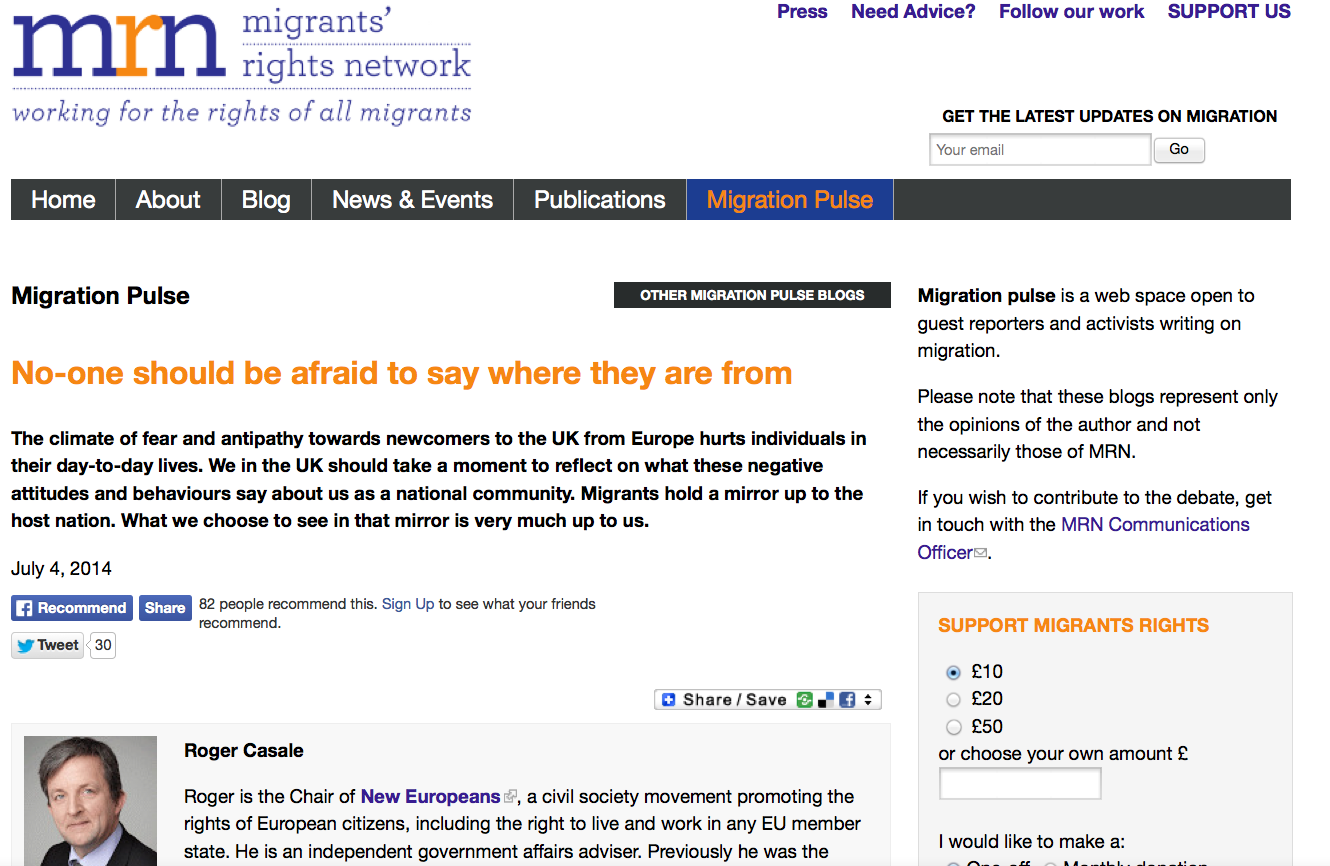
The climate of fear and antipathy towards newcomers to the UK from Europe hurts individuals in their day-to-day lives. We in the UK should take a moment to reflect on what these negative attitudes and behaviours say about us as a national community. Migrants hold a mirror up to the host nation. What we choose to see in that mirror is very much up to us.
Näyttökuva 2014-7-8 kello 6.49.16

Read original blog entry here.


At the beginning of April, a young woman came to my door collecting for Battersea Cats and Dogs Home. We have one dog and two cats in our house so we struck up a good conversation.

It turned out that the young woman was a trained lawyer, about to start a Masters course at UCL. “That’s wonderful” I said,  “I noticed a slight accent in your voice, do you mind if I ask where you were born?”

“I’m afraid I can’t tell you that” the young woman replied “ in Britain it is considered a weakness if you come from my country”.

It may me feel very uncomfortable to think that things had got to this point in Britain.

This young woman, with so much to offer this country, felt that the climate of opinion was so negative in Britain – and this in London – that she was unable to acknowledge where she came from.

“Well you’ve knocked on the right door,” I replied, “because I am part of an organisation called New Europeans, which is working with other groups to change the narrative on migration.”

The young woman’s name is Mihaela. I gave her the contact details for New Europeans and she then told me she is from Romania and offered to help with our campaigns.

“Thank you, I said, we need you, but don’t get distracted from your studies! The UK also needs your contribution and I wish you every success!”

Two years ago, we all celebrated with the world at the London Olympics. Britain showed a face that was warm, open, tolerant, welcoming and strong.

Above all, we celebrated our diversity as a nation – our unity in diversity. There were no trucks driving around the streets at that time with pointy fingers telling immigrants to go home.

One reason why this nation needs migration is because men and women from other countries help to remind us who we are.

They hold the mirror up to us. We see our shortcomings but we also see our own potential, including our potential for change.

The challenge of change upsets many people – the idea that things can be done differently, that life doesn’t always have to go on as before.

The migrant, the outsider, represents change, embodies change in the journey he or she has made to be with us in Britain today.

Without migration, Britain can neither sustain its economy and public services nor grow as a nation and as a community.

We are fortunate in Britain that we are a country of migration, a nation of migrants.

We are fortunate in Britain that we are a country in which you can still breathe the air of freedom.

We are fortunate in Britain that people like Mihaela come here to study, to work and to contribute to our society.

This does not make the British better or worse than anybody else – but it does mean that we are a nation, which is able to understand and celebrate difference. Migrants remind us who we are.

New Europeans have joined the Migrants Contribute campaign because we firmly believe that migration is a powerful and positive force in our society.

It is high time that we the ‘open’, ‘tolerant’, ‘fair-minded’, ‘diverse’, British were shaken up and reminded of that fact.

And as for the politicians who play politics with the issue of migration – well in my view, we need to send a clear, simple, co-ordinated message with these three words “Don’t you dare!”.

We want to live in a country where Mihaela and others like her feel comfortable and proud to say where they come from, don’t we?

Read original story here.

This piece was reprinted by Migrant Tales with permission.


* Roger Casale is the Chair of New Europeans, a civil society movement promoting the rights of European citizens, including the right to live and work in any EU member state. He is an independent government affairs adviser. Previously he was the Labour MP for Wimbledon and a parliamentary private secretary in the Foreign Office.

Four in five Swedes express concern over xenophobia

Posted on June 28, 2014 by Migrant Tales

Swedes are more worried about the rise of xenophobia in their country than the ever-growing number of immigrants, according to The Local, citing a study by the SOM Institute of Gothenburg University. The survey revealed that while 49% expressed concern over immigration levels, 78% were worried about the rise of xenophobia. 

Näyttökuva 2014-6-28 kello 13.32.15

Read full story here.

Writes The Local: The negative attitude towards xenophobia is likely due to the fact that the topic has been a hot one for the past two or three years, said Marie Demker, a political scientist, was quoted as saying.

“I noticed that people fell that xenophobia threatens society,” she said. “We talk an awful lot about xenophobia and there is also a strongly negative attitude to all forms of racism and xenophobia.”

Demker said that it was “quite clear” that her countrymen and countrywomen were more worried about attitudes towards immigrants and refugees than they were about foreigners themselves.

Compared with the “what do you think about immigrants” surveys carried out in Finland, we can learn a lot from Sweden. Instead of asking if Finland should increase the number of immigrants, why don’t we ask them their opinions about xenophobia? Irrespective if a country has few or many immigrants, few will say that there are too few immigrants, which reveals that these types of surveys have loaded questions.

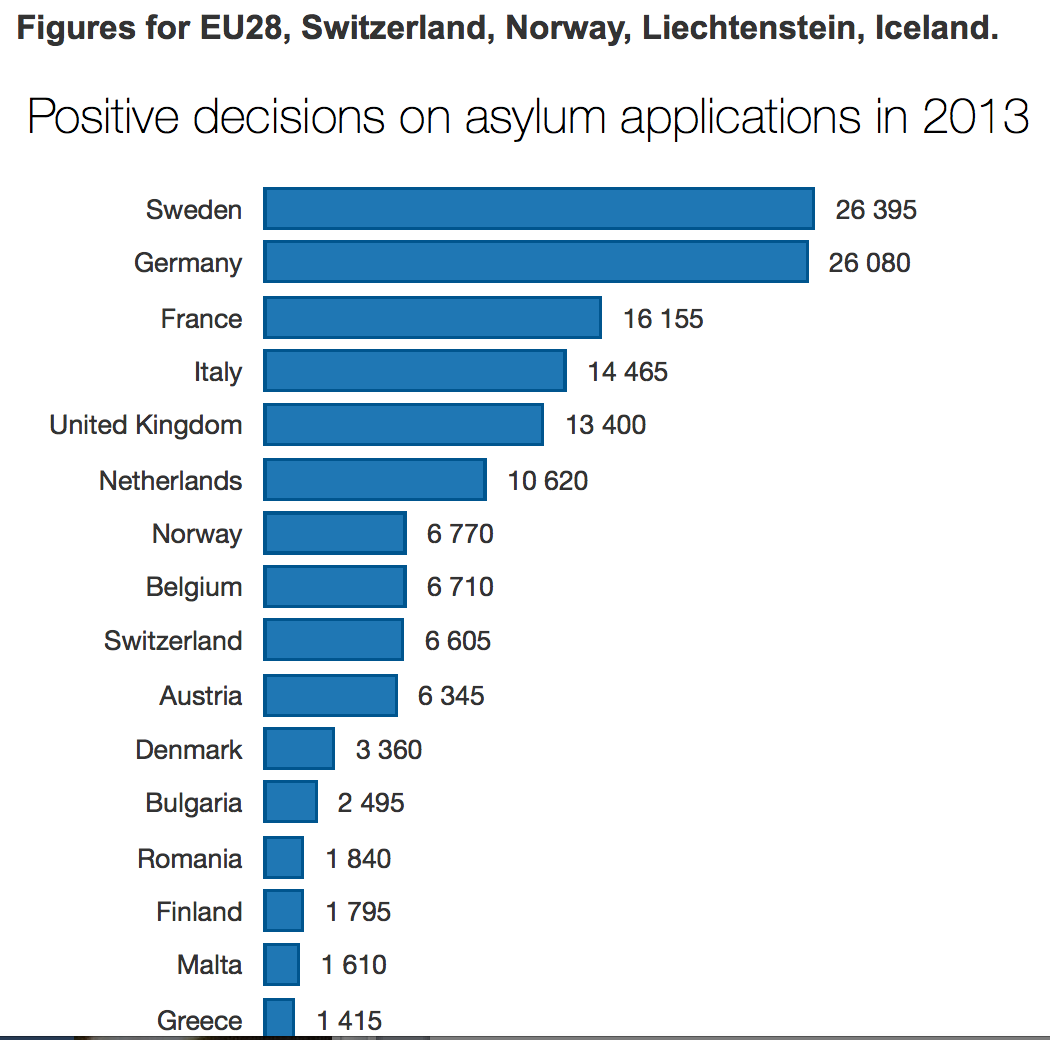
Meanwhile, Eurostat announced last week that Sweden took in 20% (26,395) of all asylum seekers in the EU in 2013. That was followed by Germany (26,080), France (16,155), Italy (14,495) and the United Kingdom (13,400).

Finland ranked 14th with 1,795.

Näyttökuva 2014-6-28 kello 13.06.15


Read full story here.

Anonymous: Against all odds human spirt cannot be crushed

Posted on June 9, 2014 by Migrant Tales

Migrant Tales insight: Anonymous is one of the many readers that not only visit our blogs but contribute their stories and poems. I’m not at liberty to disclose her identity but can vouch for her story. We have been in touch countless of times on the phone and she has told me her six-year ordeal in Finland many, many times. 

Anonymous has been put in an institution since they claim she suffers from paranoia. She disagrees with this diagnosis. Talking with her one matter shines: Anonymous is disappointed with herself for failing to integrate into Finnish society. By integration we mean getting a profession, job and learning how to stand on your feet economically and socially. Even so, she claims that she lived without any money from the social welfare office for 15 months and without any aid from Kela for 20 months. 

Sometimes as a journalist and writer there are life stories that are painful to write possibly because the pain and suffering is still too restless and too obvious. That is the case of Anonymous. 

I’m honored that Migrant Tales is your anchor of hope in a world that appears hopeless. If writing can move mountains, I hope it can help heal your pain and frustration. 

IMG_8659

____________________

By Anonymous

The story that is so difficult to believe yet so disturbingly real. When a migrant woman’a pathway towards integration turns to one of disintegration, where she is caught in a twisted hair battle across the welfare spectrum after turning down two job proposals due to studies overwhelming workload, her four-and-half-year ordeal is still tragically going on today.  

Unfortunately it deliberately cultivated hate for a lengthy period. Given the fact that, in such an economic climate where the unemployment rate is high, acquiring any form of employment is usually a golden opportunity or a dream come true. On the other hand, I would have been willing to avail my services to these institutions were it not, for the nature of my studies being quite demanding, required at least 110 percent of my energy. Paradoxically, I was thinking in terms of education as an investment and having a stable future career that would offer job security. In my opinion, being a translator is usually a temporary job and is based on a need-by-need basis.

Eventually, this news wasn’t received well by the social workers. It created a stalemate and invited hostilities across the welfare peripherals. My housing assistance was subsequently cut a month after arrival in the city which I call home and reimbursement of all outstanding payments were delayed and put on hold for the sole purpose of causing hardship and a cycle of deprivation.

While my own social worker says “they can’t help you,” the utterance becomes a common rhetoric across welfare sectors from migrant office to labour office. With only unemployment benefit at that time of only 414 euros a month and having other huge expenses, I had to stretch my budget to the limits and make a lot of sacrifices. I ended up living under less than 3 euros per day for almost four months. Three years later, after being asked if I am still studying social work, of which they are aware, because they usually ask me to submit my performance certificate, I am taking a risk with the officials at the labour office when I fill out the form. I’m told that if I fill it, I will only get assistance for one month and then after that they’ll decide whether to extend it or not. The official adds: “We cannot help you” or “can Kela help you,” which is a familiar phrase across the welfare establishment.

Paradoxically, my attempt to seek further assistance for a period of 40 days failed and I had to live without any formal assistance. I couldn’t pay the rent, the electricity was cut off as well.

I then later received a negative response for unemployment benefits from the labour office and a negative response for labour market subsidy from Kela. These continuous discouraging decisions gave me the impetus not to enroll as a jobseeker anymore. So from November 2012 until now whilst from December 2012, due to misinformation from the welfare office to get me back again into the system which by then was the only remaining source of benefits at the time for me, I had to indicate that I’m a full time student entitled to study-assistance, state-guaranteed loan and should therefore seek assistance from Kela.

Having gotten used to the mind-cheese-games and the manipulative tactics of the social workers, I didn’t apply for the above, since they were well aware that I wasn’t again eligible for such benefits.  This strategic play continued for a period of consecutively three months hung a warning: If I didn’t apply for these subsidies  I may end-up with a rejected income-assistance decision. The bottom line was that if I didn’t have any income I wouldn’t be able to pursue my studies and get a career.

Institutional racism at fore

Survival a struggle at the core

career battle like a septic sore

considered an enemy-adore

assistance slash at the pore

every day life becomes a chore

aspirations will wore

pathological interest the roots of truth tore

and render her homeless furthermore

nothing left, asks what else in store?

Aware of these repercussions, I had to forgo living under uncertainties, being a welfare slave and thus, had to prepare myself for the inevitable with equanimity come what may!  Consequently I ended up being considered an adored enemy spreads through all welfare sectors and its arrays of influence to the extent that, even due to misinformation and disinformation being ignorant with good grades, I was asked to redo some courses and as a result ended up losing a precious year.

Then again, with excellent grades, I was once again denied a place at the same nearby higher institution of learning. Thus the race to accomplish it ran into serious speed bump. Have all gone well, it would have been an accomplishment. I would have earned a master’s degree in social work at the end of this year after only being in Finland for six years. However, I encountered considerable resistance (gone far …too fast… needed to be pushed back). Worst and above all, being ambitious yet still attracted hostility, my sheer hard work and dogged perseverance becomes my handicap creating atrocious situations for me. Due to the battle to preserve a career I am unable to accomplish an equivalent of a bachelor’s degree. Evidently, I am seen as a rival across the welfare peripherals and told, I’m taking a risk to pursue a career of my choice.

Her choice has no voice,

her choice is not like Sanna’s or Joice

for her aspirations she can’t rejoice

it extremely creates a loud noise.


Migrant Tales (March 21, 2013): Some immigrants adapt so well to Finland that they even parrot the language of the racist

Posted on December 23, 2013 by Migrant Tales

Intolerance doesn’t only originate from the majority group, but is alive and kicking among some immigrants as well. White immigrants may have prejudices against their fellow black ones, gays against heterosexuals, religion x against religion y.  In sum, there’s a lot of intolerance promoted out there that reveals itself in the most surprising places. 

Read original column here.

One of the pillars of  our integration program in Finland should be to teach immigrants how to live in a culturally diverse society and the importance of mutual acceptance and respect for others. This may be easier said than done, taking into account that immigration and cultural diversity are new to some Finns.

Here’s the crux of the problem: If we don’t practice what we teach we encourage at the end of the day newcomers to hold the same negative values as us. Don’t we make a mockery of our own values like social equality (tasa-arvo) if we don’t practice what we preach?

Some immigrants have adapted so well to our society that they even parrot the language and jokes of those that loathe them.

I was quite surprised to hear an immigrant make a joke about another immigrant.

Here’s what he said: There was a bomb explosion at a white Finns’ and immigrants’ home. Why didn’t the Finns die?

Answer: Because the Finns were at work and their children at school. The immigrants were all at home because neither their parents were employed nor did their children attend school.

What?!

A black unemployed immigrant telling such a tasteless “joke” about other immigrants in Finland?

As far as our integration program is concerned, it got a big “FAIL” with this person.

Sad but true.

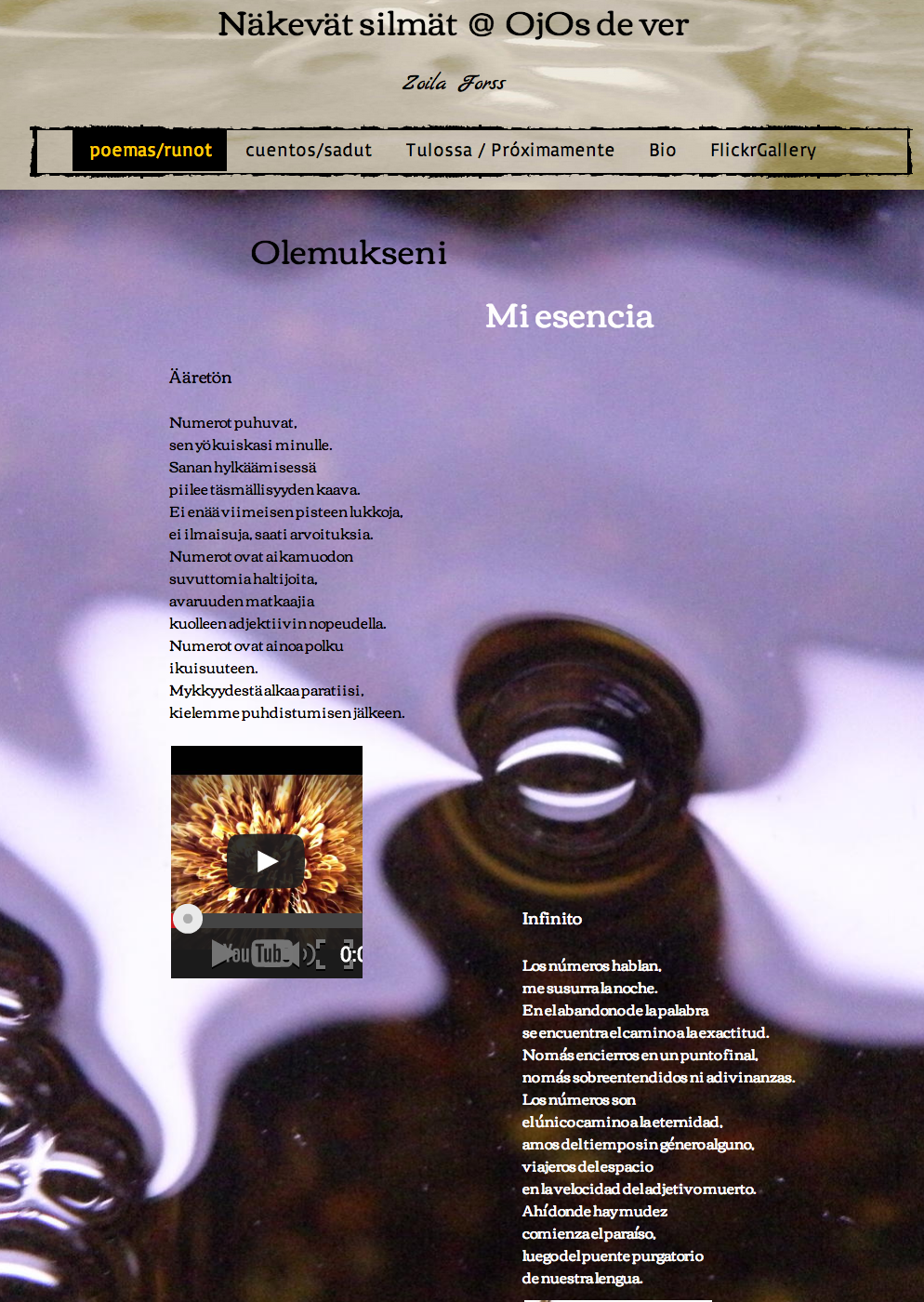
Migrant Tales Literary: Zoila Forss – Infinito, Ääretön

Posted on December 21, 2013 by Migrant Tales


Kuvankaappaus 2013-12-21 kello 23.38.10

Zoila Forss es una poeta peruana que vive en Finlandia pero que se muda con su familia al Perú por un año a principios de enero de 2014.  Leer a Zoila es transportarse a los  paisajes personales de una persona que vive simultáneamente en dos países. Puede leer su blog, Ojos de ver/Näkevät silmat, aquí.

Infinito??

Los números hablan,
me susurra la noche.
En el abandono de la palabra
se encuentra el camino a la exactitud.
No más encierros en un punto final,
no más sobreentendidos ni adivinanzas.
Los números son
el único camino a la eternidad,
amos del tiempo sin género alguno,
viajeros del espacio
en la velocidad del adjetivo muerto.
Ahí donde hay mudez
comienza el paraíso,
luego del puente purgatorio                                                                                                de nuestra lengua.?

Esta poesía fue publicada con permiso de la autora. 

Escucha a la poesía aquí/kuuntele runo tässä.

______________________

Ääretön?

Numerot puhuvat,                                                                                                                    sen yö kuiskasi minulle.                                                                                                Sanan hylkäämisessä                                                                                                       piilee täsmällisyyden kaava.                                                                                             Ei enää viimeisen pisteen lukkoja,                                                                                ei ilmaisuja, saati arvoituksia.                                                                          Numerot ovat aikamuodon                                                                          suvuttomia haltijoita,                                                                                            avaruuden matkaajia                                                                                                kuolleen adjektiivin nopeudella.                                                                  Numerot ovat ainoa polku                                                                        ikuisuuteen.                                                                                                          Mykkyydestä alkaa paratiisi,                                                                       kielemme puhdistumisen jälkeen.

Tämä runo julkaistiin Migrant Talesissä luvalla.


Does social welfare hinder or encourage migrants to integrate into Finnish society?

Posted on November 27, 2013 by Migrant Tales

Abdi Osman, 44, a naturalized Finn who came to Finland fifteen years ago with 50 dollars in his pocket from his native Somalia via Moscow, is a good example of how refugees and immigrants bring vitality to the economy. His story is that of millions of other immigrants and refugees who made it in their new homelands. 

Kuvankaappaus 2013-11-27 kello 12.13.51

Read full story here.

There are, however, millions of immigrants who don’t make it and are exploited in their new homelands. This is sadly even the case in Finland, where some immigrant workers have been paid starvation wages or end up being marginalized.

There are the Osmans as well. He runs a construction company that employs 60 people, generates annual turnover of 1.4 million euros that makes a net profit of about 200,000 euros, according to Jyväskylä-based Keskisuomalainen.

One of the controversial points the businessman says is that he would not pay asylum-seekers any welfare or teach 40- and 50-year-olds Finnish.

”The best workers are those that don’t get welfare,” he was quoted as saying. ”I have sixty people working for me. If they got welfare tomorrow, none of them would turn up at work.”

While work was a way for Osman succeed in Finnish society, it can’t be an all-size-fits-all answer for integrating immigrants. It’s like telling the unemployed to establish a business. For some it may work while for others it could spell disaster.

Don Flynn of the Migrants’ Rights Network makes an excellent point on how deregulation is the main culprit in the UK when it comes to watering down workers’ rights and wages:

The presence of migrants provides us with the opportunity to marvel at the apparently heroic efforts of this one group of workers to drag out subsistence from the conditions of their lives at the same moment when we blind ourselves to the fact that there are now hundreds of thousands of people who are not migrants who are being pitched into exploitative labour markets in the expectation that they will find some sort of a way to scratch out an existence on wages which are now widely acknowledged to be below levels needed to secure a decent life for any individual and her dependents.

Our response to such a scenario in Finland should be constant vigilance that we defend our basic rights.

When it comes to integration and adaption of immigrants in a new homeland, we have to be careful about simplifying matters. If things were as simple as Osman claims, then we would have solved all our integration problems in an instant.

While the businessman’s views sound like that of the Youth League of the National Coalition Party, he does raise an interesting point on how social welfare is used to marginalize migrants, reinforce institutional racism and the status quo.

By the status quo I mean no rocking the boat and keeping matters as they are. One of the ways of keeping the status quo is to pay migrants welfare without taking serious steps to promote their integration into society by helping them to get work and build a future in this country.

Like amongst Finns, migrants on welfare constitute a minority.

Even so, our social welfare is an important right and gesture by society that nobody should be left behind.


Dana: Why doesn’t President Sauli Niinistö care about immigrants? What’s his stance on racism?

Posted on October 23, 2013 by Migrant Tales

Dana

OLYMPUS DIGITAL CAMERA

Finland is a small country but a very proud one about its political and legal system. Some Finns believe they are, however, so different from other people on this planet and they can’t explain why.

For example…in Finland the law functions like magic; they believe that the law is so comprehensive that no-one in this country can behave in a racist manner and make the same mistake over and over again.

You can ask questions about the political and legal system but no-one will answer your questions…the Finnish system is supposed to respect human rights and give you a lot of freedom but still there’s a reject stamp on each question you ask, especially if it’s about family reunification.

This blog entry is about Sauli Niinistö, the President of Finalnd.

I have never seen him once organize a seminar or meeting with our immigrant community. Have you?

Why hasn’t he??? Is there a Finn that can answer this question? What about a foreigner?

What does Niinistö think about immigrants, refugees, or about me as a foreigner who lives here?

Who knows? Come on! Hands up! Speak up! Why doesn’t anyone ask this question to Niinistö: “Why don’t you speak up and defend our ever-growing culturally diverse society? Why haven’t you shown any interest in us, immigrants and refugees alike?

IS IT FEAR MR PRESIDENT???

Or is it because we are still such a small community that you still haven’t noticed that we’re here?

Small in size maybe but in which respect? In values, in will?

Do you have any news or information about the president’s new, even old thoughts about foreigners?

Can Niinistö understand my suffering – or aren’t I worthy of his attention?

He’s been president of Finland for some time. During his mandate he has hosted Independence Day celebrations at the Presidential Palace. He’s been seen dancing among supermen and superwomen on that day. Everyone has their eyes on him. The media watches him like white on rice but they don’t speak about anything else except how he’s dressed.

I believe the media in this country is materialistic because it is more interested in expensive clothes than in the suffering of others never mind growing social problems like poverty.

Niinistö went on official trips abroad, here and there; he spoke about different things but he NEVER EVER noticed our community, us foreigners, his neighbors who live in same country.

Tell me WHY??????

The rich people of the UAE are just like him. Since the Finnish governments needs money, they only respect rich foreigners from countries like the UAE.

No-one can call me a second-class citizen of this country. I am first-class and will always be no matter what anyone does.

In a nutshell, this is the course of humanity in Finland: Some treat me well while others look down on me.

Those that want to relegate me to the lower human leagues make my blood boil!

Migrants’ life in Finland: Some endure intolerance better than others – some hit back, others don’t

Posted on October 20, 2013 by Migrant Tales

The ocean is a desert, with it’s life underground
And a perfect disguise above.
Under the cities lies, a heart made of ground,
But the human will give no love.

A Horse with No name, America

Intolerance, bigotry, racism, prejudice and a list of other social ills strike their victims in different ways. Some of us can endure such hostility better than others, even when it lashes out at you at the right moment when you make the wrong move. 

You can get in trouble with the order of things when you question your hapless predicament. If you choose the normal route, or not to rock the boat, some recommend that you grin and bear the situation and remember that you are the one being watched, not the thing that is watching you and giving you the short end of society’s stick.

It’s like being on a horse with no name in the desert with not even a shred of evidence to make a case in your defense. Under the perfect disguise of the desert above, lies concealed the source of the loathing and prejudices, deep underground.

Kuvankaappaus 2013-10-20 kello 12.11.41

Listen to full song with lyrics here.

Dana is one of Migrant Tales’ frequent visitors. She has contributed beautiful poetry and shared her grief, when her mother and father died in May and July, respectively.

She blames the system for “killing her parents.” The system, which makes family reunification in this country like winning the lottery, didn’t even grant her the opportunity to see and feel the warm embrace and love of her parents before they died.

Those who have been victims of racism and discrimination, understand what is meant by sensing hostility. It’s like bad karma, telepathic messages from Pandemonium, a defense mechanism that warn you that you are now under attack.

No, you don’t understand what I mean. You cannot feel Dana’s pain or that of others like her because too many of us are too white to grasp that kind of pain.

Some of us deny its existence if we can’t feel other people’s suffering. Denying racism is the new racism.

Writes Dana: “If your mind is dirty, how can u make peace with anyone? If ur mind is dirty, how can you make peace??? If I think my color, my race, my blue eyes are better than your black and darker ones, then I’m a very sick person. That sickness will poison your blood and make you cranky, sick and put you at war – that’s the problem. Why can’t you see that a black person is also a human. What’s wrong with a black person???”

Dana told me that for the last six years she has been fighting back. Whenever she feels that people attack her with their hostile looks or comments, she doesn’t run away in silence but turns to her attackers and calls them, “racist.”

The reaction she gets is mixed and people either ignore her, threaten (and sometimes do) call the police and security guards, or call her a “terrorist” who should be kicked out of the premises and Finland.

“I’ve learned a lot from the time that the police arrested me at the social-welfare office,” she says. “I make an escape before anyone can detain me. I won’t take this kind of hostility any longer. I always fight back in public.”


Migrant Tales Literary: Foreigner

Posted on September 25, 2013 by Migrant Tales

By Musimenta Dansila

you call me

in your eyes a foreigner

I am to mother earth

are we not all?

as a foreigner

I stand declare

mother earth to be mine

as a foreigner

you despise me

you segregate me

you scorn me

but isn’t mother earth for all?

as a foreigner

I refuse to be caged

I shall sough my seeds

they will be kissed

by the sun

all over the earth

a foreigner’s seed

will expand

embrace,

feed your heart

with warmth

foreigners we all are

to mother earth!

Does Finland promote two-way or one-way adaption of immigrants?

Posted on September 21, 2013 by Migrant Tales

Our integration law promotes two-way adaption as opposed to assimilation, which is a one-way process. Section 17 of the Finnish Constitution states that each person living in this country has the right to maintain and develop their own language and culture. What do these two important laws mean in practice and how are they applied?

Sensible Finns understand what cultural diversity implies but a poll published by Helsingin Sanomat Friday shows that 53% fully (22%) or partially agreed (31%) that immigrants should aim at becoming as Finnish as possible. That compares with 48% in 2011 an 37% in 2006.

While these types of surveys are problematic because they reveal more the prejudices of the respondents, market research companies and the newspapers that publish the poll results, it shows, among other things, general expectations that give little to no insight on how to move ahead as our society becomes more diverse.

What does being Finnish imply never mind mean? Are we using the nineteenth century cultural yardstick or a totally different one in this century to make our society more inclusive to new groups who are and want to be Finnish according to their cultural backgrounds?

The crux of the matter, in my opinion, is that our ideal is two-way adaption but the rule is one-way assimilation.

This can be even be seen in our exemplary educational system, where we still promote “us” and “them” by openly labeling third-culture pupils as children “with immigrant backgrounds” (maahanmuuttajataustainen).

I personally believe that Finland is on the right track and should continue to promote and defend its present laws that ensure cultural diversity.

If you think of it, the whole debate on immigration and refugees presently taking place in this country hinges on one important point: acceptance of cultural diversity. Do we accept people moving to our country who are from different cultures? What must we give up in order to accommodate these new groups and what must these newcomers do to be included?

We have always spoken of two-way acceptance and respect on Migrant Tales. Why? Because it is inclusive and the most effective way to integrate people.

Why would you want to have a system that fuels prejudice and intolerance? At the end of the day our prejudices will cost us dearly because they will fuel social exclusion and high unemployment already so evident in many European countries.

Even if Finland is a society that has the right tools and resources to promote two-way acceptance and respect between groups, or cultural diversity, our prejudices continue to be part of the problem. They don’t permit us to have a clearer bigger picture of how to move ahead.

The answers and models that can be employed are lying right under our very noses. We have good laws and Nordic democratic values in this country to build a vibrant society where we can celebrate our diversity.

The challenge then is applying these laws and values to include Finland’s new inhabitants.

It’s that simple.

  • Previous
  • 1
  • 2
  • 3
  • 4
  • 5
  • …
  • 8
  • Next
Read more about documentary film
Read more

Recent Posts

  • Finland’s tabloids Iltalehti and Ilta-Sanomat are the pits
  • Riikka Purra’s Dr Jekyll and Mr Hyde mask
  • Double standards
  • Perussuomalaiset: Uusi logo, sama vanha juttu
  • Taco Trump

Recent Comments

  1. Absolutely Socking: Racist Finnish Facebook group against human rights gets flooded with socks on Musta Barbaari’s mother and sister charged by the police in “ethnic profiling” case
  2. Ilkka Nuotio on Pekka Myrskylä: “Tilastot kertovat toista kuin poliittinen keskustelu”
  3. Genrih Soinkara on The war in Ukraine and the Russian-Finnish border crisis are showing Finland’s ugly side
  4. Ahti Tolvanen on Comment by Ahti Tolvanen on the Helsinki +50 conference
  5. Angel Barrientos on Angel Barrientos is one of the kind beacons of Finland’s Chilean community

Archives

  • June 2026
  • May 2026
  • April 2026
  • March 2026
  • February 2026
  • January 2026
  • December 2025
  • November 2025
  • October 2025
  • September 2025
  • August 2025
  • July 2025
  • June 2025
  • May 2025
  • April 2025
  • March 2025
  • February 2025
  • January 2025
  • December 2024
  • November 2024
  • October 2024
  • September 2024
  • August 2024
  • July 2024
  • June 2024
  • May 2024
  • April 2024
  • March 2024
  • February 2024
  • January 2024
  • December 2023
  • November 2023
  • October 2023
  • September 2023
  • August 2023
  • July 2023
  • June 2023
  • May 2023
  • April 2023
  • March 2023
  • February 2023
  • January 2023
  • December 2022
  • November 2022
  • October 2022
  • September 2022
  • August 2022
  • July 2022
  • June 2022
  • May 2022
  • April 2022
  • March 2022
  • February 2022
  • January 2022
  • December 2021
  • November 2021
  • October 2021
  • September 2021
  • August 2021
  • July 2021
  • June 2021
  • May 2021
  • April 2021
  • March 2021
  • February 2021
  • January 2021
  • December 2020
  • November 2020
  • October 2020
  • September 2020
  • August 2020
  • July 2020
  • June 2020
  • May 2020
  • April 2020
  • March 2020
  • February 2020
  • January 2020
  • December 2019
  • November 2019
  • October 2019
  • September 2019
  • August 2019
  • July 2019
  • June 2019
  • May 2019
  • April 2019
  • March 2019
  • February 2019
  • January 2019
  • December 2018
  • November 2018
  • October 2018
  • September 2018
  • August 2018
  • July 2018
  • June 2018
  • May 2018
  • April 2018
  • March 2018
  • February 2018
  • January 2018
  • December 2017
  • November 2017
  • October 2017
  • September 2017
  • August 2017
  • July 2017
  • June 2017
  • May 2017
  • April 2017
  • March 2017
  • February 2017
  • January 2017
  • December 2016
  • November 2016
  • October 2016
  • September 2016
  • August 2016
  • July 2016
  • June 2016
  • May 2016
  • April 2016
  • March 2016
  • February 2016
  • January 2016
  • December 2015
  • November 2015
  • October 2015
  • September 2015
  • August 2015
  • July 2015
  • June 2015
  • May 2015
  • April 2015
  • March 2015
  • February 2015
  • January 2015
  • December 2014
  • November 2014
  • October 2014
  • September 2014
  • August 2014
  • July 2014
  • June 2014
  • May 2014
  • April 2014
  • March 2014
  • February 2014
  • January 2014
  • December 2013
  • November 2013
  • October 2013
  • September 2013
  • August 2013
  • July 2013
  • June 2013
  • May 2013
  • April 2013
  • March 2013
  • February 2013
  • January 2013
  • December 2012
  • November 2012
  • October 2012
  • September 2012
  • August 2012
  • July 2012
  • June 2012
  • May 2012
  • April 2012
  • March 2012
  • February 2012
  • January 2012
  • December 2011
  • November 2011
  • October 2011
  • September 2011
  • August 2011
  • July 2011
  • June 2011
  • May 2011
  • April 2011
  • March 2011
  • February 2011
  • January 2011
  • December 2010
  • November 2010
  • October 2010
  • September 2010
  • August 2010
  • July 2010
  • June 2010
  • May 2010
  • April 2010
  • March 2010
  • February 2010
  • January 2010
  • December 2009
  • November 2009
  • October 2009
  • September 2009
  • August 2009
  • July 2009
  • December 2008
  • November 2008
  • October 2008
  • September 2008
  • August 2008
  • July 2008
  • June 2008
  • May 2008
  • April 2008
  • March 2008
  • February 2008
  • January 2008
  • November 2007
  • October 2007
  • September 2007
  • August 2007
  • July 2007
  • June 2007
  • May 2007

Categories

  • ?? Gia L?c
  • ????? ?????? ????? ???????? ?? ??????
  • ???????
  • @HerraAhmed
  • @mondepasrond
  • @nohatefinland
  • @oula_silver
  • @Varathas
  • A Pakistani family
  • äärioikeisto
  • Abbas Bahmanpour
  • Abdi Muhis
  • Abdirahim Hussein Mohamed
  • Abdirahim Husu Hussein
  • Abdirisak Mahamed
  • About Migrant Tales
  • activism
  • Adam Al-Sawad
  • Adel Abidin
  • Afrofinland
  • Ahmed IJ
  • Ahti Tolvanen
  • Aino Pennanen
  • Aisha Maniar
  • Alan Ali
  • Alan Anstead
  • Alejandro Díaz Ortiz
  • Alekey Bulavsev
  • Aleksander Hemon
  • Aleksanterinliitto
  • Aleksanterinliitto ry
  • Aleksanterinliitto ry:n hallitus
  • Alex Alex
  • Alex Mckie
  • Alexander Nix
  • Alexandra Ayse Albayrak
  • Alexis Neuberg
  • Ali Asaad Hasan Alzuhairi
  • Ali Hossein Mir Ali
  • Ali Rashid
  • Ali Sagal Abdikarim
  • Alina Tsui
  • Aline Müller
  • All categories
  • Aman Heidari
  • Amiirah Salleh-Hoddin & Jana Turk
  • Amin A. Alem
  • Amir Zuhairi
  • Amkelwa Mbekeni
  • Ana María Gutiérrez Sorainen
  • Anachoma
  • Anders Adlecreutz
  • Angeliina Koskinen
  • Anna De Mutiis
  • Anna María Gutiérrez Sorainen
  • Anna-Kaisa Kuusisto ja Jaakko Tuominen
  • Annastiina Kallius
  • Anneli Juise Friman Lindeman
  • Announcement
  • Anonymous
  • Antero Leitzinger
  • anti-black racism
  • Anti-Hate Crime Organisation Finland
  • Anudari Boldbaatar
  • Arshiya Nasser
  • Aspergers Syndrome
  • Asylum Corner
  • Asylum seeker 406
  • Athena Griffin and Joe Feagin
  • Autism
  • Avaaz.org
  • Awale Olad
  • Ayan Said Mohamed
  • AYY
  • Barachiel
  • Bashy Quraishy
  • Beatrice Kabutakapua
  • Beri Jamal
  • Beri Jamal and Enrique Tessieri
  • Bertolt Brecht
  • Boiata
  • Boodi Kabbani
  • Bruno Gronow
  • Carmen Pekkarinen
  • Çelen Oben and Sheila Riikonen
  • Chiara Costa-Virtanen
  • Chiara Costa-Virtanen
  • Chiara Sorbello
  • Christian Thibault
  • Christopher Wylie
  • Clara Dublanc
  • Dana
  • Daniel Malpica
  • Danilo Canguçu
  • David Papineau
  • David Schneider
  • Dexter He
  • Don Flynn
  • Dr Masoud Kamali
  • Dr. Faith Mkwesha
  • Dr. Theodoros Fouskas
  • Edna Chun
  • Eeva Kilpi
  • Emanuela Susheela
  • En castellano
  • ENAR
  • Enrique
  • Enrique Tessieri
  • Enrique Tessieri & Raghad Mchawh
  • Enrique Tessieri & Yahya Rouissi
  • Enrique Tessieri and Muhammed Shire
  • Enrique Tessieri and Sira Moksi
  • Enrique Tessieri and Tom Vandenbosch
  • Enrique Tessieri and Wael Che
  • Enrique Tessieri and Yahya Rouissi
  • Enrique Tessieri and Zimema Mhone
  • Epäluottamusmies
  • EU
  • Europe
  • European Islamophobia Report
  • European Islamophobia Report 2019,
  • European Union
  • Eve Kyntäjä
  • Ezequiel Caldeiro
  • Facebook
  • Fadumo Dayib
  • Faisa Kahiye
  • Farhad Manjoo
  • Fasismi
  • Finland
  • Fizza Qureshi
  • Flyktingar och asyl
  • Foreign Student
  • Fozia Mir-Ali
  • Frances Webber
  • Frida Selim
  • Gareth Rice
  • Ghyslain Vedeaux
  • Global Art Point
  • Great Replacement
  • Habiba Ali
  • Hami Bahadori
  • Hami Bahdori
  • Hamid
  • Hamid Alsaameere
  • Hamid Bahdori
  • Handshake
  • Harmit Athwal
  • Hassan Abdi Ali
  • Hassan Muhumud
  • Heikki Huttunen
  • Heikki Wilenius
  • Helsingin Sanomat
  • Henning van der Hoeven
  • Henrika Mälmsröm
  • Hser Hser
  • Hser Hser ja Mustafa Isman
  • Husein Muhammed
  • Hussain Kazemian
  • Hussain Kazmenian
  • Ibrahim Khan
  • Ida
  • Ignacio Pérez Pérez
  • Iise Ali Hassan
  • Ilari Kaila & Tuomas Kaila
  • Imam Ka
  • inside-an-airport
  • Institute of Race Relations
  • Iraqi asylum seeker
  • IRR European News Team
  • IRR News Team
  • Islamic Society of Norhern FInland
  • Islamic Society of Northern Finland
  • Islamophobia
  • Jacobinmag.com
  • Jallow Momodou
  • Jan Holmberg
  • Jane Elliott
  • Jani Mäkelä
  • Jari Luoto
  • Jari Taponen
  • Jegor Nazarov
  • Jenni Stammeier
  • Jenny Bourne
  • Jessie Daniels
  • Joe Davidow
  • Johannes Koski
  • John D. Foster
  • John Grayson
  • John Marriott
  • Jon Burnett
  • Jorma Härkönen
  • Jos Schuurmans
  • José León Toro Mejías
  • Josue Tumayine
  • Jouni Karnasaari
  • Juan Camilo
  • Jukka Eräkare
  • Julian Abagond
  • Julie Pascoet
  • Jussi Halla-aho
  • Jussi Hallla-aho
  • Jussi Jalonen
  • JusticeDemon
  • Kadar Gelle
  • Kaksoiskansalaisuus
  • Kansainvälinen Mikkeli
  • Kansainvälinen Mikkeli ry
  • Katherine Tonkiss
  • Kati Lepistö
  • Kati van der Hoeven-Lepistö
  • Katie Bell
  • Kättely
  • Kerstin Ögård
  • Keshia Fredua-Mensah & Jamie Schearer
  • Khadidiatou Sylla
  • Khadra Abdirazak Sugulle
  • Kiihotus kansanryhmää vastaan
  • Kirsi Crowley
  • Koko Hubara
  • Kristiina Toivikko
  • Kubra Amini
  • KuRI
  • La Colectiva
  • La incitación al odio
  • Laura Huhtasaari
  • Lauri Finér
  • Leif Hagert
  • Léo Custódio
  • Leo Honka
  • Leontios Christodoulou
  • Lessie Branch
  • Lex Gaudius
  • Leyes de Finlandia
  • Liikkukaa!
  • Linda Hyökki
  • Liz Fekete
  • M. Blanc
  • Maarit Snellman
  • Mahad Sheikh Musse
  • Maija Vilkkumaa
  • Malmin Kebab Pizzeria Port Arthur
  • Marcell Lorincz
  • Mari Aaltola
  • María Paz López
  • Maria Rittis Ikola
  • Maria Tjader
  • Marja-Liisa Tolvanen
  • Mark
  • Markku Heikkinen
  • Marshall Niles
  • Martin Al-Laji
  • Maryan Siyad
  • Matt Carr
  • Mauricio Farah Gebara
  • Media Monitoring Group of Finland
  • Micah J. Christian
  • Michael McEachrane
  • Michele Levoy
  • Michelle Kaila
  • Migrant Tales
  • Migrant Tales Literary
  • Migrantes News
  • Migrants' Rights Network
  • MigriLeaks
  • Mikko Kapanen
  • Miriam Attias and Camila Haavisto
  • Mohamed Adan
  • Mohammad Javid
  • Mohammad M.
  • Monikulttuurisuus
  • Monisha Bhatia and Victoria Canning
  • Mor Ndiaye
  • Muh'ed
  • Muhamed Abdimajed Murshid
  • Muhammed Shire
  • Muhammed Shire and Enrique Tessieri
  • Muhis Azizi
  • Musimenta Dansila
  • Muslimiviha
  • Musulmanes
  • Namir al-Azzawi
  • Natsismi
  • Neurodiversity
  • New Women Connectors
  • Nils Muižnieks
  • No Labels No Walls
  • Noel Dandes
  • Nuor Dawood
  • Omar Khan
  • Otavanmedia
  • Oula Silvennoinen
  • Paco Diop
  • Pakistani family
  • Pentti Stranius
  • Perussuomalaiset
  • perustuslaki
  • Petra Laiti
  • Petri Cederlöf
  • Pia Grochowski
  • Podcast-lukija Bea Bergholm
  • Pohjois – Suomen Islamilainen Yhdyskunta
  • Pohjois Suomen Islamilainen Yhyskunta
  • Polina Kopylova
  • Race Files
  • racism
  • Racism Review
  • Raghad Mchawh
  • Ranska
  • Rashid H. and Migrant Tales
  • Rasismi
  • Raul Perez
  • Rebecka Holm
  • Reem Abu-Hayyeh
  • Refugees
  • Reija Härkönen
  • Remiel
  • Reza Nasri
  • Richard Gresswell
  • Riikka Purra
  • Risto Laakkonen
  • Rita Chahda
  • Ritva Kondi
  • Robito Ibrahim
  • Roble Bashir
  • Rockhaya Sylla
  • Rodolfo Walsh
  • Roger Casale
  • Rostam Atai
  • Roxana Crisólogo Correa
  • Ruth Grove-White
  • Ruth Waweru-Folabit
  • S-worldview
  • Sadio Ali Nuur
  • Sami Rusanen
  • Sandhu Bhamra
  • Sara de Jong
  • Sarah Crowther
  • Sari Alhariri
  • Sarkawt Khalil
  • Sasu
  • Scot Nakagawa
  • Shabana Ahmadzai
  • Shada Islam
  • Sharon Chang blogs
  • Shenita Ann McLean
  • Shirlene Green Newball
  • Sini Savolainen
  • Sira Moksi
  • Sonia K.
  • Sonia Maria Koo
  • Steverp
  • Stop Deportations
  • Suldaan Said Ahmed
  • Suomen mediaseurantakollektiivi
  • Suomen Muslimifoorumi ry
  • Suomen viharikosvastainen yhdistys
  • Suomen viharikosvastainen yhdistys ry
  • Suomi
  • Supermen
  • Susannah
  • Suva
  • Syrjintä
  • Talous
  • Tapio Tuomala
  • Taw Reh
  • Teivo Teivainen
  • The Daily Show
  • The Heino
  • The Supermen
  • Thomas Elfgren
  • Thulfiqar Abdulkarim
  • Tim McGettigan
  • Tino Singh
  • Tito Moustafa Sliem
  • Tobias Hübinette and L. Janelle Dance
  • Transport
  • Trica Danielle Keaton
  • Trilce Garcia
  • Trish Pääkkönen
  • Trish Pääkkönen and Enrique Tessieri
  • Tuulia Reponen
  • Uncategorized
  • UNITED
  • University of Eastern Finland
  • Uyi Osazee
  • Väkivalta
  • Vapaa Liikkuvuus
  • Venla-Sofia Saariaho
  • Vieraskynä
  • W. Che
  • W. Che an Enrique Tessieri
  • Wael Ch.
  • Wan Wei
  • Women for Refugee Women
  • Xaan Kaafi Maxamed Xalane
  • Xassan Kaafi Maxamed Xalane
  • Xassan-Kaafi Mohamed Halane & Enrique Tessieri
  • Yahya Rouissi
  • Yasmin Yusuf
  • Yassen Ghaleb
  • Yle Puhe
  • Yuliet Tresa
  • Yve Shepherd
  • Zahra Khavari
  • Zaker
  • Zalina Ametova
  • Zamzam Ahmed Ali
  • Zeinab Amini ja Soheila Khavari
  • Zimema Mahone and Enrique Tessieri
  • Zimema Mhone
  • Zoila Forss Crespo Moreyra
  • ZT
  • Zulma Sierra
  • Zuzeeko Tegha Abeng
© 2026 Migrant tales | Powered by Minimalist Blog WordPress Theme