I’m always surprised by the aha moment of the mainstream media when it comes to the hostile and polarizing message of the Perussuomalaiset (PS).* After PS Interior Minister Mari Rantanen was caught with her hand in the cookie jar by attempting to favor Christians over Muslims in the quota-refugee scheme, Finland’s biggest daily reported that between 2015-2022 the PS led all other parties by a long shot by addressing in parliament the term Islam.
Of the 199 times Islam was addressed in a parliamentary session, the PS brought it up 66.3% of the total followed by the Christian Democrats, which mentioned it 7.5% of the total.
Another favorite terms of the PS are “Muslim,” “Africa” and “Somalia,” which were brought up by the party 58.9%, 95.3% and 61.7% of the total, respectively.
Is it surprising that the non-discrimination ombudswoman findings on discrimination of Muslims over Christians in the quota refugees slammed the PS as “openly Islamophobic?”
An article in Mikkeli-based daily Länsi-Savo (10 August) interviewed three members of the Finns Party (PS) from the South Savo region who claimed that racism has no place in the party. If this is true, it is significant and welcome news.
In the face of the numerous racism scandals that have overshadowed the activities of the PS over the years and, at the latest, in July, the claim by the members of the party is fantastical. We believe that racism has historically been as important to the PS as the Swedish language is to the Swedish People’s Party.
But in the name of fairness, I (Tessieri) would like to thank the PS who, in the meetings of the Mikkeli City Council that I have attended, do not speak of immigrants in a demeaning way like their fellow MPs in parliament.
However, the PS is historically the first major contemporary Finnish party to have benefited from the polarization between different groups and to have attacked other ones, such as Muslims, Africans, and other non-EU nationals, as unequals.
Racism is a serious social illness in which groups of people are treated as inferior due to their ethnic origin, skin color, nationality, culture, or religion.
While the party may not necessarily recognize its immigration policy as racist, it is highly discriminatory. The changes proposed by the government, especially the PS, in the new policy promote inequality and make it more difficult for migrants to participate in our society as equals.
We also disagree with Jani Sension that this summer’s numerous racism scandals is something made up by the media.
If the racism scandals have highlighted an important point, it is the Finnish media’s important role in defending the rule of law and the fundamental rights of all people, regardless of background.
PS Minister of the Interior Mari Rantanen, who has also published racist and far-right posts and removed them from her social media sites, has said that the government’s immigration policy will undergo a paradigm shift.
We hope that in light of these racism scandals, the media will experience its own paradigm shift in its role as the nation’s watchdog and not leave a stone unturned in its important work.
Enrique Tessieri, Yahya Roussi
The authors are members of the board of Kansainvälinen Mikkeli, a registered associationpromoting diversity. Tessieri is also a deputy city councilperson of the Mikkeli City Council.
Finnish Broadcasting Company (Yle) published Saturday a story about two far-right youths belonging to the openly fascist and racist Blue-and-Black Movement (Sinimusta liike), and one to Suomen Sisu, which the authorities named in 2011 as “a Nazi-spirited association.” Thanks to the Yle article, the reader can read how much these so-called “radical nationalists” hate migrants.
Pyry-Lii Soinio is a twenty-two-year member of the Blue-and-Black Movement. He does not hide his loathing for outsiders. “I don’t think immigration should be restricted,” he said, “but [foreign] people should be deported altogether. I don’t care whether immigrants are good citizens or taxpayers. What matters to me is whether they are Finns.”
This is the third article that Yle has published on far-right members in the last three years. The first one was in 2019 by TV host Sean Ricks on far-right youths, followed by Suomineito in 2022.
Both stories received their fair share of criticism.
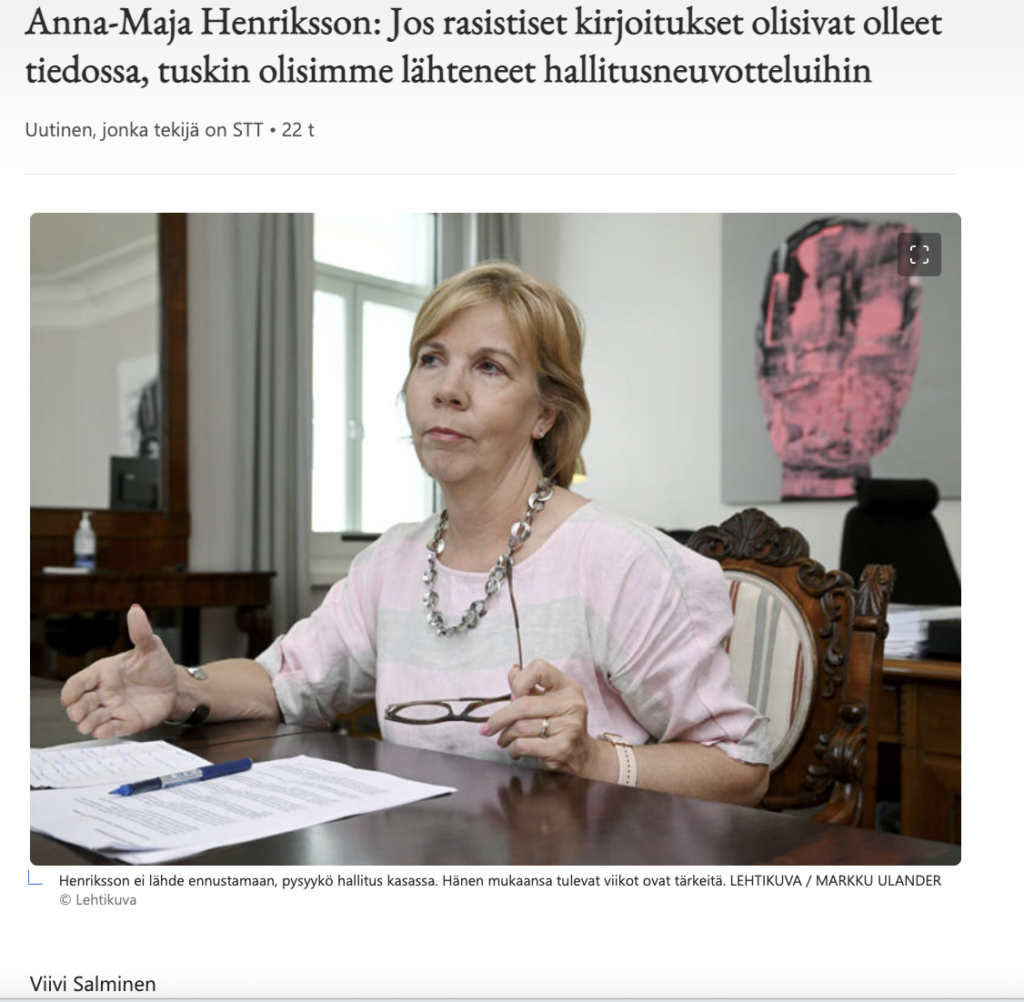
One of the most startling comments heard from politicians like Prime Minister Petteri Orpo and Anna-Maja Henriksson of the Swedish People’s Party (SPP) is that they were ignorant of the Perussuomalaiset’s (PS)* racist posts and comments on social media.
The claim by the head of the SPP left a lot of political analysts with open mouths.
“If the racist writings [by Ministers Riikka Purra and Wille Rydman] had been known, we would hardly have entered the government negotiations,” Henriksson was quoted by STT.
SPP Education Minister Anna-Maja Henriksson claims that her party would have never entered government negotiations if the racist writings of Riikka Purra and Wille Rydman would have been known. Source: STT.
Probably what Henriksson is saying is that if she’d known that the racist writings would have caused such a scandal, the SPP would not have entered into government negotiations.
But why didn’t the SPP, Orpo, the media and others take the duck test: If it walks like a duck, looks like a duck, and quacks like a duck, it’s a duck.
Denial of the PS’ racism problem and how it has spread in our society still runs deep. We know that it exists, but we do little to challenge it. Let’s just ignore it.
Even the daily of my hometown of Mikkel, had local PS politicians claimed that “racism has no place in the Perussuomalaiset party” and that the scandals are a media fabrication.
For too many years, the media has turned a semi-blind eye to many of the racist writings and comments by PS politicians. Like a cancer that spreads, they now acknowledge that something must be done. It’s as if Finland, not wanting to look at a dark side of itself, has now found the courage to face the mirror.
Everything isn’t lost and there are some encouraging signs. The fact that the media has exposed the racist writings of high-ranking politicians is not only welcome but vital if we are to live in a society where our Nordic values, enshrined in human rights, and the rule of law are respected.
As Migrant Tales correctly predicted, interest in the so-called “youth gang” problem has tanked in the media and social media after the parliamentary election. Twenty-threedays after and before the April 2 election, news on the topic by five media outlets (Helsingin Sanomat, Yle, MTV, Iltalehti, and Ilta-Sanomat) plummeted by 54.5% to five stories from 11, according to a Meltwater search. The most significant drop was seen on social media, diving by 87.4% to 314 posts from 2.56k.
The fall was even more pronounced for all media, sinking by 70.5% to 13 stories from 44 stories.
What do these figures tell us about the fake and exaggerated “youth gang” topic spread by the Islamophobic Perussuomalaiset and its National Coalition Party ally? That was a political stunt to attract voters with the help of fear-mongering. The media (more traffic), the police (more funds to fight crime), and politicians (get voters) all profited from the topic.
Just like in the last four parliamentary elections, narratives such as migrant crime spread by the far-right anti-immigration Finns Party (PS) paid off handsomely. It is not, however, the only reason why the PS was able to win a record 46 seats but was helped by the National Coalition Party, which won the election with 48 seats.
Despite the good result of the Eurosceptic party, the Social Democratic Party, which came in third place with 43 seats, Green League, Left Alliance and Swedish People’s Party announced they would not form a new government with the PS.
The election was a disappointment to underrepresented cultural, racial, ethnic, and religious groups. Especially parties like the PS, threatened to weaken the civil rights of minorities with a heavy hand.
PS head Riikka Purra made clear her worrying immigration stance on numerous occasions:
The PS will not form part of a government that does not tighten immigration policy further.
Stop people from outside the EU from moving and working in Finland.
Islam and white Finland are incompatible.
Seeking asylum is not a human right but a privilege.
Cultural programs are a luxury.
Nearly everything that does not work in society is due to poor immigration policy.
Long-term plan to exclude foreigners from getting social welfare.
Leave the European Union in the long term.
Harden criminal sentences, especially when migrants or minorities are involved.
It is important to note that many of these radical proposals breach human rights and Finnish law and can lead to further discrimination and inequality against minorities. Defending diversity and social equality in society are important to every member of society and political parties should work to uphold such rights.
In the face of these radical proposals by the Finns Party, it should not come to a surprise that some newspapers abroad like The Guardian, Le Monde, El País and other call, among other names, the PS a far-right party.
We believe in the media’s watchdog role to protect the rights of all people in Finland irrespective of their background. Unfortunately, watching the news and what is discussed on it after the election, reveals that civil and human rights are not high up on the priority list.
*Media Monitoring Group of Finland aims to promote fair and accurate reporting by the Finnish media of underrepresented cultural, racial, ethnic, and religious groups. As Finland’s cultural diversity continues to grow, the role of the media in forming public opinion and attitudes about minorities becomes even more relevant.
It is surprising how the foreign and local media treat the Perussuomalaiset (PS)*differently, even if The Guardian and El País of Madrid refer to the party as far right. Other adjectives are used, like Eurosceptic, nationalistic, and right-wing populist.
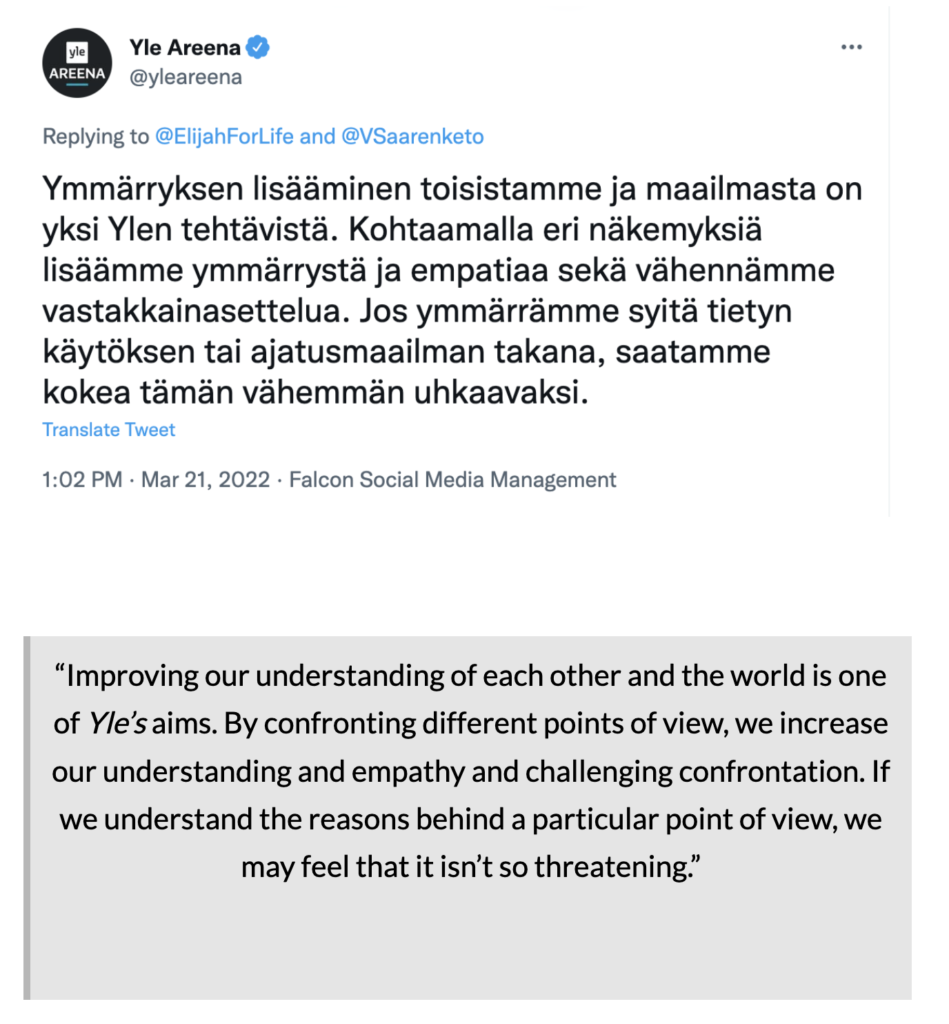
In Finland, we rarely, if ever, see such descriptions of the PS. Yle News, for example, refers to the radical right party as “nationalist.”
The fact that the media treats the PS as a “normal” party explains how its radical policies are becoming normalized.
Here are some things PS head Riikka Purra has spread recently:
The PS will not form part of a government that does not tighten immigration policy further.
Stop people from outside the EU from moving and working in Finland.
Islam and white Finland are incompatible.
Seeking asylum is not a right.
Cultural programs are a luxury.
Everything that does not work is due to poor immigration policy.
Only Finnish citizens can get social welfare.
Leave the European Union in the long term.
Harden criminal sentences, especially when migrants or minorities are involved.
If these are “normal” political opinions, they are nothing more than a betrayal of our most important values based on human rights and human dignity. The fact that the media appears not to take such opinions seriously, coming from the second-biggest party in Finland, reveals our country’s denial of the social ill.
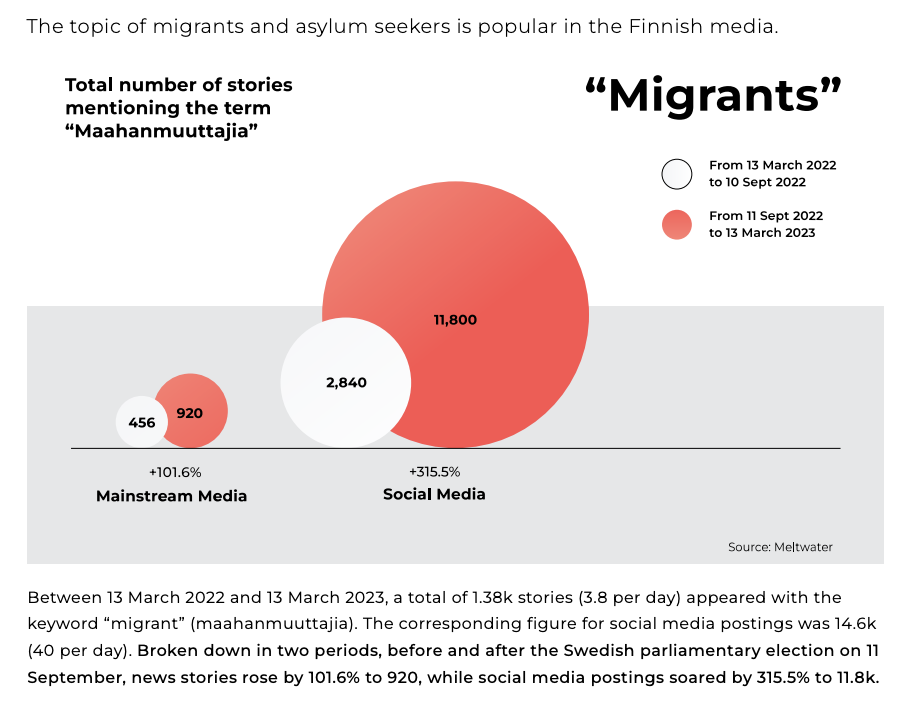
Looking at the number of stories written about the so-called youth gang problem in Finland, it is interesting to note that reporting of the issue by Yle doubled compared with the eight months of the year.
Stories about Sweden’s youth gang problem started to pick up in the fall after Sweden’s 11 September parliamentary election. Before the election (during 1 January-10 September 2022), Yle published 29 stories, but from 11 September to 16 February, the number of stories soared by 124% to 65.
The number of stories during those periods under review remains stable for Helsingin Sanomat, MTV, Ilta.Sanomat and Iltalehti.
Why did Yle its coverage of the topic? Are politicians pulling some strings behind the scenes?
Considering that we are in an election year and, due to past actions of the police and media in cities like Oulu, is the whole gang “problem” in Finland a storm in a teacup. Is it something that politicians from the Perussuomalaiset – excuse the language – pulled out of their asses? Is it similar to the stolen election lies spread by MAGA Republicans?
If it is true that the whole youth gang story is grossly exaggerated for political purposes, what responsibility does the media have for perpetuating the story?
Law enforcement institutions like the police, Finnish Border Guard, and others must make a case to acquire funds. What better way than to warn the public of a danger that does not yet exist but needs resources?
The media should do a better job and void being taken for rides by politicians and the police.
Those who are worried about the blow to the credibility of the security guards due to several scandals that even led to the death of a woman in Espoo are quick to point out one should not jump to conclusions and label all security guards and the sector.
True, we should always be careful not to generalize.
There is, however, something wrong with that defense. The same people who are saying that we must not generalize are the ones who constantly generalize about migrants.
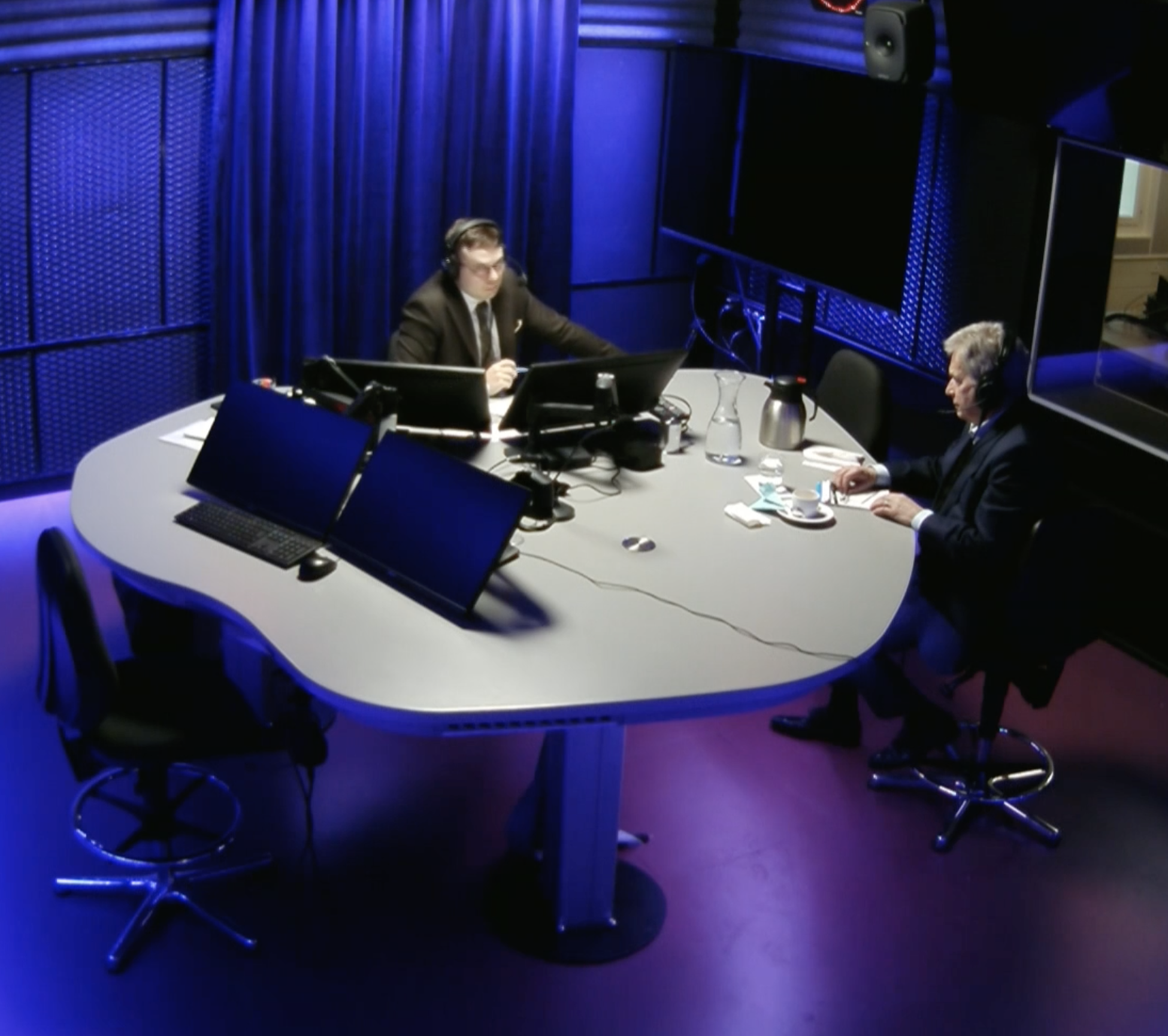
President Sauli Niinistö, who is no friend of Finland’s culturally diverse communities, added more feathers to tarred minority youths in the ongoing debate on youth crime. Source: Yle
Downplaying the problem is also an important part of the narrative about white crime versus crime committed by minorities.
After reading 77 stories published by Yle (9 stories), Helsingin Sanomat (19), Iltalehti (6), Ilta-Sanomat (30), and MTV (13) about the Avarn Security scandal, only one story alleges racism as a factor in the working culture of security guards. Another story by Ilta-Sanomat, which wrote about excessive force, only mentioned once a “person of foreign background” was apprehended by security guards.
Meanwhile, according to various media reports, a woman died on Saturday at Espoo’s Iso Omena shopping center. The woman was being escorted out of the shopping center by Securitas security guards. The police suspect that manslaughter is the cause of death.
Avarn Security guards holding down a victim. Source: Helsingin Sanomat.
While the youth gang stories hyped by the media have no problem labeling “persons of foreign background” as a source of the “problem,” there is no mention of ethnic profiling as a factor. Surprisingly, non of the 77 stories mention ethnic profiling at all.
Helsingin Sanomat asked in a story what the security guards’ motives were in using excessive violence and humiliating their victims. Another story by the daily alleged that excessive force is used against socially venerable and disadvantaged people.
What do they mean? The homeless? Drunks? Old people? People of color? Other minorities?