Migrant tales
Menu
  • #MakeRacismHistory “In Your Eyes”
  • About Migrant Tales
  • It’s all about Human Rights
  • Literary
  • Migrant Tales Media Monitoring
  • NoHateFinland.org
  • Tales from Europe
Menu

Tag: Europe

Migrant’s Rights Network: How the legacy of racism continues to make ‘others’ out of migrant people

Posted on July 7, 2015 by Migrant Tales

Anna De Mutiis* 

The ongoing crisis on the Mediterranean has shed light on an old unsolved – and clearly so often poorly addressed problem at the heart of Europe: namely its relation with its Other.

Europe’s favoured perspective seems to concentrate on a diplomatic, political or geopolitical crisis – as suggested by the very notion of a ‘Mediterranean’ crisis – which leaves aside the tragedy of human losses, drowned hopes, the expectation of finding shelter, and the dream of a safe place to live and the chance to survive.

Näyttökuva 2015-7-7 kello 13.38.44

Read full opinion piece here.

The European and International media have played a big role in how this tragedy has been appropriated and narrated especially to EU citizens. Even if some headlines have clearly condemned European powers for neglecting their responsibility and remaining indifferent to more than 28.000 death in the last 15 years, many media accounts rode on the old rhetoric (echoing Thatcherite themes) of fearing an ‘invasion’ of migrants.  The implication that ‘we can’t take them all’ contains the inevitable suggestion that we should let some, at least, die in the sea.

Continue reading “Migrant’s Rights Network: How the legacy of racism continues to make ‘others’ out of migrant people”

Who would you believe? PS MP Hakkarainen or the little girl at sea?

Posted on May 7, 2015 by Migrant Tales

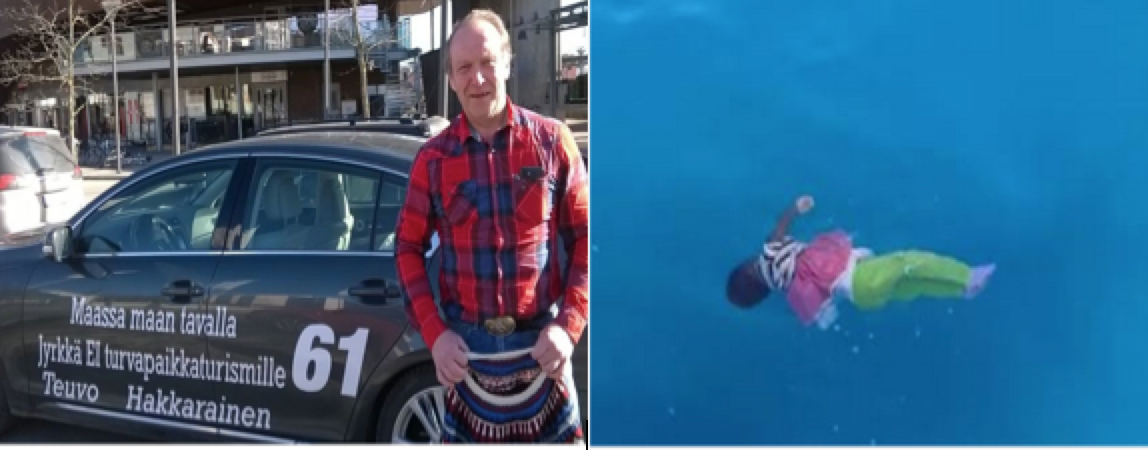
Who would it be? Perussuomalaiset (PS)* MP Teuvo Hakkarainen who got reelected below for claiming that newcomers should adapt or ship out of Finland and “a sharp no to asylum tourism,” or the silence of a little girl at sea? 

Yes, right, this is the very PS MP who sent an SMS message wth a picture of his phallus by cellphone and who likes to hang around the yellow press with his scandals made up or real. Yes, this is the MP who claimed a while back that Islam was a Trojan Horse invading Europe and that homosexuals, lesbians and Somalis should be relocated to the Åland Islands.

Let’s now ask the dead girl with the pink dress at sea below what she thinks about PS MP Hakkarainen’s claims.

Dead silence.

Näyttökuva 2015-5-7 kello 8.54.46


On the left PS MP Teivo Hakkarainen’s election campaign claiming that he’ll get migrants to adapt or leave and that he’s against so-called “asylum tourism.” Next to this PS MP is a dead girls with a pink dress, or one of these so-called “asylum tourists.”

Continue reading “Who would you believe? PS MP Hakkarainen or the little girl at sea?”

Migrant Tales (June 16, 2012): The crux of European racism – too little inclusion, too much race and blood

Posted on April 27, 2015 by Migrant Tales

Much of the way Europeans perceive themselves as a group today is still deeply embedded in racism. The fact that we haven’t yet even started to confront the legacy of colonialism, which fuels our ”us” and ”them” view of the world, reveals a disturbing fact: There’s still too little inclusion and acceptance in this part of the world. 

Sadder still is the fact that too few of us openly promote more inclusion and acceptance in our society. How many times have you heard your local politician use terms like “mutual acceptance” and “respect” when speaking of immigrants and visible minorities?

Our race-and- blood view of ourselves and “others” explains why some Europeans still have difficulty overcoming the “us vs. them” mindset.

It would be naive, even foolhardy, to claim that the root of European racism does not date back to the nineteenth century, when we were a colonial power.

Racist views of other groups, especially blacks, is still predominant. The drawing is from the Golden Book Encyclopedia. The 1959 edition sold over 60 million volumes. 

Continue reading “Migrant Tales (June 16, 2012): The crux of European racism – too little inclusion, too much race and blood”

My identity is mine, not yours, so stop labeling me according to your prejudices

Posted on April 14, 2015 by Migrant Tales

Don’t let anyone, no one, ever define who you are. That’s your right and never give it away.

Why do some public services like the police even some migrants believe they have the right to define who are? The police do it constantly. Every time they label a person or group as a person with “foreign” or “migrant” background they are effectively relegating that person publicly to second- or third-class status in society. 

Like in neighboring Sweden, where “a person with migrant background” is code for non-European or non-white, in Finland, it is used to remind you that white Finns run this country politically, culturally, economically and socially.

IMG_6181

If a flag represents a country what represents a person’s personality and his or her identity?

Continue reading “My identity is mine, not yours, so stop labeling me according to your prejudices”

Institute of Race Relations: Deaths of Europe’s ‘unwanted and unnoticed’ migrants exposed

Posted on March 27, 2015 by Migrant Tales

IRR European News Team

The IRR publishes a disturbing new report, Unwanted, unnoticed: an audit of 160 asylum and immigration-related deaths in Europe, revealing the extent of Europe’s departure from its vaunted humanitarian ideals.

Na?ytto?kuva 2015-3-27 kello 9.08.28

Continue reading “Institute of Race Relations: Deaths of Europe’s ‘unwanted and unnoticed’ migrants exposed”

Migrant Tales Literary: Peep show

Posted on March 23, 2015 by Migrant Tales

Leo Honka

Folks! We’re not going to visit a traditional peep show with women or men but one where all your bigotry, hate, and racism undress before you.

Social media peep show sites like Hommaforum* are such places. People visit them anonymously and get all excited by their lewd thoughts. They too undress but with the help of their racist comments.

A poem on a social media peep show wall once read:

Näyttökuva 2015-3-15 kello 9.53.26


Continue reading “Migrant Tales Literary: Peep show”

Racism Review: #JeSuisCharlie? Maybe if you’re white!

Posted on February 22, 2015 by Migrant Tales

Raul Perez

Now that some of the dust has settled following the shooting of 12 cartoonists from the satirical magazine Charlie Hebdo in Paris, the numbers are in.

According to a recent Pew survey  (n=1,003), 3 in 4 Americans heard about the attacks on Charlie Hebdo and 60% supported the magazine’s depiction of the Prophet Mohammed, echoing the rallying call “#IAmCharlie” that took the internet by storm in the days following this tragic incident. In fact, #IAmCharlie became one of the most tweeted hashtags in Twitter history.
Je Suis Charlie protest in France

(Image source)

Among those who defended the cartoons as acceptable, the study finds two things were key among supporters. 70% cited “freedom of the press” to defend their positions, and roughly 1 in 10 defended the magazine as an “equal opportunity offender” that took jabs at all groups, not just Muslims. But a closer look at the numbers reveals a significant gap between whites and non-whites and their approval of the cartoons. While 70% of whites believed it was “Okay” for the magazine to publish insulting cartoons of the Prophet Mohammed, only 37% of non-whites believed they were acceptable.

In other words, if you tweeted #IAmCharlie in the days following the incident, it’s safe to say you were probably white—and male (67% of males and 52% of females thought the cartoons were “Okay”). Even among liberals we can see a clear racial divide on this issue. Among liberals, 66% of whites supported the cartoons, while only 39% of non-whites did.

What this survey reveals is that beliefs in notions like “free speech” and “the sense of humor” are colored by race. Moreover, it illustrates that a “white racial frame” was at play for individuals making sense of this tragic incident. According to sociologist Joe Feagin, a white racial frame is a dominant ideological perspective that allows whites (and often non-whites) to interpret discriminatory and oppressive events and information in ways that defend and accentuate white actions as righteous. From this perspective, the insulting cartoons of the Prophet may be “tasteless,” but they were merely an exercise in “free speech,” a core Western value after all. Moreover, a white racial frame suggests the magazine was vulgar and offensive in a “responsible way”—it mocked everyone, even the Pope! Therefore, the real problem is Islam, not the cartoons.

While some have tried to defend this kind of humor on grounds that the tradition of satire has always been to “punch everyone,” my research on racial humor suggests that an “equal opportunity offender” strategy is a more recent phenomenon. For instance, in the U.S. it was only after communities of color publically challenged the decades long use of racial ridicule by whites (e.g., blackface minstrelsy) during the civil rights movement that white humorists began to diversify their targets to avoid being labeled “racist.” Moreover, countless examples illustrate that “satire” works most effectively when it “punches up” not down the social hierarchy. That is, when it challenges the prevailing power structure (Richard Pryor and George Carlin come to mind. See Hari Kondabolu, Aamer Rahman, and John Oliver for more recent examples). Otherwise, such “humor” is little more than taunting and bullying and only works to confirm existing power relations.

Yes, we should all condemn the killing of the cartoonists. But, in the wake of the routine shooting of black and brown bodies by police officers, the ongoing “war on terror” that targets Arab-Americans as suspect, and let’s not forget the ongoing wars in the Middle East, historic levels of incarceration of blacks and Latin@s, and the mass deportation of Latin@s, it’s no surprise that for people of color in the U.S. it’s was kind of hard to #IAmCharlie.

In the end, the attacks on Charlie Hebdo will work to strengthen a white racial frame if we do not work to challenge it. This incident will be used to highlight Muslim extremism and violence as the rule, rather than the exception, and further justify racial profiling. It is worth pointing out that the reverse does not make sense through this powerful racial frame. White shooters are not viewed as terrorists, and their actions are not reflected upon all whites. And therein lays the danger of this dominant racial frame in reinforcing a system of racial inequality.

~ Guest blogger Raúl Nguyen-Pérez is a PhD Candidate in Sociology at University of California at Irvine

The post #JeSuisCharlie? Maybe if you’re white! appeared first on racismreview.com.

Read original blog entry here.

This piece was reprinted by Migrant Tales with permission.

European Network Against Racism: Muslims in Europe – Questions and Answers

Posted on February 21, 2015 by Migrant Tales

European Network Against Racism (ENAR)*

As anti-Muslim manifestations increase in Europe, particularly in the aftermath of the Paris and Copenhagen attacks, we clarify some misconceptions and answer some of the most frequent questions about Muslims in Europe.

Näyttökuva 2015-2-21 kello 9.55.11

Visit original posting here.


Q: Who are Muslim Europeans?

Muslims have been present in Europe since the 7th century. Diplomacy and trade exchanges have always existed between the Muslim world and Europe. After World War II, a large immigrant labour force coming primarily from Mediterranean countries with majority Muslim populations were recruited to support rebuilding efforts in Europe. Nowadays, Muslim communities are as diverse as European countries are. Different ethnic and cultural origins, nationalities, political views, social classes mean that there is no such thing as one ‘Muslim community’. While in Europe, Islam is often associated with Arabs, the latter make up only 15% of the world’s Muslim population. Muslims refer to different understandings and lectures of the Islamic literature and to a great variety of theological, juridical and spiritual schools, obedience and traditions. Muslims are spread across the spectrum of potential religious practice: from total non-practice to intensive practice – the level of practice evolving also during a life time. Levels of practice differ also according to the religious practice: whereas estimates consider that only 10% of Muslims are engaging in regular prayers, more than 70% tend to respect fasting during the month of Ramadan.

Q: How many Muslims are there in Europe?

Most EU countries do not collect data disaggregated by religion in censuses, so it is impossible to know exactly how many Muslims live in Europe. However, research based on proxies has estimated that around 19 million Muslims live in Europe, which represents 6% of the total European population. Populist and far-right parties tend to increase this number to support the argument of an “islamisation of Europe”. Recent public opinion surveys have shown that the number of European Muslims is often overestimated. A 2014 survey found that French respondents thought that 31% of their compatriots were Muslim, while actual figures show that only 8% of French residents are Muslims – including non-practising Muslims. UK respondents thought there were 21% Muslims in Britain, when they constitute only 5 % of the British population.

Q: Are all Muslims violent, terrorist extremists?

While there is no single interpretation of Islam, renowned Islamic authorities across the world have repeatedly affirmed that terrorism cannot be justified by the teachings of their religion, which aims to promote justice and peace. Muslim leaders and scholars often speak out against terrorism and seek to counter misinterpreted or twisted teachings based on a theology of violence and death that fringe groups use to justify their violent actions. Most Muslims feel as threatened as anyone else by these violent extremists who say they act in the name of Islam. Muslims have been the target of terrorist attacks too, and are in no way protected because of their religion. To date, worldwide, Muslims suffer the highest death toll due to jihadist terror groups. Some of the victims of the Paris attacks were Muslims.

Q: If all Muslims are not terrorists, are all terrorists Muslims?

A survey conducted by the Center for Research and Globalization found that the terrorists acts perpetrated by Muslim extremists constitute only 2.5% of all terrorist attacks on U.S. soil between 1970 and 2012. In 2013, 152 terrorist attacks occurred in Europe with only one attack being religiously motivated while 84 were motivated by ethno-nationalist or separatist beliefs. The massive media coverage of Muslims extremists’ acts contributes to feeding the myth that all terrorist acts are perpetrated by Muslims. Far-right movements are also a form of extremism present in Europe, which poses a similar threat to society and peaceful coexistence.

Q: Do Muslims agree with the Paris and Copenhagen terror attacks?

Some Muslims have felt offended by some of Charlie Hebdo’s cartoons. But this in no way means that they support the deadly attacks. Most Muslim organisations publically condemned these murders, recalling that words should be countered with words, and that Islam shouldn’t be used as a way to justify terror attacks. Many of these organisations were present on 11th January to peacefully march in Paris and other French and European capitals. A number of European Muslim intellectuals have also insisted on the importance of freedom of expression.

Q: Are European Muslims increasingly anti-Semites?

Anti-Semitism is not new in Europe and is still very much present across European society. Muslims are not immune to anti-Semitism. Some Muslims are influenced by theological discourses rooted in anti-Semitism, far-right ideologues, negationists and those spreading confusion between Israel and Jews in general. However, a recent Pew Research Center study shows that negative opinions on Jews are growing in Europe, reaching 25 % of unfavourable opinion in Germany, where only 6 % of the population is Muslim. In Spain, where less than 3 % of the population is Muslim, close to 50 % of the population hold negative opinions about Jews. In France, research and surveys have showed that an ‘old’ type of far-right anti-Semitism is still dominant and goes hand in hand with other forms of prejudice, including Islamophobia. Affirmations that Muslims are the only source of anti-Semitism in Europe are based on an attempt to pit Jews and Muslims against each other, divide society and spread both Islamophobia and anti-Semitism.

Q: What are the consequences of the Paris attacks on Muslim communities?

Muslims have been publicly called to condemn the attacks, implying that Muslims intrinsically support the perpetrators of the attacks. As a consequence, some Muslims have feared retaliation. The attacks took place in a context of growing Islamophobia in Europe (47% increase in recorded Islamophobic acts in France in 2013 compared to 2012), anti-Muslim marches organised by the far-right Pegida movement, and regular attacks of mosques in Sweden. From 7 January 2015 to 7 February 2015, there were 153 Islamophobic incidents against individuals and places of worship in France, which represents a 70% increase compared to January 2014.

Q: Are young Muslims in Europe becoming more radicalised?

Discrimination and social exclusion are key factors leading young Muslims, among others, to feel excluded and humiliated in Europe and become easy targets for radicalisation. It is necessary to address social segregation and discrimination in employment to include those who no longer believe in the structures that regulate our societies: families, education and employment.

Former and current armed conflicts in the Middle East and beyond have left abandoned populations in chaos in countries that are not able to guaranty a minimum level of security. These conflicts are used in narratives and easily spread by violent extremists to justify terrorist acts. This propaganda is widely spread via social media and mostly appealing to young people’s emotions. Worrying trends show an increase of the number of European young Muslims leaving to join jihadist organisations. However, estimates show that these represent less than 0.1% of the total Muslim youth.

Q: What is Islamophobia? How can it be a form of racism as Islam is not a race?

Islamophobia is a specific form of racism that refers to acts of violence and discrimination, as well as racist speech, fuelled by historical abuses and negative stereotyping and leading to exclusion and dehumanisation of Muslims, and all those perceived as such. Islamophobia can also be the result of structural discrimination. Islamophobia is a form of racism in the sense that it is the result of the social construction of a group as a race and to which specificities and stereotypes are attributed. These characteristics are considered genetic (for instance “Islam is violent, thus Muslims and their kids are violent”). Consequently, even those who choose not to practice Islam but who are perceived as Muslim are subjected to discrimination. Islamophobia has nothing to do with criticism of Islam. Islam, as a religion, as an ideology, is subject to criticism as any other religion or ideology.

Q: Is racial profiling the solution to prevent radicalism?

Data mining and surveillances practices have not yield conclusive results on combating terrorism or radicalisation. These data collection practices can lead to discriminatory practices and prohibited processing of data revealing race, ethnic origin or religion through the use of proxies. Information such as residency status, home address, nationality, place of birth, phone calls to certain countries, time of bank operations or physical appearance (a beard, a veil, etc.) can be used to racially profile individuals. Racial profiling is a form of racial discrimination that is prohibited under international law. It is also ineffective and counter-productive in that it alienates the very communities whose support is necessary for fighting crime and terrorism. Racial profiling is not effective in terms of law enforcement. Policing depends on cooperation from the public to report crime, provide suspect descriptions and give witness testimonies. Research shows that poor police-citizen contacts and bad treatment by law enforcement officers can have a negative impact on public confidence in law enforcement and also result in reduced cooperation with the latter.

*Migrant Tales is a member of the European Network Against Racism.

Are we sowing the seeds of a second Holocaust in Europe?

Posted on February 5, 2015 by Migrant Tales

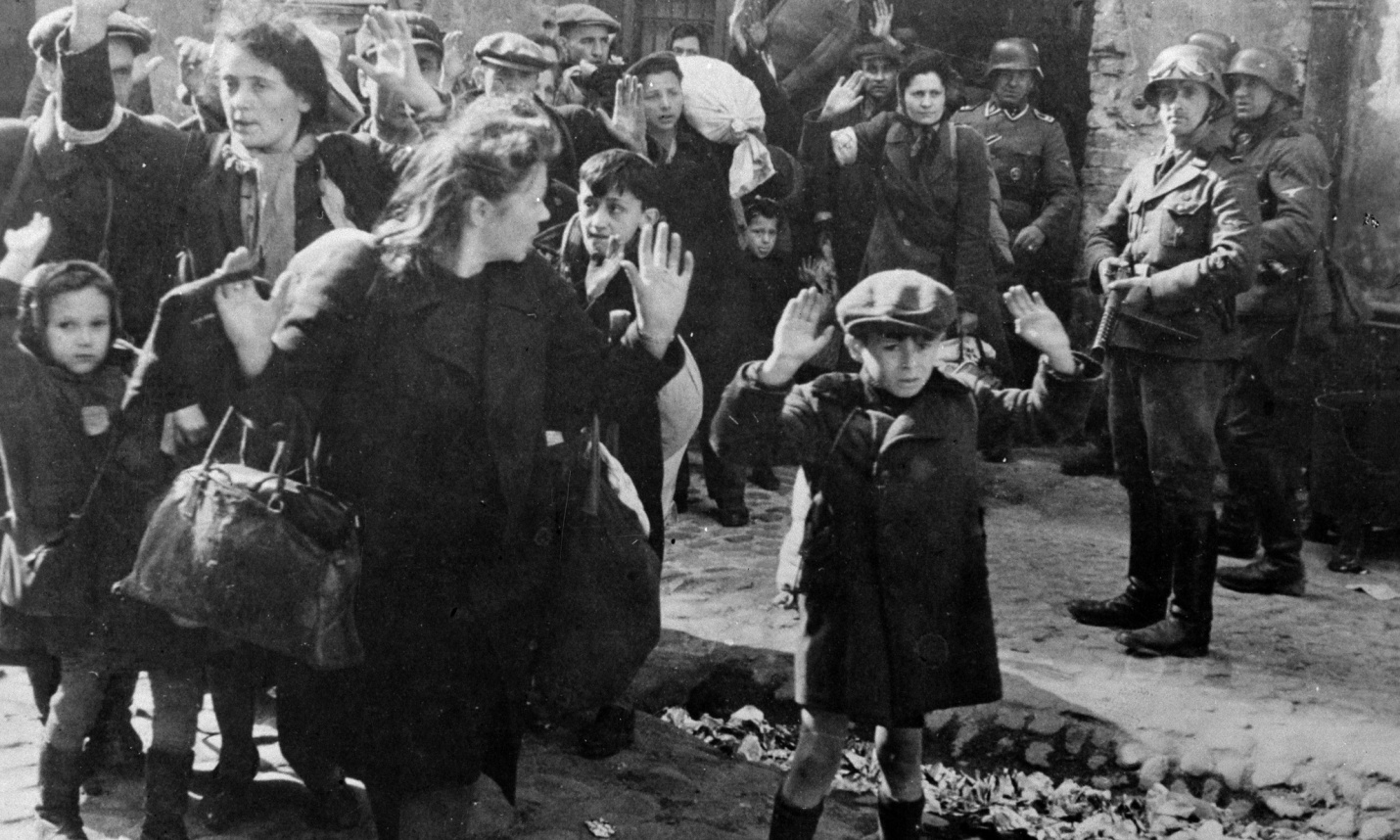
If we look at this famous, or infamous, picture of Germans rounding up Jews in Warsaw to be sent to a death camp, a harrowing question emerges: Could it happen again? Instead of Jews would there be Roma, Muslims or even Jews being escorted at gunpoint to a box car?

Even if such a question may be premature, there’s nothing to suggest that Europe has totally forgotten what happened during the Holocaust never mind the acts of genocide it committed in the Americas, Africa and elsewhere.

The same racist ideology that drove a country like Germany to murder millions of people still exists today. It can be found in the soil from where the poisonous plants of racism and hatred grow and bloom.

It isn’t hard to figure out what is wrong with the picture below. What is worrying in Europe today is that a large majority of white Europeans still believe that they are the only ones who have the right to live here. Minorities like the Roma, Muslims and others are only disenfranchised “guests.”

As long as we think we are the only ones who have the right to live here we’ll always flirt with the Holocaust. It may not happen in the same way as in World War 2 but can take other sinister forms.

d58c1239-43b6-41c2-9d22-7841ed6b1cc1-2060x1236

This story published in 1942 was barely noticed in the Daily Telegraph. The big question is why. A modern version of this picture could be European border guards keeping out people from war-torn, hunger-ravaged and impoverished regions who are trying to get into Europe.  We don’t send them to concentration camps but to the abyss and despair.

Do you think that something this harrowing as the picture above shows could happen in Europe again?


Institute of Race Relations: ‘Apologists for terrorism:’ dissent and the limits of free expression

Posted on January 30, 2015 by Migrant Tales

Frances Webber

Freedom of thought, expression and inquiry is under renewed threat from governments which, paradoxically, claim to be fighting to preserve freedom of expression in Europe.

freedom-of-expression

The ongoing case of a Belgian prison teacher issued with a work ban on national security grounds, and other disturbing cases of exclusion and criminalisation that have occurred in France since the Paris massacres, need to be placed at the centre of mainstream debate.

When Belgian prison teacher and human rights defender Luk Vervaet was finally told why he was barred from going to any Belgian prison – and he had had to fight for years for the right to know – it was his activism in support of freedom of expression and association, his solidarity work in defence of prisoners, and his work on Palestine which were held to justify the ban.The security services cited his membership of organisations such as CLEA (Committee for Freedom of Expression and Association), his involvement with the International Parliamentary Union for Palestine, his former membership of the Belgian Workers’ Party (PTB) and his founding of a party Egalité (which he had since left).

Blurring the boundaries

None of the organisations cited was proscribed, none of the activities unlawful, nor has Vervaet ever made any secret of his campaigning activities for victims of injustice in Belgium, Palestine or elsewhere. He had no criminal record and was highly regarded by prison governors. Three years ago the Conseil d’Etat, Belgium’s constitutional court, had ruled the work ban illegal. But the minister refused either to revoke the ban or to offer compensation. And when Vervaet took his case for reparation back to court, the Brussels first-instance court upheld his exclusion, and the destruction of his livelihood, as justified on national security grounds.

How could the first-instance court reach this decision, in the face of the constitutional court’s unequivocal condemnation of the work ban? Its arguments, which are difficult to convey, seem to come straight out of the pages of Kafka. But in a nutshell, the judges reasoned that the higher court was ruling only on the manner of the ban (the failure to inform Vervaet of the reasons or give him a right to be heard), and not on its merits – an interpretation Vervaet and his lawyers roundly reject. That it was the justice minister, of all people, who persuaded the court not to follow the Conseil d’Etat ruling reveals a lack of respect for the rule of law in the ministry which should be doing most to uphold it. An order that Vervaet – who has been unable to work since 2009 owing to the ban – pay six thousand euros in costs for his unsuccessful application, completed the legal mockery.

What were the ‘national security’ grounds which justified destroying a man’s livelihood? According to the court, a ‘vague suspicion’ that ‘the defence of supposed victims of anti-terrorist laws could have led him to cross the line from legitimate defence of justice to the support of ideologies indirectly justifying terrorism’ made it ‘understandable that in the context of the security of the prison regime, [allowing him into prisons] was a risk they could not take.’

The judgment enshrines the blurring of the distinction between peaceful political action against injustice and support for terrorism. Support for Palestine becomes support for terrorism; campaigning against the inhuman treatment of prisoners is seen as support for the prisoners’ crimes. The court meekly accepted this logic, according to which European MPs who support the International Parliamentary Union for Palestine should all be barred from their posts for support of an ideology ‘indirectly justifying terrorism’. Its refusal to uphold the right to express dissenting or unpopular opinions reveals the narrowing limits of free expression.

Lopsided freedom

The contradictions and distortions surrounding free expression multiplied in the febrile atmosphere after the Paris massacres. In the city where in July 2014 a rally to protest the deaths of hundreds in Israel’s invasion of Gaza was banned, the rally in support of freedom of expression was led by some of the most virulent oppressors of press freedom in Egypt, Russia, Turkey and Algeria, a BBC reporter’s clumsy and, according to some, anti-Semitic reference to Palestinian suffering led to calls for his dismissal, and a suburban mayor banned acclaimed anti-jihadist film Timbuktu by Mauretanian director Abderrahmane Sissako because, made by a Muslim, it was bound to support jihad – these were just some of the multiple ironies created by a ‘free speech’ harnessed to the interests of the powerful and used to discipline the powerless.

The ‘right to offend’ in the name of freedom of speech has almost been elevated to a public duty, as media outlets including the Guardian were called cowards for refusing to reproduce Charlie Hebdo’s most provocative and racialised cartoons of the Prophet, and London’s Victoria and Albert museum faced accusations of self-censorship after it withdrew from display a depiction of Mohammed. But as several commentators including Seumas Milne have pointed out, while ‘the right to single out one religion for abuse has been raised to the status of a core liberal value’, there has been little tolerance for freedom of expression for Muslims, in the country which banned the headscarf in schools and the burqa in any public place, whose former president demanded that foreigners ‘melt into the national community’ and attacked halal meat, prayers outside mosques and minarets. According to Amnesty International, in the aftermath of the massacres at least sixty-nine arrests were made in one week in France for speech deemed to ‘defend terrorism’. In addition to the well-publicised prosecution of Dieudonné (who has regularly been prosecuted for anti-Semitic hate speech) for his Facebook message ‘I feel like Charlie Coulibaly’, a drunk and mentally disturbed French-Tunisian man received six months’ imprisonment for shouting support for the attackers as he passed a police station in Bourgoin-Jallieu, south-east France, while a drunk driver who hit another vehicle and expressed similar sentiments when arrested received four years in prison.[1] A Poitiers philosophy teacher was suspended for four months and reported to police for ‘defence of terrorism’ for ‘inappropriate comments’ following the minute’s silence for the victims, and a 15-year-old youth who posted on Facebook an ironic take on one of Charlie Hebdo’s most offensive cartoons [2] was detained and charged with defending terrorism. Even the Syndicat de la Magistrature (Magistrates’ Association) condemned the government crackdown.
In some French schools the atmosphere was like a witch-hunt. When an eight-year-old boy replied to his teacher’s question ‘Are you Charlie?’ with ‘No, they insult my religion, I’m with the terrorists’, the head was summoned, and asked the boy the same question three times in front of the class. The child and his father were reported to police, who questioned them for two hours on suspicion of defending terrorism. Another apologist for terrorism’ was a thirteen-year-old French Muslim child in the southern Loire region who blurted out in a classroom debate that the perpetrators of the Paris massacres ‘were right’, who found himself excluded from school, held in police custody for twenty-four hours and taken to court under the counter-terrorism laws. At least forty children were reported to police for their classroom responses, out of some 200 ‘incidents’ in French schools reported to the education ministry.

Policing the classroom

As some French teachers have observed, such extreme punitive reactions to children’s fumbling attempts to articulate their sense of unfairness teach them nothing, other than to keep their mouths shut. Children who say something provocative in a classroom are not dangerous demagogues seeking to manipulate idealism and strong emotions in the cause of violence. Treating the juvenile testing of boundaries as dangerous, to be punished under laws designed against terrorist violence, shows a serious failure of understanding, as well as potentially ruining educational and career prospects for life.

One teacher, trying to understand the hostility of her teenage black and Muslim French-born students to the minute’s silence imposed in all public offices and schools for the massacre’s victims, mused on how the education system had failed on its promise of equality and entrenched social exclusion. Her students questioned the double standards which saw ugly and hate-filled anti-Semitic mockery rightly condemned, while ugly and hate-filled anti-Islamic mockery was held up as glorious examples of secular free speech in a society which excluded them.

A society which seeks to integrate its minorities must listen to them. But angry young Muslims are not listened to, only monitored, for words which suggest support for terrorism. In the aftermath of the massacres, French politicians announced new counter-terror measures including the adoption of the PREVENT programme pioneered in the UK, as well as even tougher penalties for online ‘defence of terrorism’. British educationalists believe the PREVENT strategy has further stigmatised Muslim communities, while the fear of surveillance has stifled classroom debate. Teachers, afraid to allow young people to test the boundaries in open discussion of difficult subjects, are failing to teach them to think – leaving them vulnerable to emotion-led responses to injustice, including violence. ‘Strong language and strong views are much better aired within facilitated educational processes that are set against multiple perspectives, than in private spaces where no challenge or learning is encouraged’, argue Ted Cantle and Paul Thomas. ‘PREVENT has not … encouraged open political debate and education about the sort of domestic and international political issues that may anger some young Muslims and attract them towards more radical groups.’

The Counter-Terrorism and Security Bill currently going through the UK parliament seeks to make this monitoring and reporting compulsory, with sanctions for failure to comply, which will further entrench alienation and anger. In some areas an Orwellian surveillance mentality has already taken hold: in September 2014, Lancaster University Students’ Union president Laura Clayson found police photographing two posters displayed in her office, against fracking and Israel’s attacks on Gaza. Challenged, they said she was potentially committing a public order offence.

Enforcing the new orthodoxies

When education is redefined, in the words of Howard Hotson of the Council for the Defence of British Universities, as ‘a paid-for service to acquire the skills needed to advance the UK’s prosperity’, there is no room for thought, debate or dissent. It is not just ‘extremist’ speakers or political ideas which are banned from schools and campuses, either: no radical, non-orthodox economics which questions free-market theories is taught in British universities (or in those of many other countries). Liberal democracies are becoming increasingly uncomfortable with thinking, questioning citizens who inquire into or expose corrupt links between politicians and global corporations, sweetheart tax deals and foreign policy priorities which lead to complicity with torture and renditions. With Chelsea Manning serving thirty-five years and Edward Snowden in exile for believing the world had a right to know what our security services were doing, exposure of the burgeoning security state is itself now ferociously punished under the guise of indirect support for terrorism.

Frank La Rue, UN special rapporteur on the promotion and protection of freedom of opinion and expression, warned two years ago that the defence of national security must not be used as grounds for harassing journalists who investigate sensitive subjects such as human rights abuses. In the UK, investigative journalists are deemed a threat to GCHQ information security on a par with terrorists or hackers, their confidential communications with sources are intercepted by police and security services with no requirement of judicial authorisation. In the UK, state surveillance and harassment of journalists who reveal government wrongdoing, such as British state complicity with rendition and torture, led Society of Editors’ head Bob Satchwell to protest that ‘Journalism is not a crime and should not be treated as such’.

We need to fight for the freedom of expression that allows marginalised voices to be heard, that helps young people to learn to think, and that listens to unwelcome truths rather than seeking to suppress them.

RELATED LINKS

See Mohamed Ouachen’s filmed interview (in French) with Luk Vervaet about his case here.

See also:

‘More state power, not free speech, the likeliest we-are-Charlie result‘

‘The west is a variegated place for free speech: Teju Cole, Unmournable bodies‘

Thanks to Naima Bouteldja for her additional research. References: [1] ‘France invokes law to detain dozens’, International New York Times 16 January 2015. [2] The original cartoon, and the version posted by the boy which landed him in court, can be seen on the Electronic Intifada website, here.  

The Institute of Race Relations is precluded from expressing a corporate view: any opinions expressed are therefore those of the authors.

Read original story here.

This piece was reprinted by Migrant Tales with permission.
  • Previous
  • 1
  • 2
  • 3
  • 4
  • 5
  • 6
  • …
  • 12
  • Next
Read more about documentary film
Read more

Recent Posts

  • Finland’s tabloids Iltalehti and Ilta-Sanomat are the pits
  • Riikka Purra’s Dr Jekyll and Mr Hyde mask
  • Double standards
  • Perussuomalaiset: Uusi logo, sama vanha juttu
  • Taco Trump

Recent Comments

  1. Absolutely Socking: Racist Finnish Facebook group against human rights gets flooded with socks on Musta Barbaari’s mother and sister charged by the police in “ethnic profiling” case
  2. Ilkka Nuotio on Pekka Myrskylä: “Tilastot kertovat toista kuin poliittinen keskustelu”
  3. Genrih Soinkara on The war in Ukraine and the Russian-Finnish border crisis are showing Finland’s ugly side
  4. Ahti Tolvanen on Comment by Ahti Tolvanen on the Helsinki +50 conference
  5. Angel Barrientos on Angel Barrientos is one of the kind beacons of Finland’s Chilean community

Archives

  • June 2026
  • May 2026
  • April 2026
  • March 2026
  • February 2026
  • January 2026
  • December 2025
  • November 2025
  • October 2025
  • September 2025
  • August 2025
  • July 2025
  • June 2025
  • May 2025
  • April 2025
  • March 2025
  • February 2025
  • January 2025
  • December 2024
  • November 2024
  • October 2024
  • September 2024
  • August 2024
  • July 2024
  • June 2024
  • May 2024
  • April 2024
  • March 2024
  • February 2024
  • January 2024
  • December 2023
  • November 2023
  • October 2023
  • September 2023
  • August 2023
  • July 2023
  • June 2023
  • May 2023
  • April 2023
  • March 2023
  • February 2023
  • January 2023
  • December 2022
  • November 2022
  • October 2022
  • September 2022
  • August 2022
  • July 2022
  • June 2022
  • May 2022
  • April 2022
  • March 2022
  • February 2022
  • January 2022
  • December 2021
  • November 2021
  • October 2021
  • September 2021
  • August 2021
  • July 2021
  • June 2021
  • May 2021
  • April 2021
  • March 2021
  • February 2021
  • January 2021
  • December 2020
  • November 2020
  • October 2020
  • September 2020
  • August 2020
  • July 2020
  • June 2020
  • May 2020
  • April 2020
  • March 2020
  • February 2020
  • January 2020
  • December 2019
  • November 2019
  • October 2019
  • September 2019
  • August 2019
  • July 2019
  • June 2019
  • May 2019
  • April 2019
  • March 2019
  • February 2019
  • January 2019
  • December 2018
  • November 2018
  • October 2018
  • September 2018
  • August 2018
  • July 2018
  • June 2018
  • May 2018
  • April 2018
  • March 2018
  • February 2018
  • January 2018
  • December 2017
  • November 2017
  • October 2017
  • September 2017
  • August 2017
  • July 2017
  • June 2017
  • May 2017
  • April 2017
  • March 2017
  • February 2017
  • January 2017
  • December 2016
  • November 2016
  • October 2016
  • September 2016
  • August 2016
  • July 2016
  • June 2016
  • May 2016
  • April 2016
  • March 2016
  • February 2016
  • January 2016
  • December 2015
  • November 2015
  • October 2015
  • September 2015
  • August 2015
  • July 2015
  • June 2015
  • May 2015
  • April 2015
  • March 2015
  • February 2015
  • January 2015
  • December 2014
  • November 2014
  • October 2014
  • September 2014
  • August 2014
  • July 2014
  • June 2014
  • May 2014
  • April 2014
  • March 2014
  • February 2014
  • January 2014
  • December 2013
  • November 2013
  • October 2013
  • September 2013
  • August 2013
  • July 2013
  • June 2013
  • May 2013
  • April 2013
  • March 2013
  • February 2013
  • January 2013
  • December 2012
  • November 2012
  • October 2012
  • September 2012
  • August 2012
  • July 2012
  • June 2012
  • May 2012
  • April 2012
  • March 2012
  • February 2012
  • January 2012
  • December 2011
  • November 2011
  • October 2011
  • September 2011
  • August 2011
  • July 2011
  • June 2011
  • May 2011
  • April 2011
  • March 2011
  • February 2011
  • January 2011
  • December 2010
  • November 2010
  • October 2010
  • September 2010
  • August 2010
  • July 2010
  • June 2010
  • May 2010
  • April 2010
  • March 2010
  • February 2010
  • January 2010
  • December 2009
  • November 2009
  • October 2009
  • September 2009
  • August 2009
  • July 2009
  • December 2008
  • November 2008
  • October 2008
  • September 2008
  • August 2008
  • July 2008
  • June 2008
  • May 2008
  • April 2008
  • March 2008
  • February 2008
  • January 2008
  • November 2007
  • October 2007
  • September 2007
  • August 2007
  • July 2007
  • June 2007
  • May 2007

Categories

  • ?? Gia L?c
  • ????? ?????? ????? ???????? ?? ??????
  • ???????
  • @HerraAhmed
  • @mondepasrond
  • @nohatefinland
  • @oula_silver
  • @Varathas
  • A Pakistani family
  • äärioikeisto
  • Abbas Bahmanpour
  • Abdi Muhis
  • Abdirahim Hussein Mohamed
  • Abdirahim Husu Hussein
  • Abdirisak Mahamed
  • About Migrant Tales
  • activism
  • Adam Al-Sawad
  • Adel Abidin
  • Afrofinland
  • Ahmed IJ
  • Ahti Tolvanen
  • Aino Pennanen
  • Aisha Maniar
  • Alan Ali
  • Alan Anstead
  • Alejandro Díaz Ortiz
  • Alekey Bulavsev
  • Aleksander Hemon
  • Aleksanterinliitto
  • Aleksanterinliitto ry
  • Aleksanterinliitto ry:n hallitus
  • Alex Alex
  • Alex Mckie
  • Alexander Nix
  • Alexandra Ayse Albayrak
  • Alexis Neuberg
  • Ali Asaad Hasan Alzuhairi
  • Ali Hossein Mir Ali
  • Ali Rashid
  • Ali Sagal Abdikarim
  • Alina Tsui
  • Aline Müller
  • All categories
  • Aman Heidari
  • Amiirah Salleh-Hoddin & Jana Turk
  • Amin A. Alem
  • Amir Zuhairi
  • Amkelwa Mbekeni
  • Ana María Gutiérrez Sorainen
  • Anachoma
  • Anders Adlecreutz
  • Angeliina Koskinen
  • Anna De Mutiis
  • Anna María Gutiérrez Sorainen
  • Anna-Kaisa Kuusisto ja Jaakko Tuominen
  • Annastiina Kallius
  • Anneli Juise Friman Lindeman
  • Announcement
  • Anonymous
  • Antero Leitzinger
  • anti-black racism
  • Anti-Hate Crime Organisation Finland
  • Anudari Boldbaatar
  • Arshiya Nasser
  • Aspergers Syndrome
  • Asylum Corner
  • Asylum seeker 406
  • Athena Griffin and Joe Feagin
  • Autism
  • Avaaz.org
  • Awale Olad
  • Ayan Said Mohamed
  • AYY
  • Barachiel
  • Bashy Quraishy
  • Beatrice Kabutakapua
  • Beri Jamal
  • Beri Jamal and Enrique Tessieri
  • Bertolt Brecht
  • Boiata
  • Boodi Kabbani
  • Bruno Gronow
  • Carmen Pekkarinen
  • Çelen Oben and Sheila Riikonen
  • Chiara Costa-Virtanen
  • Chiara Costa-Virtanen
  • Chiara Sorbello
  • Christian Thibault
  • Christopher Wylie
  • Clara Dublanc
  • Dana
  • Daniel Malpica
  • Danilo Canguçu
  • David Papineau
  • David Schneider
  • Dexter He
  • Don Flynn
  • Dr Masoud Kamali
  • Dr. Faith Mkwesha
  • Dr. Theodoros Fouskas
  • Edna Chun
  • Eeva Kilpi
  • Emanuela Susheela
  • En castellano
  • ENAR
  • Enrique
  • Enrique Tessieri
  • Enrique Tessieri & Raghad Mchawh
  • Enrique Tessieri & Yahya Rouissi
  • Enrique Tessieri and Muhammed Shire
  • Enrique Tessieri and Sira Moksi
  • Enrique Tessieri and Tom Vandenbosch
  • Enrique Tessieri and Wael Che
  • Enrique Tessieri and Yahya Rouissi
  • Enrique Tessieri and Zimema Mhone
  • Epäluottamusmies
  • EU
  • Europe
  • European Islamophobia Report
  • European Islamophobia Report 2019,
  • European Union
  • Eve Kyntäjä
  • Ezequiel Caldeiro
  • Facebook
  • Fadumo Dayib
  • Faisa Kahiye
  • Farhad Manjoo
  • Fasismi
  • Finland
  • Fizza Qureshi
  • Flyktingar och asyl
  • Foreign Student
  • Fozia Mir-Ali
  • Frances Webber
  • Frida Selim
  • Gareth Rice
  • Ghyslain Vedeaux
  • Global Art Point
  • Great Replacement
  • Habiba Ali
  • Hami Bahadori
  • Hami Bahdori
  • Hamid
  • Hamid Alsaameere
  • Hamid Bahdori
  • Handshake
  • Harmit Athwal
  • Hassan Abdi Ali
  • Hassan Muhumud
  • Heikki Huttunen
  • Heikki Wilenius
  • Helsingin Sanomat
  • Henning van der Hoeven
  • Henrika Mälmsröm
  • Hser Hser
  • Hser Hser ja Mustafa Isman
  • Husein Muhammed
  • Hussain Kazemian
  • Hussain Kazmenian
  • Ibrahim Khan
  • Ida
  • Ignacio Pérez Pérez
  • Iise Ali Hassan
  • Ilari Kaila & Tuomas Kaila
  • Imam Ka
  • inside-an-airport
  • Institute of Race Relations
  • Iraqi asylum seeker
  • IRR European News Team
  • IRR News Team
  • Islamic Society of Norhern FInland
  • Islamic Society of Northern Finland
  • Islamophobia
  • Jacobinmag.com
  • Jallow Momodou
  • Jan Holmberg
  • Jane Elliott
  • Jani Mäkelä
  • Jari Luoto
  • Jari Taponen
  • Jegor Nazarov
  • Jenni Stammeier
  • Jenny Bourne
  • Jessie Daniels
  • Joe Davidow
  • Johannes Koski
  • John D. Foster
  • John Grayson
  • John Marriott
  • Jon Burnett
  • Jorma Härkönen
  • Jos Schuurmans
  • José León Toro Mejías
  • Josue Tumayine
  • Jouni Karnasaari
  • Juan Camilo
  • Jukka Eräkare
  • Julian Abagond
  • Julie Pascoet
  • Jussi Halla-aho
  • Jussi Hallla-aho
  • Jussi Jalonen
  • JusticeDemon
  • Kadar Gelle
  • Kaksoiskansalaisuus
  • Kansainvälinen Mikkeli
  • Kansainvälinen Mikkeli ry
  • Katherine Tonkiss
  • Kati Lepistö
  • Kati van der Hoeven-Lepistö
  • Katie Bell
  • Kättely
  • Kerstin Ögård
  • Keshia Fredua-Mensah & Jamie Schearer
  • Khadidiatou Sylla
  • Khadra Abdirazak Sugulle
  • Kiihotus kansanryhmää vastaan
  • Kirsi Crowley
  • Koko Hubara
  • Kristiina Toivikko
  • Kubra Amini
  • KuRI
  • La Colectiva
  • La incitación al odio
  • Laura Huhtasaari
  • Lauri Finér
  • Leif Hagert
  • Léo Custódio
  • Leo Honka
  • Leontios Christodoulou
  • Lessie Branch
  • Lex Gaudius
  • Leyes de Finlandia
  • Liikkukaa!
  • Linda Hyökki
  • Liz Fekete
  • M. Blanc
  • Maarit Snellman
  • Mahad Sheikh Musse
  • Maija Vilkkumaa
  • Malmin Kebab Pizzeria Port Arthur
  • Marcell Lorincz
  • Mari Aaltola
  • María Paz López
  • Maria Rittis Ikola
  • Maria Tjader
  • Marja-Liisa Tolvanen
  • Mark
  • Markku Heikkinen
  • Marshall Niles
  • Martin Al-Laji
  • Maryan Siyad
  • Matt Carr
  • Mauricio Farah Gebara
  • Media Monitoring Group of Finland
  • Micah J. Christian
  • Michael McEachrane
  • Michele Levoy
  • Michelle Kaila
  • Migrant Tales
  • Migrant Tales Literary
  • Migrantes News
  • Migrants' Rights Network
  • MigriLeaks
  • Mikko Kapanen
  • Miriam Attias and Camila Haavisto
  • Mohamed Adan
  • Mohammad Javid
  • Mohammad M.
  • Monikulttuurisuus
  • Monisha Bhatia and Victoria Canning
  • Mor Ndiaye
  • Muh'ed
  • Muhamed Abdimajed Murshid
  • Muhammed Shire
  • Muhammed Shire and Enrique Tessieri
  • Muhis Azizi
  • Musimenta Dansila
  • Muslimiviha
  • Musulmanes
  • Namir al-Azzawi
  • Natsismi
  • Neurodiversity
  • New Women Connectors
  • Nils Muižnieks
  • No Labels No Walls
  • Noel Dandes
  • Nuor Dawood
  • Omar Khan
  • Otavanmedia
  • Oula Silvennoinen
  • Paco Diop
  • Pakistani family
  • Pentti Stranius
  • Perussuomalaiset
  • perustuslaki
  • Petra Laiti
  • Petri Cederlöf
  • Pia Grochowski
  • Podcast-lukija Bea Bergholm
  • Pohjois – Suomen Islamilainen Yhdyskunta
  • Pohjois Suomen Islamilainen Yhyskunta
  • Polina Kopylova
  • Race Files
  • racism
  • Racism Review
  • Raghad Mchawh
  • Ranska
  • Rashid H. and Migrant Tales
  • Rasismi
  • Raul Perez
  • Rebecka Holm
  • Reem Abu-Hayyeh
  • Refugees
  • Reija Härkönen
  • Remiel
  • Reza Nasri
  • Richard Gresswell
  • Riikka Purra
  • Risto Laakkonen
  • Rita Chahda
  • Ritva Kondi
  • Robito Ibrahim
  • Roble Bashir
  • Rockhaya Sylla
  • Rodolfo Walsh
  • Roger Casale
  • Rostam Atai
  • Roxana Crisólogo Correa
  • Ruth Grove-White
  • Ruth Waweru-Folabit
  • S-worldview
  • Sadio Ali Nuur
  • Sami Rusanen
  • Sandhu Bhamra
  • Sara de Jong
  • Sarah Crowther
  • Sari Alhariri
  • Sarkawt Khalil
  • Sasu
  • Scot Nakagawa
  • Shabana Ahmadzai
  • Shada Islam
  • Sharon Chang blogs
  • Shenita Ann McLean
  • Shirlene Green Newball
  • Sini Savolainen
  • Sira Moksi
  • Sonia K.
  • Sonia Maria Koo
  • Steverp
  • Stop Deportations
  • Suldaan Said Ahmed
  • Suomen mediaseurantakollektiivi
  • Suomen Muslimifoorumi ry
  • Suomen viharikosvastainen yhdistys
  • Suomen viharikosvastainen yhdistys ry
  • Suomi
  • Supermen
  • Susannah
  • Suva
  • Syrjintä
  • Talous
  • Tapio Tuomala
  • Taw Reh
  • Teivo Teivainen
  • The Daily Show
  • The Heino
  • The Supermen
  • Thomas Elfgren
  • Thulfiqar Abdulkarim
  • Tim McGettigan
  • Tino Singh
  • Tito Moustafa Sliem
  • Tobias Hübinette and L. Janelle Dance
  • Transport
  • Trica Danielle Keaton
  • Trilce Garcia
  • Trish Pääkkönen
  • Trish Pääkkönen and Enrique Tessieri
  • Tuulia Reponen
  • Uncategorized
  • UNITED
  • University of Eastern Finland
  • Uyi Osazee
  • Väkivalta
  • Vapaa Liikkuvuus
  • Venla-Sofia Saariaho
  • Vieraskynä
  • W. Che
  • W. Che an Enrique Tessieri
  • Wael Ch.
  • Wan Wei
  • Women for Refugee Women
  • Xaan Kaafi Maxamed Xalane
  • Xassan Kaafi Maxamed Xalane
  • Xassan-Kaafi Mohamed Halane & Enrique Tessieri
  • Yahya Rouissi
  • Yasmin Yusuf
  • Yassen Ghaleb
  • Yle Puhe
  • Yuliet Tresa
  • Yve Shepherd
  • Zahra Khavari
  • Zaker
  • Zalina Ametova
  • Zamzam Ahmed Ali
  • Zeinab Amini ja Soheila Khavari
  • Zimema Mahone and Enrique Tessieri
  • Zimema Mhone
  • Zoila Forss Crespo Moreyra
  • ZT
  • Zulma Sierra
  • Zuzeeko Tegha Abeng
© 2026 Migrant tales | Powered by Minimalist Blog WordPress Theme