Migrant tales
Menu
  • #MakeRacismHistory “In Your Eyes”
  • About Migrant Tales
  • It’s all about Human Rights
  • Literary
  • Migrant Tales Media Monitoring
  • NoHateFinland.org
  • Tales from Europe
Menu

Tag: Colonia Finlandesa

Argentina’s issues with whitewashing and genocide. Like the crimes committed during the dirty war, they too should be addressed.

Posted on July 16, 2018July 6, 2024 by Migrant Tales

When I was young, I remember very well the racism that inflicted the Argentines. A friend of mine from Rosario highlighted this racism in the following example: A porteño (a resident of the capital Buenos Aires) told his friends that when they travel to countries like Peru they state that they are going to visit South America.

The more one reads Argentine history, genocide and whitewashing of Amerindians and Afro-Argentines become clearer.

From social thinker, Juan Bautista Alberdi (1810-84) to former President Faustino Sarmiento (1811-88), their suspicion and hatred of non-white Europeans is more than clear.


Juan Bautista Alberdi and Domingo Faustino Sarmiento. Sources: El Intransigente and Organization of American States.

In his most famous book, Bases y puntos de partida para la organización política de la República Argentina (1852), Alberdi states: “The indigenous does us justice by naming us Spaniards to this date. I don’t know of any distinguished person of our society that carries a Pehuenche or Auraucano [Amerindian] surname…[W]ho would want their sister or daughter to marry an infamous Araucanian and not a thousand times an English shoemaker?”

Sarmiento, considered the father of Argentina’s education system, not only despised Amerindians but was an ardent defender of white European racial purity. Of the Gauchos, the Argentine cowboy who were mestizos, he said that their only use was to serve as fertilizer when they died.

Sarmiento wrote in El Nacional of Nov. 25, 1857: “Will we be able to exterminate the Indians? For the savages of America, I feel an invincible repugnance that I cannot cure. Those scoundrels are not anything more than disgusting Indians that I would hang if they reappeared…”

Even today, an argument used by some to justify the genocide of the Amerindians is that they were so few. Thus genocide of the Amerindian was not a major crime because they were so few.

Some estimates place the number of Amerindians living outside colonial jurisdiction in the nineteenth century between 300,000 and 2 million.

Historical guilt

Some Argentines put a poker face to cover up the atrocities committed against the Amerindians with arguments by claiming that we are a melting pot.

Nothing could be further from the truth unless “melting pot” means white European.

Racist comments by some white Argentineans reinforce how racism and bigotry are still alive and kicking in the country. “White” in Argentina means anyone who has a European background. Those of mixed mestizo ethnicity, Europeans mixed with Amerindians, are called disrespectfully cabecita negra, or little black head.

In my research of the Finns of Argentina, who founded a Finnish colony in the province of Misiones in 1906, racism was present in the many interviews I did. When I asked one former late colonist how many races there existed, he responded three: “white, black, and pitch-black.”

The colonist whom I interviewed, admitted that race mixing was good but not with blacks. He said he would never accept his daughter marrying an Amerindian, black or member of the Romany community even if the person “were an airline captain.”


A family working at a corn field in Colonia Finlandesa. The picture was taken in 1978. Photo: Enrique Tessieri

In light of our problematic history with non-European whites, should we children and grandchildren of European migrants in Argentina feel guilty for the genocide and whitewashing that took place?

The answer to that question is clear. Recognizing the injustices committed against groups like the Amerindians and Afro-Argentines is a good start to healing wounds.

Acknowledging and correcting what happened to minority groups is similar to how the country has tried to come to grips with the atrocities committed by military regimes, in particular to those that ruled the country during the dirty war (1976-83).

If we as a nation forget our past atrocities and conveniently brush them under the rug, we are in danger of committing the same crimes again.

A person whom I’ve known since childhood was adopted as a baby by a white porteño family and who came from Amerindian parents.  When I met him in 2016, his hatred for Bolivians and other non-white nationals in Argentina surprised and shocked me.

“We got to kick all these Bolivians out of the country,” he said, adding that there are too many of them.

Whitewashing “Made in Argentina”

Throughout Argentine history, we have seen history whitewashed, turned upside down and then right side up again. Consider when Juan Manuel de Rosas (1793-1877), one of Argentina’s most important caudillos of the nineteenth century, went into exile in Great Britain in 1852. His enemies, and they were many, made certain that no plaza or street in Argentina would carry his name until 1989 when his remains were repatriated.

We saw the same happen after Juan Domingo Perón’s overthrow by the military in 1955 with Decree 4161 of 1956, which prohibited people from mentioning the names of Juan Perón and Eva Duarte de Perón.

Looking at the above examples, should we be surprised that so much whitewashing and genocide went on in Argentina?

Not at all.

We must remember that the millions of migrants that moved to Argentina in the nineteenth and twentieth century not only brought with them their physical belongings but also their prejudices and racism. Colonial powers like the United Kingdom, Spain, Portugal, and France reinforced with the examples of colonial oppression, exploitation, mass murder the genocide of groups like the Amerindians.

That racism is ever-present in the treatment of African migrants in Argentina today.

Mauricio Macri and the legacy of racism

Taking into account Argentina’s racialized society and its history of racism, President Mauricio Macri aims at scoring brownie points with the voters by spreading xenophobia and fear of outsiders.

“We can’t allow criminals to keep picking Argentina as a place to commit offenses,” he was quoted as saying in The Guardian. According to the London-based newspaper, the comment was made after Macri signed a controversial and far-reaching executive order that permits foreigners to be deported from Argentina.


Read the full story here.

Singling out and scapegoating certain immigrant groups is the same questionable example found today in the United States and in European countries. Such rhetoric is a slippery slope that can lead to the horrors we saw in Europe in the last century.

Argentina’s Security Minister Patricia Bullrich, who belongs to one of the country’s richest families, didn’t mind labeling and linking crime to immigration like far-right, anti-immigration parties in Europe.

She claimed that “Peruvian and Paraguayan citizens come here and end up killing each other for control of the drug trade.”

Such rhetoric is racist that aims to harm and victimize the good name of certain national and ethnic groups.

Argentina needs today more than ever an earnest debate about its history and how we wronged non-white European minorities.

YLE Radio 1: Suomalaisten utopiayhteisöjen historiaa

Posted on April 21, 2013 by Migrant Tales

Jenni Stammeier

Atlantis, Eden ja Eldorado. Ihanneyhteiskuntien on uskottu perinteisesti sijaitsevan kadonneilla tai kaukaisilla saarilla. Siellä kaikille riittää tasapuolisesti töitä, vapaa-aikaa ja vaurautta. Realistit ovat aina tienneet, että mahdotonta ei kannata yrittää tavoitella. Mutta utopisteja on riitänyt maailman sivu, ja jotkut heistä ovat tarttuneet toimeen ja kulkeneet edellä. Jenni Stammeierin toimittama 8-osainen sarja käy läpi utopiayhteisöjen historiaa.

Tässä on YLE Radio 1 linkki.

Mate

Suomalaisia siirtolaisia Colonia Finlandesassa 1920-luvun lopulla.

Osa 4/8 ma 22.4.2013 klo 12.15, uusinta su 28.4. klo 17.15
Uuden Suomen perustajat suuntaavat Amerikkaan

Venäläistämispaineiden alla Suomea ja suomalaisia suunniteltiin siirrettäväksi Amerikkaan. “Uudelle Suomelle” etsittiin 1800- ja 1900 -lukujen taitteessa paikkaa ensin USAsta ja Kuubasta. Etenkin suomenruotsalaiset kokivat olonsa ahtaiksi, ja monet oli jo karkoitettu maasta. Lopulta boheemi intellektuelli Arthur Thesleff löysi eksoottisen Argentiinan, joka houkutteli yli sata suomalaista liikkeelle. Joukko koostui pääosin suomenruotsalaisista kaupunkilaismiehistä, joita innoitti seikkailumieli. Matkaan lähdettiin myös rikastumistavoittein. Minkälaisen paratiisin eksotiikannälkäiset suomalaiset Argentiinan viidakosta löysivät? Asiantuntijoina professori Jussi Pakkasvirta, professori Marja Jalava sekä argentiinansuomalaisten tutkija Enrique Tessieri.

Finland and cultural diversity in 2012 will be published on December 28

Posted on December 23, 2012 by Migrant Tales

Migrant Tales will publish on December 28 its review of the major events that shaped 2012 on the cultural diversity and immigration front in Finland. Contrary to 2011, this year’s review will be called Finland and cultural diversity in 2012.

8_eelisheikkila-copy_edited-1

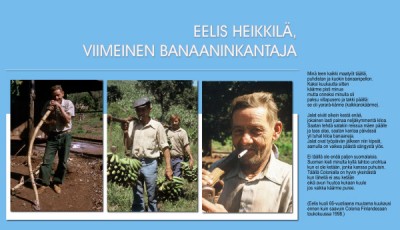
Finns colonized Argentina in 1906. Some, like Eelis Heikkilä, made a meager living by picking bananas.

Why have we changed the name?

The answer is simple: The real issue being debated in this country isn’t immigration per se but acceptance of cultural diversity. How inclusive is our society to “otherness?”

As far as we can tell, there is one party as well as many politicians from other parties who are fighting tooth and nail to keep Finland white physically and spiritually. In their myopic world, the only “good” Finn is a white Finn.

We disagree. Being Finnish is a personal matter and does not hinge on how anti-immigration parties and groups define it.

Thanks to the over 1.2 million Finns that left this country between 1860 and 1999, Finnish culture and identity is richer than some people would like to admit.

No matter how many obstacles these anti-immigration and counterjihadist groups place on our path, the tide turned many decades ago. The ever-growing cultural diversity we see within our borders today is fueling a new sense of Finnishness that is proud and diverse.

If you have any suggestions you would like to make concerning the most important events that took place in Finland in 2012 on the cultural diversity and immigration front, please drop us a line ([email protected]).

Thank you for your support and for making Migrant Tales one of Finland’s most successful blogs.


Exposición de Colonia Finlandesa, Argentina

Posted on December 4, 2012 by Migrant Tales

Esta exposición sobre la Colonia Finlandesa, Argentina, fue expuesta en las ciudades finlandesas de Kitee, Helsinki, Peräseinäjoki, Mikkeli, Tampere y Turku entre 2007 y 2010. La colonización finlandesa nace en 1906, cuando Arthur Thesleff lleva un grupo de ciento y pico de finlandeses a colonizar las selvas de Misiones en el noreste argentino. Los inmigrantes son mayormente sueco-parlantes y de ciudades como Helsinki. 

Esta exposición de la Colonia Finlandesa es una muestra humilde de esas historias que contarían si estuvieran vivos hoy.

Pinche aquí si quiere escuchar a los fino-argentinos que están en la exposición.

1/9: Llegada a Colonia Finlandesa

En la primera colina

a la derecha un yerbatal

a la izquierda una zona desmontada

los troncos cortados esperan

ser transportados a un aserradero.

Caminando colonia adentro

se acerca un hombre

de unos sesenta años

no es finlandés

con un diente de oro.

No se conocen

pero se saludan

porque el ladrido lejano de un perro

no hay nadie más que ustedes;

en alguna parte se escucha el viento

que acaricia los pinos

pero también se esfuma.

Todo parece tan vacío.

(Miércoles, 29 de agosto de 1984)

2/9: Svea Gumberg: Nacer en la historia

Tengo que admitir algo:

siempre he tenido miedo

de irme de esta colonia

proque es aquí

donde me siento segura.

Cuando venía

la gente del censo o autoridades,

yo me escapaba al monte.

Nunca me he ido de aquí

a no ser por una emergencía.

No tengo documentos

y por eso ninguna

autoridad sabe que existo.

Me da miedo que algún día

alguna autoridad me lleve de aquí.

Nadie en la Argentina se atreve

salir de su casa sin documentos

la policía y el ejército paran

a cualquiera hoy en día

con mucha facilidad.

Me voy otra vez de visita.

Me puse mi mejor ropa:

un vestido blanco,

decorado con flores azules.

Y zapatos nuevos.

(Svea murió el día siguiente cuando la entrevisté el 19 de diciembre de 1977. Ella murió cuando una víbora la picó. Nació en 1906, el mismo año que fue fundada Colonia Finlandesa.)

3/9: De Kitee a las selvas de Misiones

Karelianos, principalmente de Kitee,

buenos agricultores

plantaban tabaco y yerba mate (un té local)

que los finlandeses llamaban kuija.

También plantaban otros cultivos.

Los karelianos trajeron consigo

a Colonia Finlandesa läskisoosi

(salsa de tocino acompañado con papas)

y los carelianos la disfrutaron con buen apetito

aún con una temperatura ambiente de 35 grados;

algunos la comían diariamente.

Drante los 1920

llegó a Colonia Finlandesa

de Kitee casi un pueblo entero:

Los Laasonen, los Pirhonen, los Heino, los Malinen

dos familias Hirvonen y cuatro familias Lemmetyinen,

muchos Putkuri.

De soltero de Kitee llegaron

por lo menos Jussi Makkonen y Eino Parkkulainen.

Eran diferentes a los finlandeses de origen sueco

que llegaron en 1906

a muy pocos gustaba trabajar como agricultores.

Los de Kitee se identificaban con el trabajo de la tierra.


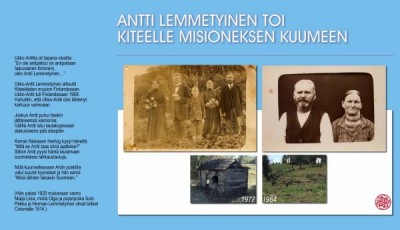
4/9: Antti Lemmetyinen despertó el interés en Misiones

El viejo Antti solía decir:

“No soy antipático, soy Antti Lemmetyinen.”

…Era el viejo Antti Lemmetyinen

quien despertó el interes de muchos de Kitee

a Colonia Finlandesa.

El viejo Antti llegó a la Finlandesa en 1908.

Se decía que él se había fugado de su mujer.

A veces Antti contaba

que había dejado a su mujer.

Algunas veces él se sentaba sobre

una caja de madera

deprimido y con la cabeza agachada.

Una ves Hedvig Niskanen le preguntó:

“¿Qué estás pensando?”

Entonces Antti le pediía que cantara

canciones finlandesas de amor.

Al escucharlas a Antti

le empezaba a caer

grandes lágrimas y dijo:

“Vuelvo a Finlandia.”

(Regresó a Misiones en 1920 con su esposa Maija Liisa, y su yerna Olga y su nieto Sulo. Pekka y Herman Lemmetyinen se establicieron en Colonia Finlandesa en 1914.)

5/9: Eino Parkkulainen: El Chermau Blanco

No tenía ninguna razón para irme,

pero quería ver el mundo;

tenía 22 años y era soltero

de la parroquia de Kitee,

del pueblo de Juurikkajärvi,

de la localidad de Kokkoniemi

y quería ver al mundo…

El jefe indio me dio

un nombre de honor: Chermau Blanco (Hermano Blanco).

Es el honor más grande,

que un indio guaraní puede darle a un forastero.

Conseguí todo tipo de invitaciones al campamento indio.

El jefe indio mandó

cinco hombres armados

para ser mis guaraespaldas durante el viaje.

Unos paraguayos

trabajando en la ruta preguntaron

si ellos podrían ir también a la fiesta

uno de los guaraespaldas le respondió:

“Sí, pueden venir,

pero no sé si regresarán.

Chermau Blanco si regresará.”

Fue la mejor parte de mi vida.

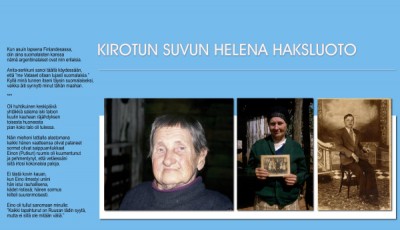
6/9: Helena Haksluoto: Encuentro con la muerte

Cuando vivía en Colonia Finlandesa

siempre estaba con finlandeses

estos argentinos son tan diferentes a nosotros.

Mi prima Anita me dijo una vez de visita:

“Nosotros los Vatanen somos bien finlandeses.”

Me siento netamente finlandesa

aunque mi mamá me dio a luz en esta tierra.

***

Era un mediodía de abril

de repente cayó un rayo en la casa

escuché una explosión fuerte

en la otra habitación

de repente la casa etaba en llamas.

Vi a mi marido en el piso, desnudo

tenía toda la ropa quemada

sus dedos estaban resbalosos como el jabón.

El cuerpo de Eino se había quemado

y ablandado cuando lo arrastraba

salían pedazos enteros de su carne.

No hace mucho tiempo,

Eino me visitó en un sueño

estaba sentado tranquilo,

con sus manos cruzadas; su anillo

brillaba intensamente.

Eino me había visitado para decirme:

“Todo lo que ha pasado es culpa de tu tía Ruusa

pero no tiene ninguna importancia.”

7/9: Eelis Heikkilä: El último recolector

Yo hago todo el trabajo aquí

limpio y carpo el bananal.

Hace dos meses me picó una víbora

suerte que tenía puesto

un pulóver grueso y un saco:

era un yarará (Bothrops alternatus).

Mis pies no aguantan más

cada cargamento que llevo pesa cuarenta kilos

puede ser que haga hasta 100 cargamentos por día

puede ser que en un día

haya cargado más de mil kilos de bananas.

Mis pies ya no aguantan más

mis pies están doloridos

después de un día de trabajao

es difícil levantarse en la mañana.

No hay en esta zona tantos finlandeses

Me estoy olvidando del finlandés

no tengo con quien hablar.

Colonia Finlandesa es un lugar triste

como nadie vive cerca de mí

me quedaría solo tirado

y nadie escucharía a mi socorro

si me picara una víbora.

(Eelis falleció a los 66 años unos meses antes de que visitara a Colonia Finlandesa en mayo de 1998.)

8/9: Helga y Artturi Heino se enamoran y se quedan

Siempre en el campo

conseguí un poco de fuerza

pensando que este sería

el último año

que hiciera este trabajo.

Lo único que nos faltaba

era un comprador para la chacra

todo estaba listo

pero después me embarazé.

Cuando nació Jussi

había estallado en Europa

la Segunda Guerra Mundial

pero nos quedo una pequeña esperanza:

Nos mudaríamos cuando

terminara la guerra.

Pero cuando terminó la guerra

había nacido

una pequeña hija,

Elena, en 1941.

Teníamos cuatro hijos

y poco dinero.

Artturi siempre añoraba

a Finlandia y toda su vida

vivió con la esperanza

de volver a su país natal.

9/9: Últimos pensamientos

El poeta fancés, Edmond Haraucourt (1856-1941), creía que la imagen de la muerte aparece siempre cuando dos personas se separan. Dijo: “El partir es morir un poco, es morir a lo que uno ama.”

El ritual de la despedida era una experiencia más traumática a comienzos del siglo pasado que hoy.  En aquellos tiempos, las personas que no se volverían a ver nunca más, por el destino o las circunstancias de la geografía, tuvieron que disfrazar las despedidas con grandes dosis de esperanza. Tuvieron que convencerse de que pronto se volverían  a ver, aunque nunca lo hicieran.

¿Cuántos inmigrantes de Finlandia y de otros países hubieran dejado a sus seres queridos si hubieran sabido que sería la última vez que los vieran? Seguramente la historia de la humanidad se hubiera escrito de manera distinta si hubiéramos tenido el don de saber si nuestros adioses eran los últimos.

Eino Parkkulainen’s home in Argentina becomes a community library

Posted on June 7, 2012 by Migrant Tales

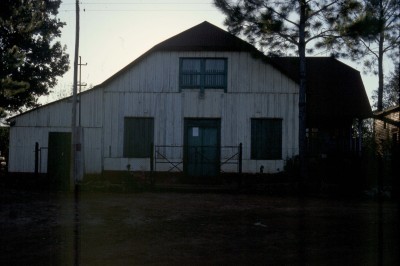
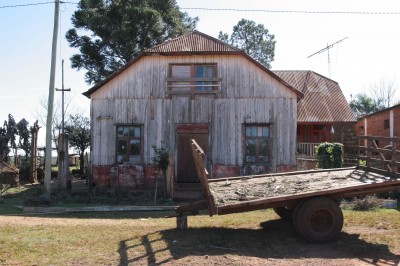
The late Eino Parkkulainen, a Finn who moved to Argentina in 1924 from Kitee, would be proud to see part of his former home  in the hamlet of San Martín being used as a library. Built in the mid-1930s, his home is probably the last one in existence built by the Finns that colonized Misiones province in northeastern Argentina.

Parkkulainen was a very enterprising man. One of the many things he accomplished during his lifetime was write a Finnish-Spanish dictionary. Unfortunately, the dictionary no longer exists.

Colonia Finlandesa was founded in 1906 by Arthur Thesleff.

Patricia Ocampo and Daniela Paola Friedl are spearheading a project to build numerous community libraries throughout Misiones. The first ones to open their doors to the public are the libraries of  San Martín and Puerto Leoni. Check out this video (in Spanish) of the inauguration of the San Martín Library on May 24.

The first picture I took of Pakkulainen’s home was in 1978.

Parkkulainen’s home in 2007.

One of the books on the shelves of the San Martín library is Lejana tierra mía authored by yours truly.

If you ever visit Misiones province and visit Colonia Finlandesa, you’ll probably pass by Parkkulainen’s former home.

In 1984, when I was taking pictures of the house, a fifty-year-old woman came out and asked me what I was doing. Everything was fine after I told her that I was  doing research on the Finns of Misiones.

“Send don Parkkulainen many regards when you see him,” she said. “Tell him that the house isn’t in such good shape. In a few years it may not be standing any longer.”

If you continue walking about 70 meters from the house you’ll soon hear the sound of rushing water of the Mártires River. If you stand on the wooden bridge that crosses it built by Artturi Heino about fifty years ago (in 1984), you’ll conclude that it too won’t last long.

After crossing the bridge you’ll be in Colonia Finlandesa.*

*Enrique Tessieri: Kaukainen maani. WSOY. Juva 1986. p. 33.


Llegada a Colonia Finlandesa (Misiones, Argentina) en 1977

Posted on November 2, 2011 by Migrant Tales

Por Enrique Tessieri

Me acuerdo como si fuera ayer la primera vez que viajé a la Colonia Finlandesa, en la provincia de Misiones. Era jueves, un día de sol y primavera del 3 de noviembre de 1977. Aunque el viaje en avión desde Buenos Aires a Posadas dura aproximadmente una hora y media, y después unas horas más en bus hasta Oberá, y luego a la Colonia en taxi o a pie, el viaje en realidad era muchos más largo de lo que parecía muchos años atrás…

[youtube=http://www.youtube.com/watch?v=i71zCNWFmmA&feature=related]
Esta canción me transporte a esos paisajes de la Colonia Finlandesa de diciembre de 1977.

…En 1977 ya no vivían muchos finlandeses en la colonia. Aparte de Artturi Heino, estaban Hedvig Niskanen, Svea Gumberg, Aarmas Heikkilä, Fanni Granlund, Reino Putkuri, Aaron Palo, Greta Holmberg de Oberá y unos pocos más. Habían finlandeses de segunda generación como Eero Granlund, que había nacido en la Argentina. A Eero lo había encontrado por casualidad en un camino cuando iba al almacén y con un sombrero de paja, recién había llegado de carpir. Sentí el fuerte olor a alcohol en su aliento cuando me hablaba.

El sol de la tarde acariciaba desde el fondo su cara barbuda y arrugada prematuramente. El rostro de Eero me dio lástima, era como el de un hombre vencido por la vida y el alcohol; era como si hubiera aceptado vivir la pobreza con todos sus defectos y debilidades.

Hablábamos un poco en finlandés, pero más en castellano. Me contó que quería irse de la colonia a la región de Iguazú, donde hay tierras fértiles. También me habló de trabajar en una cantera partiendo piedras. Pagaban bien. Dijo que no podía irse de la Colonia Finlandesa por sus dos hijos, hasta que fueran mayores. “Hice algunos malos negocios y me vino abajo,” dijo cándidamente. “Acá uno no progresa, sólo gana para vivir.”

La humilde choza de Eero una vez formó parte de la chacra de su madre Fanni Lepistö de Granlund, que vivía en una colina a medio kilómetro. Cuentan los lugareños que un día se enojó con ella y arrastró la choza hasta su lugar actual. (Fuente: Enrique Tessier, Lejana tierra mía, 2006)

[youtube=http://www.youtube.com/watch?v=2PlhyuJshdA&NR=1]

Este artículo fue publicado por primera vez en el blog Colonia Finlandesa.

Read more about documentary film
Read more

Recent Posts

  • Finland’s tabloids Iltalehti and Ilta-Sanomat are the pits
  • Riikka Purra’s Dr Jekyll and Mr Hyde mask
  • Double standards
  • Perussuomalaiset: Uusi logo, sama vanha juttu
  • Taco Trump

Recent Comments

  1. Absolutely Socking: Racist Finnish Facebook group against human rights gets flooded with socks on Musta Barbaari’s mother and sister charged by the police in “ethnic profiling” case
  2. Ilkka Nuotio on Pekka Myrskylä: “Tilastot kertovat toista kuin poliittinen keskustelu”
  3. Genrih Soinkara on The war in Ukraine and the Russian-Finnish border crisis are showing Finland’s ugly side
  4. Ahti Tolvanen on Comment by Ahti Tolvanen on the Helsinki +50 conference
  5. Angel Barrientos on Angel Barrientos is one of the kind beacons of Finland’s Chilean community

Archives

  • June 2026
  • May 2026
  • April 2026
  • March 2026
  • February 2026
  • January 2026
  • December 2025
  • November 2025
  • October 2025
  • September 2025
  • August 2025
  • July 2025
  • June 2025
  • May 2025
  • April 2025
  • March 2025
  • February 2025
  • January 2025
  • December 2024
  • November 2024
  • October 2024
  • September 2024
  • August 2024
  • July 2024
  • June 2024
  • May 2024
  • April 2024
  • March 2024
  • February 2024
  • January 2024
  • December 2023
  • November 2023
  • October 2023
  • September 2023
  • August 2023
  • July 2023
  • June 2023
  • May 2023
  • April 2023
  • March 2023
  • February 2023
  • January 2023
  • December 2022
  • November 2022
  • October 2022
  • September 2022
  • August 2022
  • July 2022
  • June 2022
  • May 2022
  • April 2022
  • March 2022
  • February 2022
  • January 2022
  • December 2021
  • November 2021
  • October 2021
  • September 2021
  • August 2021
  • July 2021
  • June 2021
  • May 2021
  • April 2021
  • March 2021
  • February 2021
  • January 2021
  • December 2020
  • November 2020
  • October 2020
  • September 2020
  • August 2020
  • July 2020
  • June 2020
  • May 2020
  • April 2020
  • March 2020
  • February 2020
  • January 2020
  • December 2019
  • November 2019
  • October 2019
  • September 2019
  • August 2019
  • July 2019
  • June 2019
  • May 2019
  • April 2019
  • March 2019
  • February 2019
  • January 2019
  • December 2018
  • November 2018
  • October 2018
  • September 2018
  • August 2018
  • July 2018
  • June 2018
  • May 2018
  • April 2018
  • March 2018
  • February 2018
  • January 2018
  • December 2017
  • November 2017
  • October 2017
  • September 2017
  • August 2017
  • July 2017
  • June 2017
  • May 2017
  • April 2017
  • March 2017
  • February 2017
  • January 2017
  • December 2016
  • November 2016
  • October 2016
  • September 2016
  • August 2016
  • July 2016
  • June 2016
  • May 2016
  • April 2016
  • March 2016
  • February 2016
  • January 2016
  • December 2015
  • November 2015
  • October 2015
  • September 2015
  • August 2015
  • July 2015
  • June 2015
  • May 2015
  • April 2015
  • March 2015
  • February 2015
  • January 2015
  • December 2014
  • November 2014
  • October 2014
  • September 2014
  • August 2014
  • July 2014
  • June 2014
  • May 2014
  • April 2014
  • March 2014
  • February 2014
  • January 2014
  • December 2013
  • November 2013
  • October 2013
  • September 2013
  • August 2013
  • July 2013
  • June 2013
  • May 2013
  • April 2013
  • March 2013
  • February 2013
  • January 2013
  • December 2012
  • November 2012
  • October 2012
  • September 2012
  • August 2012
  • July 2012
  • June 2012
  • May 2012
  • April 2012
  • March 2012
  • February 2012
  • January 2012
  • December 2011
  • November 2011
  • October 2011
  • September 2011
  • August 2011
  • July 2011
  • June 2011
  • May 2011
  • April 2011
  • March 2011
  • February 2011
  • January 2011
  • December 2010
  • November 2010
  • October 2010
  • September 2010
  • August 2010
  • July 2010
  • June 2010
  • May 2010
  • April 2010
  • March 2010
  • February 2010
  • January 2010
  • December 2009
  • November 2009
  • October 2009
  • September 2009
  • August 2009
  • July 2009
  • December 2008
  • November 2008
  • October 2008
  • September 2008
  • August 2008
  • July 2008
  • June 2008
  • May 2008
  • April 2008
  • March 2008
  • February 2008
  • January 2008
  • November 2007
  • October 2007
  • September 2007
  • August 2007
  • July 2007
  • June 2007
  • May 2007

Categories

  • ?? Gia L?c
  • ????? ?????? ????? ???????? ?? ??????
  • ???????
  • @HerraAhmed
  • @mondepasrond
  • @nohatefinland
  • @oula_silver
  • @Varathas
  • A Pakistani family
  • äärioikeisto
  • Abbas Bahmanpour
  • Abdi Muhis
  • Abdirahim Hussein Mohamed
  • Abdirahim Husu Hussein
  • Abdirisak Mahamed
  • About Migrant Tales
  • activism
  • Adam Al-Sawad
  • Adel Abidin
  • Afrofinland
  • Ahmed IJ
  • Ahti Tolvanen
  • Aino Pennanen
  • Aisha Maniar
  • Alan Ali
  • Alan Anstead
  • Alejandro Díaz Ortiz
  • Alekey Bulavsev
  • Aleksander Hemon
  • Aleksanterinliitto
  • Aleksanterinliitto ry
  • Aleksanterinliitto ry:n hallitus
  • Alex Alex
  • Alex Mckie
  • Alexander Nix
  • Alexandra Ayse Albayrak
  • Alexis Neuberg
  • Ali Asaad Hasan Alzuhairi
  • Ali Hossein Mir Ali
  • Ali Rashid
  • Ali Sagal Abdikarim
  • Alina Tsui
  • Aline Müller
  • All categories
  • Aman Heidari
  • Amiirah Salleh-Hoddin & Jana Turk
  • Amin A. Alem
  • Amir Zuhairi
  • Amkelwa Mbekeni
  • Ana María Gutiérrez Sorainen
  • Anachoma
  • Anders Adlecreutz
  • Angeliina Koskinen
  • Anna De Mutiis
  • Anna María Gutiérrez Sorainen
  • Anna-Kaisa Kuusisto ja Jaakko Tuominen
  • Annastiina Kallius
  • Anneli Juise Friman Lindeman
  • Announcement
  • Anonymous
  • Antero Leitzinger
  • anti-black racism
  • Anti-Hate Crime Organisation Finland
  • Anudari Boldbaatar
  • Arshiya Nasser
  • Aspergers Syndrome
  • Asylum Corner
  • Asylum seeker 406
  • Athena Griffin and Joe Feagin
  • Autism
  • Avaaz.org
  • Awale Olad
  • Ayan Said Mohamed
  • AYY
  • Barachiel
  • Bashy Quraishy
  • Beatrice Kabutakapua
  • Beri Jamal
  • Beri Jamal and Enrique Tessieri
  • Bertolt Brecht
  • Boiata
  • Boodi Kabbani
  • Bruno Gronow
  • Carmen Pekkarinen
  • Çelen Oben and Sheila Riikonen
  • Chiara Costa-Virtanen
  • Chiara Costa-Virtanen
  • Chiara Sorbello
  • Christian Thibault
  • Christopher Wylie
  • Clara Dublanc
  • Dana
  • Daniel Malpica
  • Danilo Canguçu
  • David Papineau
  • David Schneider
  • Dexter He
  • Don Flynn
  • Dr Masoud Kamali
  • Dr. Faith Mkwesha
  • Dr. Theodoros Fouskas
  • Edna Chun
  • Eeva Kilpi
  • Emanuela Susheela
  • En castellano
  • ENAR
  • Enrique
  • Enrique Tessieri
  • Enrique Tessieri & Raghad Mchawh
  • Enrique Tessieri & Yahya Rouissi
  • Enrique Tessieri and Muhammed Shire
  • Enrique Tessieri and Sira Moksi
  • Enrique Tessieri and Tom Vandenbosch
  • Enrique Tessieri and Wael Che
  • Enrique Tessieri and Yahya Rouissi
  • Enrique Tessieri and Zimema Mhone
  • Epäluottamusmies
  • EU
  • Europe
  • European Islamophobia Report
  • European Islamophobia Report 2019,
  • European Union
  • Eve Kyntäjä
  • Ezequiel Caldeiro
  • Facebook
  • Fadumo Dayib
  • Faisa Kahiye
  • Farhad Manjoo
  • Fasismi
  • Finland
  • Fizza Qureshi
  • Flyktingar och asyl
  • Foreign Student
  • Fozia Mir-Ali
  • Frances Webber
  • Frida Selim
  • Gareth Rice
  • Ghyslain Vedeaux
  • Global Art Point
  • Great Replacement
  • Habiba Ali
  • Hami Bahadori
  • Hami Bahdori
  • Hamid
  • Hamid Alsaameere
  • Hamid Bahdori
  • Handshake
  • Harmit Athwal
  • Hassan Abdi Ali
  • Hassan Muhumud
  • Heikki Huttunen
  • Heikki Wilenius
  • Helsingin Sanomat
  • Henning van der Hoeven
  • Henrika Mälmsröm
  • Hser Hser
  • Hser Hser ja Mustafa Isman
  • Husein Muhammed
  • Hussain Kazemian
  • Hussain Kazmenian
  • Ibrahim Khan
  • Ida
  • Ignacio Pérez Pérez
  • Iise Ali Hassan
  • Ilari Kaila & Tuomas Kaila
  • Imam Ka
  • inside-an-airport
  • Institute of Race Relations
  • Iraqi asylum seeker
  • IRR European News Team
  • IRR News Team
  • Islamic Society of Norhern FInland
  • Islamic Society of Northern Finland
  • Islamophobia
  • Jacobinmag.com
  • Jallow Momodou
  • Jan Holmberg
  • Jane Elliott
  • Jani Mäkelä
  • Jari Luoto
  • Jari Taponen
  • Jegor Nazarov
  • Jenni Stammeier
  • Jenny Bourne
  • Jessie Daniels
  • Joe Davidow
  • Johannes Koski
  • John D. Foster
  • John Grayson
  • John Marriott
  • Jon Burnett
  • Jorma Härkönen
  • Jos Schuurmans
  • José León Toro Mejías
  • Josue Tumayine
  • Jouni Karnasaari
  • Juan Camilo
  • Jukka Eräkare
  • Julian Abagond
  • Julie Pascoet
  • Jussi Halla-aho
  • Jussi Hallla-aho
  • Jussi Jalonen
  • JusticeDemon
  • Kadar Gelle
  • Kaksoiskansalaisuus
  • Kansainvälinen Mikkeli
  • Kansainvälinen Mikkeli ry
  • Katherine Tonkiss
  • Kati Lepistö
  • Kati van der Hoeven-Lepistö
  • Katie Bell
  • Kättely
  • Kerstin Ögård
  • Keshia Fredua-Mensah & Jamie Schearer
  • Khadidiatou Sylla
  • Khadra Abdirazak Sugulle
  • Kiihotus kansanryhmää vastaan
  • Kirsi Crowley
  • Koko Hubara
  • Kristiina Toivikko
  • Kubra Amini
  • KuRI
  • La Colectiva
  • La incitación al odio
  • Laura Huhtasaari
  • Lauri Finér
  • Leif Hagert
  • Léo Custódio
  • Leo Honka
  • Leontios Christodoulou
  • Lessie Branch
  • Lex Gaudius
  • Leyes de Finlandia
  • Liikkukaa!
  • Linda Hyökki
  • Liz Fekete
  • M. Blanc
  • Maarit Snellman
  • Mahad Sheikh Musse
  • Maija Vilkkumaa
  • Malmin Kebab Pizzeria Port Arthur
  • Marcell Lorincz
  • Mari Aaltola
  • María Paz López
  • Maria Rittis Ikola
  • Maria Tjader
  • Marja-Liisa Tolvanen
  • Mark
  • Markku Heikkinen
  • Marshall Niles
  • Martin Al-Laji
  • Maryan Siyad
  • Matt Carr
  • Mauricio Farah Gebara
  • Media Monitoring Group of Finland
  • Micah J. Christian
  • Michael McEachrane
  • Michele Levoy
  • Michelle Kaila
  • Migrant Tales
  • Migrant Tales Literary
  • Migrantes News
  • Migrants' Rights Network
  • MigriLeaks
  • Mikko Kapanen
  • Miriam Attias and Camila Haavisto
  • Mohamed Adan
  • Mohammad Javid
  • Mohammad M.
  • Monikulttuurisuus
  • Monisha Bhatia and Victoria Canning
  • Mor Ndiaye
  • Muh'ed
  • Muhamed Abdimajed Murshid
  • Muhammed Shire
  • Muhammed Shire and Enrique Tessieri
  • Muhis Azizi
  • Musimenta Dansila
  • Muslimiviha
  • Musulmanes
  • Namir al-Azzawi
  • Natsismi
  • Neurodiversity
  • New Women Connectors
  • Nils Muižnieks
  • No Labels No Walls
  • Noel Dandes
  • Nuor Dawood
  • Omar Khan
  • Otavanmedia
  • Oula Silvennoinen
  • Paco Diop
  • Pakistani family
  • Pentti Stranius
  • Perussuomalaiset
  • perustuslaki
  • Petra Laiti
  • Petri Cederlöf
  • Pia Grochowski
  • Podcast-lukija Bea Bergholm
  • Pohjois – Suomen Islamilainen Yhdyskunta
  • Pohjois Suomen Islamilainen Yhyskunta
  • Polina Kopylova
  • Race Files
  • racism
  • Racism Review
  • Raghad Mchawh
  • Ranska
  • Rashid H. and Migrant Tales
  • Rasismi
  • Raul Perez
  • Rebecka Holm
  • Reem Abu-Hayyeh
  • Refugees
  • Reija Härkönen
  • Remiel
  • Reza Nasri
  • Richard Gresswell
  • Riikka Purra
  • Risto Laakkonen
  • Rita Chahda
  • Ritva Kondi
  • Robito Ibrahim
  • Roble Bashir
  • Rockhaya Sylla
  • Rodolfo Walsh
  • Roger Casale
  • Rostam Atai
  • Roxana Crisólogo Correa
  • Ruth Grove-White
  • Ruth Waweru-Folabit
  • S-worldview
  • Sadio Ali Nuur
  • Sami Rusanen
  • Sandhu Bhamra
  • Sara de Jong
  • Sarah Crowther
  • Sari Alhariri
  • Sarkawt Khalil
  • Sasu
  • Scot Nakagawa
  • Shabana Ahmadzai
  • Shada Islam
  • Sharon Chang blogs
  • Shenita Ann McLean
  • Shirlene Green Newball
  • Sini Savolainen
  • Sira Moksi
  • Sonia K.
  • Sonia Maria Koo
  • Steverp
  • Stop Deportations
  • Suldaan Said Ahmed
  • Suomen mediaseurantakollektiivi
  • Suomen Muslimifoorumi ry
  • Suomen viharikosvastainen yhdistys
  • Suomen viharikosvastainen yhdistys ry
  • Suomi
  • Supermen
  • Susannah
  • Suva
  • Syrjintä
  • Talous
  • Tapio Tuomala
  • Taw Reh
  • Teivo Teivainen
  • The Daily Show
  • The Heino
  • The Supermen
  • Thomas Elfgren
  • Thulfiqar Abdulkarim
  • Tim McGettigan
  • Tino Singh
  • Tito Moustafa Sliem
  • Tobias Hübinette and L. Janelle Dance
  • Transport
  • Trica Danielle Keaton
  • Trilce Garcia
  • Trish Pääkkönen
  • Trish Pääkkönen and Enrique Tessieri
  • Tuulia Reponen
  • Uncategorized
  • UNITED
  • University of Eastern Finland
  • Uyi Osazee
  • Väkivalta
  • Vapaa Liikkuvuus
  • Venla-Sofia Saariaho
  • Vieraskynä
  • W. Che
  • W. Che an Enrique Tessieri
  • Wael Ch.
  • Wan Wei
  • Women for Refugee Women
  • Xaan Kaafi Maxamed Xalane
  • Xassan Kaafi Maxamed Xalane
  • Xassan-Kaafi Mohamed Halane & Enrique Tessieri
  • Yahya Rouissi
  • Yasmin Yusuf
  • Yassen Ghaleb
  • Yle Puhe
  • Yuliet Tresa
  • Yve Shepherd
  • Zahra Khavari
  • Zaker
  • Zalina Ametova
  • Zamzam Ahmed Ali
  • Zeinab Amini ja Soheila Khavari
  • Zimema Mahone and Enrique Tessieri
  • Zimema Mhone
  • Zoila Forss Crespo Moreyra
  • ZT
  • Zulma Sierra
  • Zuzeeko Tegha Abeng
© 2026 Migrant tales | Powered by Minimalist Blog WordPress Theme