The very simplistic arguments used by the government to close the Finnish-Russian border suffered a short circuit in June when a Russian soldier belonging to the Wagner Group crossed the border and sought asylum from the Finnish authorities.
Watching the news Friday was like returning to the Cold War days and when Finland usually cared less for the human rights of those seeking asylum. It is also interesting to note that the Finnish media is using the same language as in the Cold War when speaking of the Russian asylum seeker.
Ahti Tolvanen, a member of the Migrant Tales board, said that the case of the Russian Wagner Group soldier raises a lot of questions. “There is a lot on this guy,” said Tolvanen. “I can’t tell if he is a refugee or war criminal. Wars tend to mix categories and create moral conflusion.”
He said that the case remined him of Amerian defectors coming to Canada during te Vietnam War. “There wa controversy about wht to do with them,” he added
“Why did it take so long for the authorities to make public the case?” he said. “Why is he called a ‘defector’ rather than ‘an asylum seeker?’ If seeking asylum is a universal human right, why are the Finnish authorities investigating the matter as ‘an illegal border crossing?'”
“Another question is why is the soldier being locked up if he is an asylum seeker?”
According to the pushback law, the reasoning was to stop Muslims from seeking asylum in Finland. What happens now when those seeking asylum are Russians?
Last year, there were some 600 cases of Russians still awaiting a decision on their asylum status from the Finnish authorities.
If you found this post insightful and want to bring these conversations to your classroom, event, or publication, click here to work with me.
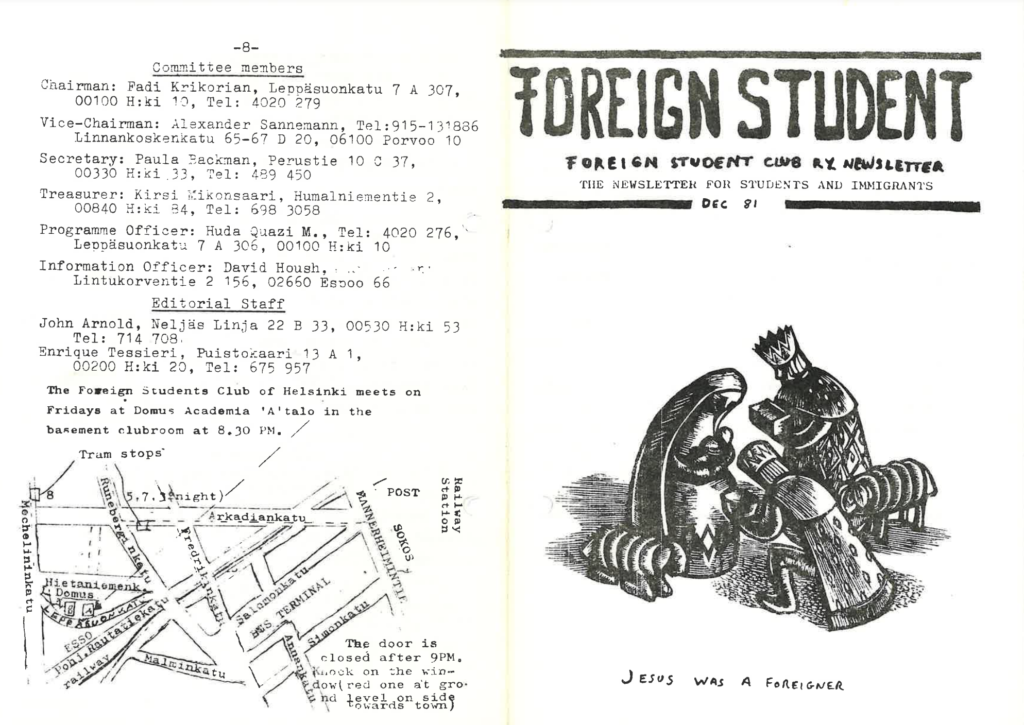
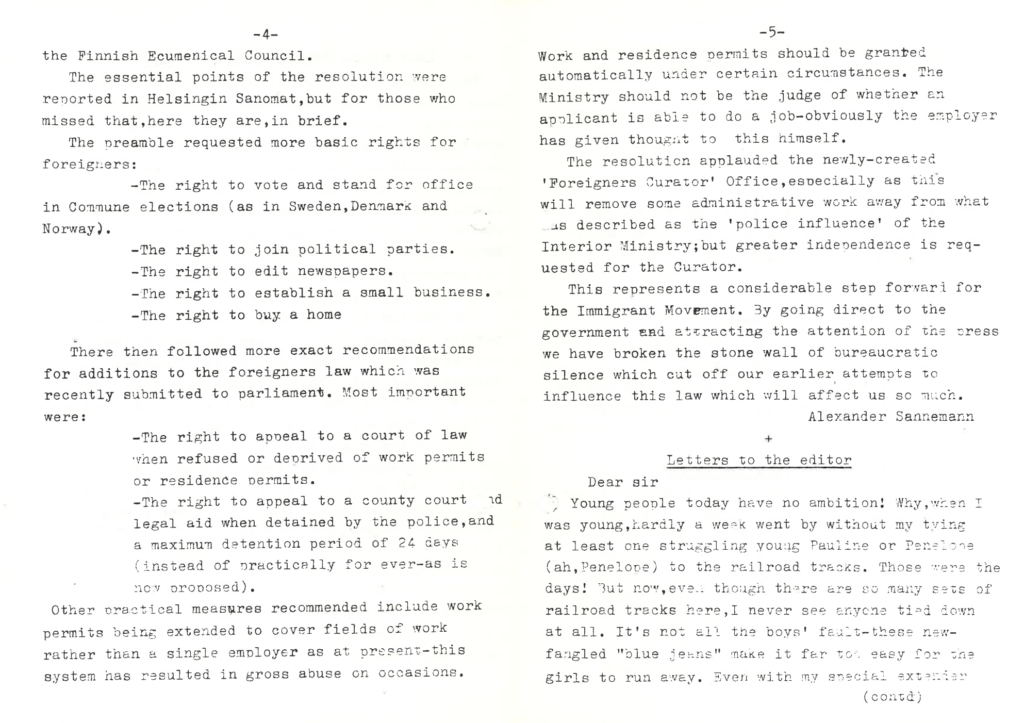
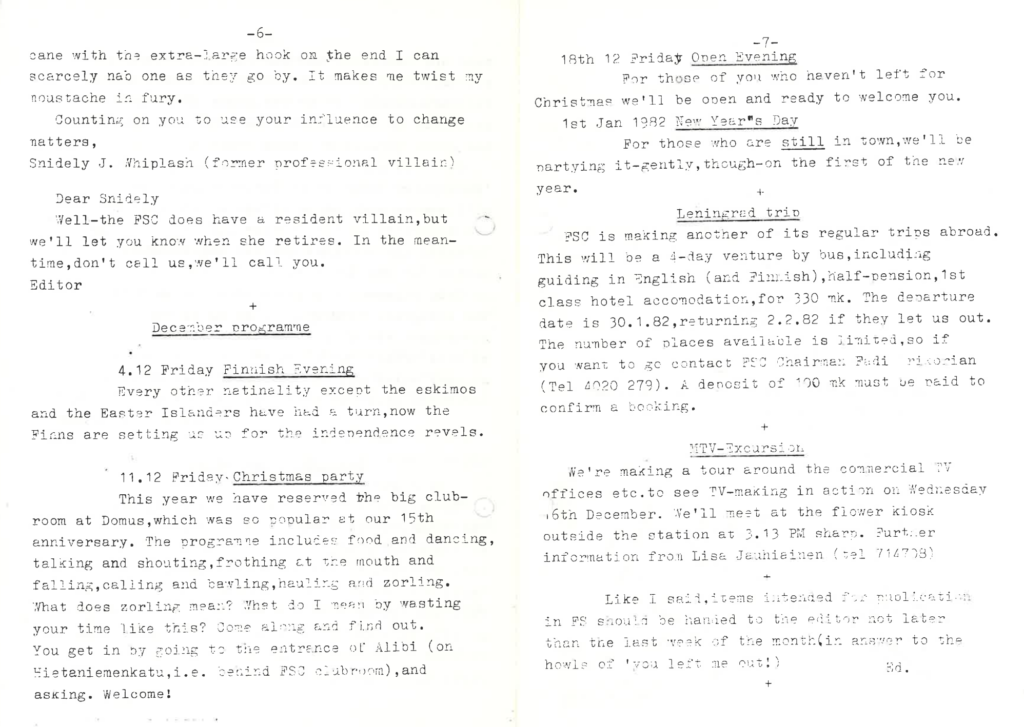
The December issue of the Foreign Student gave readers information about the ever-growing immigrant movement, which aims to improve foreigner rights in Finland. A seminar, which took place in Tampere, was attended by different political parties and officials of the interior ministry and religious groups.
“In addition to the seminar’s resolutions, the [political] parties received copies of our Mayday petition requesting that Finland observe the Helsinki Agreement and the United Nations’ Universal Declaration of Human Rights with respect to foreigners.”
Some demands made at the seminar in Tampere for greater foreigner rights included:
The right to join political parties.
The right to edit and own newspapers.
The right to establish a small business.
The right to buy a home [own property].
The right to appeal to a court of law when refused or deprived of work permits and residence permits.
The right to appeal to a county court and legal aid when detained by the police, and a maximum detention period of 24 days (instead of practically for ever as is now proposed).
Club members had the opportunity to read in the Foreign Student the Foreign Student Club’s newly elected Chairperson Fadi Krikorian’s views on the club’s direction. After thanking the previous board for their good work, Fadi said that the prospects of the club are good.
“…tradition programmes such as international evenings will continue, there will be trips inside and outside Finland, and there will be many opportunities to familiarise Finns with visitors in their country. And to the Finns I would add, come to our club and enjoy an exotic atmosphere right here in Finland,” wrote Fadi.
The new board of the club was: Fadi, chairperson; Alexander Sannemann, vice-chairperson, Paula Backman, treasurer (formerly secretary); Huda Quazi M., programme officer; David Haush, information officer, replaced Vinaya Gupta; John Arnold and Enrique Tessieri are the editorial staff of the Foreign Student.
Unfortunately, the new chairperson did not mention in his column anything about the activism of the club in securing better rights for foreigners in Finland.
I was surprised again to read a story in Yle about Russian army deserters crossing the Finnish border “without permission.” Without permission?! Understanding that the Russian deserters had crossed the border to ask for asylum in Finland, can we state that there is something “illegal” about this?
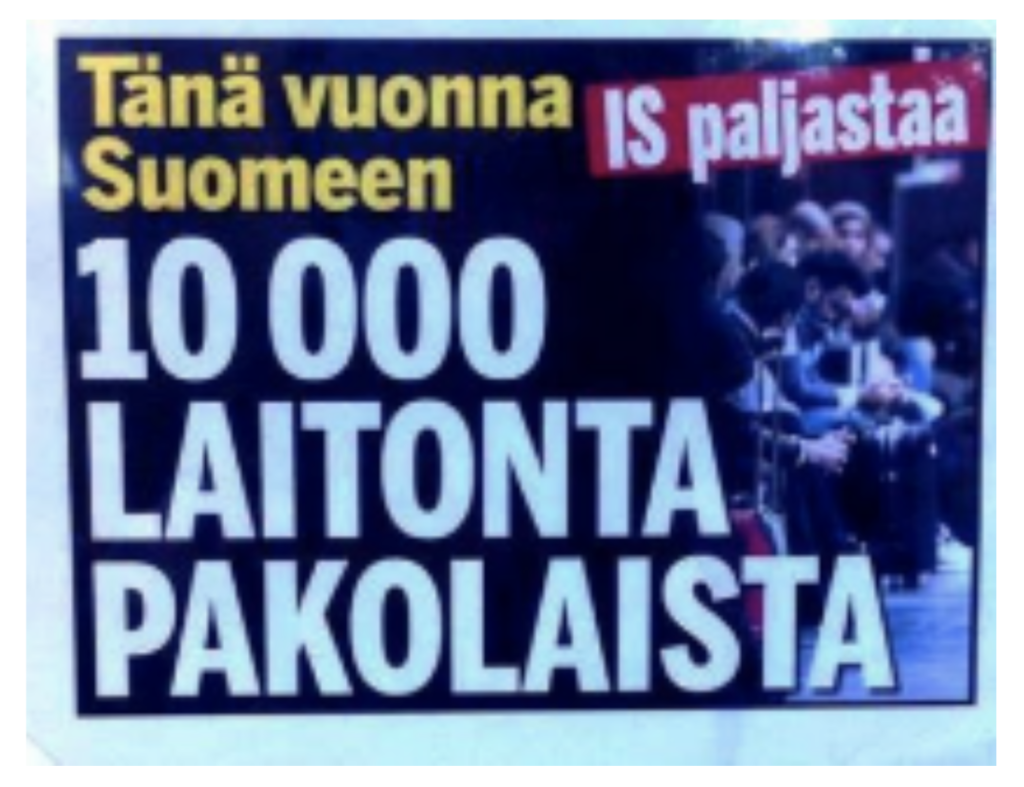
A ridiculous claim by a Finnish tabloid. How can a refugee be “illegal?” Source: Ilta-Sanomat
Moreover, another Cold War term used by Yle in the story is loikkari, or defector.
In the 1930s, Finns who moved to the Soviet Union were also called loikkari.
In the face of sensitive relations between Finland and the former Soviet Union, the Finnish authorities avoided back then calling during the Cold War a Soviet citizen an “asylum seeker.”
During the Cold War years, one or two Soviet citizens were granted asylum status in Finland. One of these, apparently, was asked to leave the country after getting asylum.
Migrant Tales had the opportunity to interview in 2012 one of these former Soviet citizens who was caught crossing the border and returned to the USSR despite having sought asylum.
Article 14 of the UN Human Rights Declaration, reads: “Everyone has the right to seek and to enjoy in other countries asylum from persecution.”
When some Finns and parties talk about returning to the “good old days,” they are saying that they’d like to return to the days when foreigners had practically no rights and where racism was king.It was also a time of appeasement to the former Soviet Union, media self-censorship, impunity, and human rights abuses.
One of the most quaint matters about those who want to take Finland back to the good old days is that they weren’t even born during those troubled times.
The treatment of asylum seekers and watching over their rights brings stark memories of the good old days. Take back Finland? Source: Twitter
What kinds of laws were in force back then? The list below is by no means exhaustive:
Finland did not have any immigration act until 1983, or about 66 years after independence;
The Aliens’ Office granted residence permits on a one-by-one basis;
The Aliens’ Office under Eila Kännö functioned like a state within a state;
Even if Finnish women were the first to get the right to vote in Europe in 1906, they could not pass on Finnish citizenship to their born child until 1984;
Foreigners did not have the right to appeal if deported;
Police surveillance of foreigners by the Finnish Security and Intelligence Service (Supo) was standard;
Supo had a register of foreigners that showed which demonstrations the person had taken part in and if he or she supported human rights;
Human rights abuses of asylum seekers were the rule;
Soviet citizens were denied asylum in Finland even if they requested it;
Finland returned tens of thousands of Ingrians and Estonians at Moscow’s request;
There were so few foreigners in the 1970s (under 12,000) that the biggest national groups were Finns who were naturalized Swedes;
Racialization was the rule and carved in stone;
Foreigners could not own or publish newspapers;
The Finnish media portrayed asylum seekers from countries like Somalia in an overtly racist manner;
Journalists, except for editors, were not allowed to write about Finland’s special relationship with the former USSR;
Finland was ruled by a strongman, Urho Kekkonen, from 1955 to 1982;
Under the Restricting Act of 1939 (219/1939), which became redundant in 1992, foreigners were not allowed to acquire a majority stake in a Finnish company;
Ownership limits of Finnish firms were 20% normally and 40% under special permission;
Foreigners could not own shares in sectors such as forestry, securities trading, transportation, mining, real estate, and shipping;
Foreigners could not own land;
Most Finns never heard of pizza;
Food markets had very few if any foreign produce.
Does any democratic-loving person who respects human rights want to return to the good old days of above?
This blog entry is dedicated to the late Donald Fields, Helsinki correspondent of the BBC, The Guardian, and Politiken to 1988.
As a journalist writing from Finland for some of Europe’s biggest dailies in the 1980s like the Financial Times, there is one matter that stands out from those days: censorship.
The censorship that Finland imposed on its media was overpowering and near-complete. Even writing about topics like EU – then EEC – membership was out of the question. Foreign policy was the sacrosanct topic reserved for only a few “wise” men.
As one example out of many, in 1992 I wrote an editorial for Apu magazine about the scrapping of the treaty of Friendship, Cooperation, and Mutual Assistance (YYA) with the Soviet Union. At the last moment, my editorial was taken down.
The only matter that remained of my editorial on the page was a black-and-white picture of Soviet Foreign Minister Vyacheslav Molotov signing the YYA agreement in 1948.
The then editor of Apu, Matti Saari, warned me: “I’m the only one that writes about such topics in editorials.”
Whenever I wrote a story that was critical about Finnish-Soviet relations, I’d get a call from the Soviet Embassy. Even the foreign ministry warned me that I would be blacklisted if I wrote critically as I once did for Spain’s leading news magazine Cambio 16 about the contraband of Bibles to the USSR.
A Finnish diplomat whom I knew in Madrid told me how furious they had been about what I had written. She said outright that if I continued to write about such topics, then I would be blacklisted by the foreign ministry.
Mike Hofman published in 2014 his thesis on media censorship during the cold war.
Soviet Foreign Minister Vyacheslav Molotov signing in 1948 the treaty of Friendship, Cooperation, and Mutual Agreement. Source: Yle.
Some of these “wise” men who guided Finland’s sacrosanct foreign policy during the cold war was the late Max Jakobson (1923-2013). I found out many years after his death that we were distant relatives. Our great great great grandfather was Jacob Weikain, who moved to Hamina in 1799 and was the first Jew to get a residence permit.
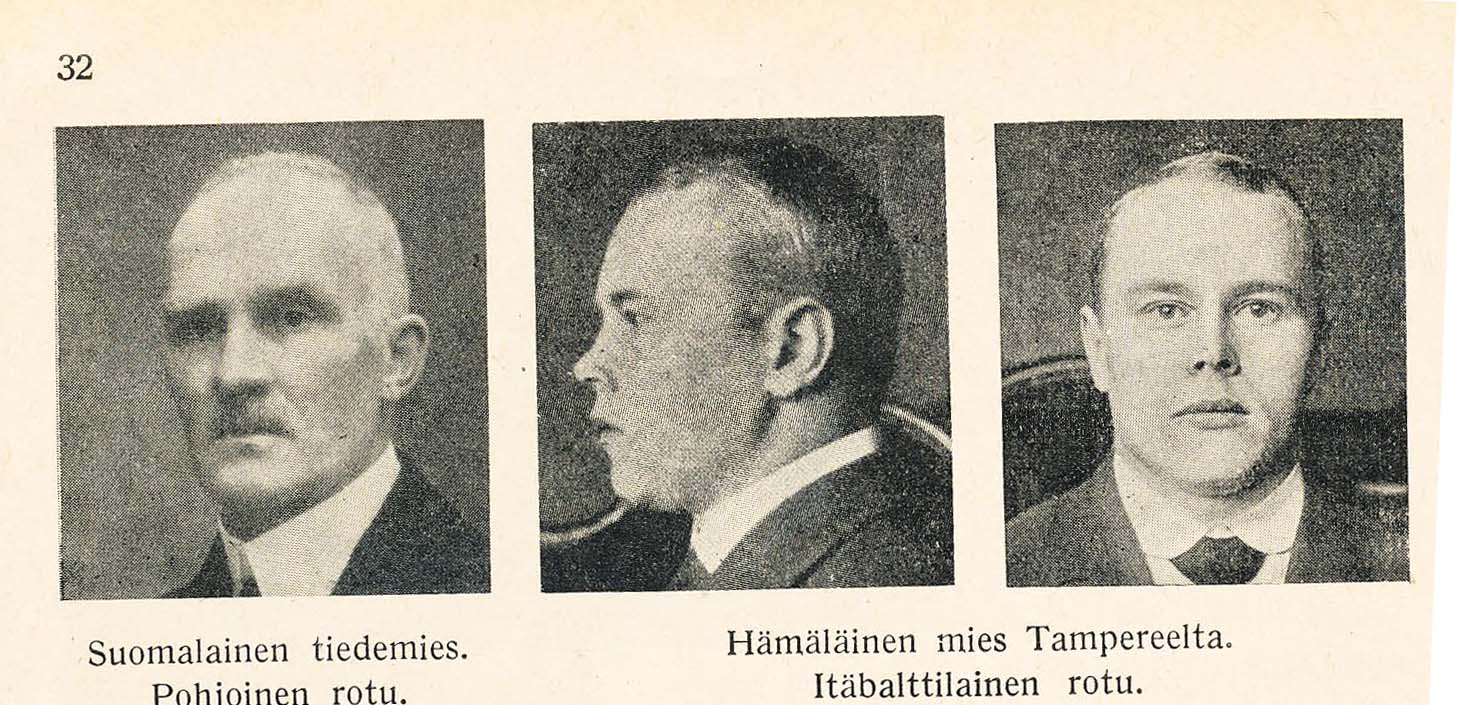
Believe it or not, history books in Finland to the 1970s still claimed that Finland was populated by two races, the Nordic and East Baltic. Eugenics was a big pseudoscience in Finland.Source: J.E. Aro, J.E. Rosberg, I Arvi F. Poijärvi, Koulun maantieto, WSOY, 1941. p.32.
Jakobson, like some of the hardliners of the foreign ministry, and associations like Finnfacts, whose job was to invite foreign journalists to Finland so they’d write positive things about the country, did not accept anyone diverging from the official interpretation of relations with Moscow.
In the minds of many foreign ministry officials, Finlandization, foreign policy dictated by the USSR, did not exist.
In the summer 1980 edition of Foreign Affairs, Jakobson wrote: “As a result, Finland is forever at the mercy of the itinerant columnist who after lunch and cocktails in Helsinki is ready to pronounce himself upon the fate of the Finnish people.”
The attitude that Finns never mind foreigners should see the country’s relations with the USSR from its perspective, reveals today Finnish exceptionalism. Foreign journalists and scholars should not give their opinion because they don’t understand our reality.
This exclusive attitude is highlighted by S. Muir and H. Worthen in “Finland’s Holocaust.” “Even when there was something written about Finland, the perspective of the foreign researcher was often criticized for hopeless objectivity and the blindness towards the specifically Finnish war-time historical context. In many cases, this has been more than justified (our emphasis).”[1]
How have the cold war years impacted Finland today? Is it evident in its immigration and asylum policy and the general suspicion of foreigners? Can we trace its impact to the rise of a racist party called the Perussuomalaiset (PS)?* What about the explosive increase of hate speech and racism?
As S. Muir and H Worthen as well as other scholars, it is clear that the roots of Finnish racism are rooted in its history.
They continue: “The myth of an ideologically unified Finland isolated from the attitudes and practices of its ally, the Third Reich, and generally unsullied by antisemitism has become an insupportable burden for contemporary Finnish historical and cultural studies, and indeed for contemporary Finnish society; the insensitivity toward these silenced histories provides a condition of continued racism and antisemitism. [2]
Cold War and Human Rights
My Finnish relatives are a source that helps me to understand the source of racism. It is right under my nose almost completely whitewashed by hostility and history.
Part of my grandfather’s family changed their surname in 1931 to Harvo from Handtwargh. Even if I never asked my grandfather why he changed his surname, I suspect it had to do with the rise of fascism and anti-foreign sentiment, which was fed by anti-Semitism.
While matters like my family’s Jewish background took decades to figure out, one of my greatest disappointments, when I moved permanently to Finland in December 1978, came when an Aliens’ Office official said that I wasn’t a Finn.
Citizenship in Finland is determined by the parents’ citizenship (jus sanguinis). Even so, I was not considered a Finn because my father wasn’t a Finn.
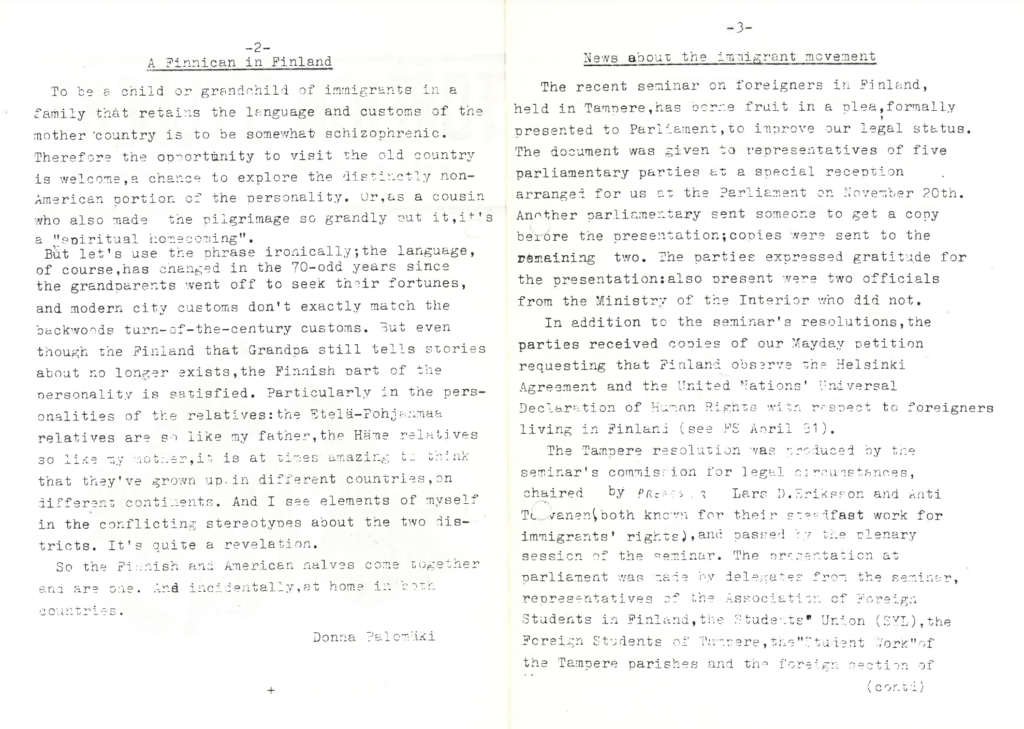
Even if people in this country are quick to point out that women where the first in Europe who won the right to vote in 1906, it was not until 1984 when they had the right to pass on Finnish citizenship to their children.
A year before women won such a right, the country had in force its first-ever Aliens Act. Before the act, foreigners were treated by the aliens’ authorities on a one-to-one basis. You had no rights and could be deported without the right to appeal.
The treatment of foreigners, especially Soviet refugees, was disgraceful during the cold war.
Migrant Tales has written onSoviet asylum-seekers in Finland in the past and how they were returned against their will to the USSR to suffer a gruesome fate in psychiatric wards and prisons. One of these that I met was Aleksandr Shatravka, who visited my home in 2011 with his wife Irina. Thanks to Aleksandr, whom I met thanks to Migrant Tales, I published in February 2010 in one of Finland’s first-ever extensive human- interest stories on a former asylum-seeker who was forcibly returned to the Soviet Union in 1976.
If Finland was hostile to refugees and suspicious of foreigners, the country was ruled until 1992 by the Restricting Act of 1939.
The Act prohibited foreigners from owning real estate and acquiring a majority stake in Finnish companies—limiting this to 20% normally and 40% under special permission. The Restricting Act stipulated that foreigners could not own shares in sectors like forestry, securities trading, transportation, mining, real estate, and shipping. Foreigners weren’t allowed to establish newspapers, never mind organize demonstrations, and be politically active.
If history shows us some of the roots of our racism and anti-Semitism today, it also sheds as well light on our restrictive asylum and immigration policy. It explains why the Finnish Immigration Service operates in the way it does and why it has been the object of much criticism.
One positive step in cutting the roots and sources of our racism was an independent investigation that confirmed in February that Finnish volunteers of the Waffen-SS Wiking Division engaged in violent acts against civilians and Jews in Russia.
Considering that the aim of the SS in Russia was a war of annihilation and genocide against Jews and other enemies of the Nazis, the conclusions of the investigation should not come as a surprise.
The big surprise, however, is that it has taken almost 85 years to connect the volunteers of the Waffen-SS dots to the genocide that took place in Russia during World War 2.
[1] Finland’s Holocaust: Silences of History, edited by S. Muir, H. Worthen, pp. 25-26.
This brought me back to the days of my reckless youth when I arrived in Finland in the early 70s to study at university. At that time a foreign citizen was not allowed by law to hold any kind of “virka” i.e. permanent public job. A foreign citizen was also not even allowed to marry a Finn. There were also a host of private sector and community jobs a foreigner could not hold like newspaper editor, city counselor, shop steward and board member in a company or association.
Little did I know at the time that I would eventually take on all of these ” illegal” activites.
Defense Minister Jussi Niinistö is a member of an anti-immigration party (formerly Perussuomalaiset, today Blue Reform*) with ties to far-right groups. Read the full story (in Finnish) here.
This was not the Finland, the fierce defender of freedom, I expected to find. This was a closed society with apparently a huge case of xenophobia with one administrative rule after another to exclude and kick out foreigners. There was actually no appeal process for foreigners who got deportation notices. Just leave or else. It was worse than Trump’s USA in that everyone seemed resigned to it and it had gone on for decades. In some ways it was like North Korea in that everybody seemed happy with the very closed system. The exception was that almost everybody had enough to eat.
I turned into a kind of career rule basher or a kind of a reluctant corporate guerrilla. It probably started when I fell in love with a Finnish woman. I actually had to chase down the Minister of Justice to get special government permission to marry. After that success I decided to stay and make it stick. That was in the vows too.
The thesis below published in 2014 by Mike Hofman. It is a comprehensive report on how censorship and self-censorship happened in Finland during the Cold War. It is surprising how Finland has sidestepped this issue and thrown it in the dustbin of history.
As the old saying states, if we don’t know or deny our history are condemned to repeat it.
Even during the height of the Cold War, when media censorship and self-censorship were endemic in Finland, I never heard of the police searching a home of a reporter without a court order as happened Sunday, according to YLE News.
Read below Hofman’s thesis (in Dutch) and my interview in English.
Read full thesis (in Dutch) and a synopsis in English here.
Below is the interview in English that Mike Hofman had with me. There is only one correction in the interview. I worked for Bridge News, not British News.
If there is one politician in Finland that gives some heartburn, that politician is without a doubt Paavo Väyrynen. It is unfortunate that the Finnish media doesn’t return to the cold war era and look into Väyrynen’s record when he was the foreign minister most of the time from 1977 to 1993. During that period there were severe censorship issues in the Finnish media and human rights violations when, among other things, Soviet citizens were forcibly returned to the USSR even after asking for asylum. Are we surprised that Väyrynen is anti-EU, anti-immigration and a nationalist?
He was always those things. Finland’s cold war stance was just that: anti-EU, anti-immigration, censorship, human rights violations, and nationalism.
The media should talk about his track record when mentioning Väyrynen.
In another move to punish former migrants who are naturalized Finns, the government of Prime Minister Juha Sipilä plans to introduce a new law to parliament within weeks that will prohibit dual citizens from holding certain jobs that involve national security, according to Seijnäjoki-based daily Ilkka, which cites Finnish News Agency (STT).
Some sensitive national security jobs are found in defense, Finnish Border Guard, police service, customs, diplomatic service, and communications, according to Kirsi Äijälä, who heads a committee drafting the new law. She said, however, that hiring decisions are made on a one-by-one basis and the law will permit exceptions.
The new law, if passed, is a sign of how Finland is flirting with the Cold War years when nationalism and suspicion of anything foreign were the rule.
During the 1990s with the demise of the Soviet Union, there was an opening up of Finland with Western Europe. It joined the Council of Europe, in 1995 it became an EU member, drafted a new Constitution, which promoted social equality, anti-discrimination, and cultural diversity as well as passed new dual citizenship laws.
The short opening up of the country started to falter in 2011 when the Perussuomalaiset* party won their historic parliamentary victory by raising the number of MPs to 39 from 5. Instead of passing laws that promote diversity, the Finnish government is passing today laws that penalize migrants.
Apart from laws that discourage cultural diversity and promote nationalism, the government has failed in containing the rise of racism and the ever-worsening anti-immigration climate of Finland.