Sweden’s Prime Minister Ulf Kristersson not only blamed migrants for the violence in Sweden, he sent a message to all of the Nordic region. It’s called the blame game. Blame is an excuse and a tool for attack that distorts reality and a way to avoid responsibility.
He reiterated Sweden’s about-turn in strict immigration policy as a way to control immigrant and minority crime. “We have globalised crime, which is very much linked to immigration,” he was quoted in Helsingin Sanomat quotting TV4. “We have had very high immigration into Sweden for a long time. We have now tightened it considerably.”
Kiristersson’s blame and denial are straight from the populuist anti-immigration songbook. The message is clear: Just tighten immigraton law and the problem is solved.
Much of the Swedish public, which voted for Sweden’s most anti-immigration government in a long time, is also filled with wishful thinking. If the PM gives such a simple solution, then it must be true, right? Dead wrong.
In Finland, too, Prime Minister Petteri Orpo’s government has blamed migrant youths for the rise in crime. A report published by us in 2023 showed how the anti-immigration Perussuomalaiset (PS)* have used the rise in youth crime in Finland as a way to gain voters and public support.
Recent discussions by the Finnish government have raised concerns among human rights groups about the possibility of copying Denmark to carry out random spot checks on people in certain neighborhoods.
If such a measure were ever implemented, it could lead to France’s controversial Article 24 which restricts videoing the police with the intention of “threatening [their] physical or psychological integrity.”
Even if such changes in the law in Finland now seem far-fetched in a country where the police have a good reputation, it is essential to examine what is happening in other European countries where far-right governments have gained power. Some of these include Switzerland, where the Swiss People’s Party is the biggest party, the ruling Brothers of Italy and Lega Nord of Italy, Fidesz of Hungary, the United Right of Poland, Sweden Democrats, and the Perussuomalaiset (PS)* of Finland.
Also, in non-EU countries like Serbia (United Serbia) and North Macedonia (VMRO-DPMNE), there are far-right parties that target migrants and refugees.
Considering that the EU is a region that abides by the European Convention of Human Rights, it is concerning that such parties above target ethnic groups and minorities and want to weaken the civil rights of such people.
One consistent pattern seen in countries where far-right ideologies have gained power is the control and manipulation of narratives to instill fear, racist conspiracy theories, and the perception of dangerous threats by migrants to the native population.
At the core of these ideologies lie xenophobia and ethnic superiority. The far-right presents itself as the savior and protector of the native population, framing every outsider—immigrant, Roma, or anyone deemed different—as an ongoing threat and suspect.
Ethnic Profiling and Suspicion
A common tactic employed by far-right governments is ethnic profiling and the disproportionate targeting of ethnic, religious, and other minority groups by law enforcement agencies. This type of profiling often masquerades as “legitimate” when the police suspect someone of drug possession or gang affiliation.
“Legalized” ethnic profiling is used to justify the increased scrutiny and surveillance of certain communities and ethnic groups even if crime does not have a specific skin color or ethnicity. But when law enforcement focuses its attention on one particular ethnic group, they are more likely to uncover crime, not because of inherent criminality but due to increased scrutiny. It can lead to a vicious cycle, where arrests and convictions are used to justify further restrictions and targeting, perpetuating the belief that these communities are inherently dangerous.
Minister of Interior Mari Rantanen
In an interview with Joona Aaltonen of Helsingin Sanomat, Minister of Interior Mari Rantanen acknowledged concerns about the country’s “growing” youth and gang crime problem. She cited a statement by Jonne Rinne, the chairman of the Association of Police Organizations, who estimated that 95% of street gang members in Finland are of foreign origin on the basis of their names and ethnic backgrounds. Rinne did not care to elaborate if these youths were born in Finland, were Finnish citizens or had a Finnish parent.
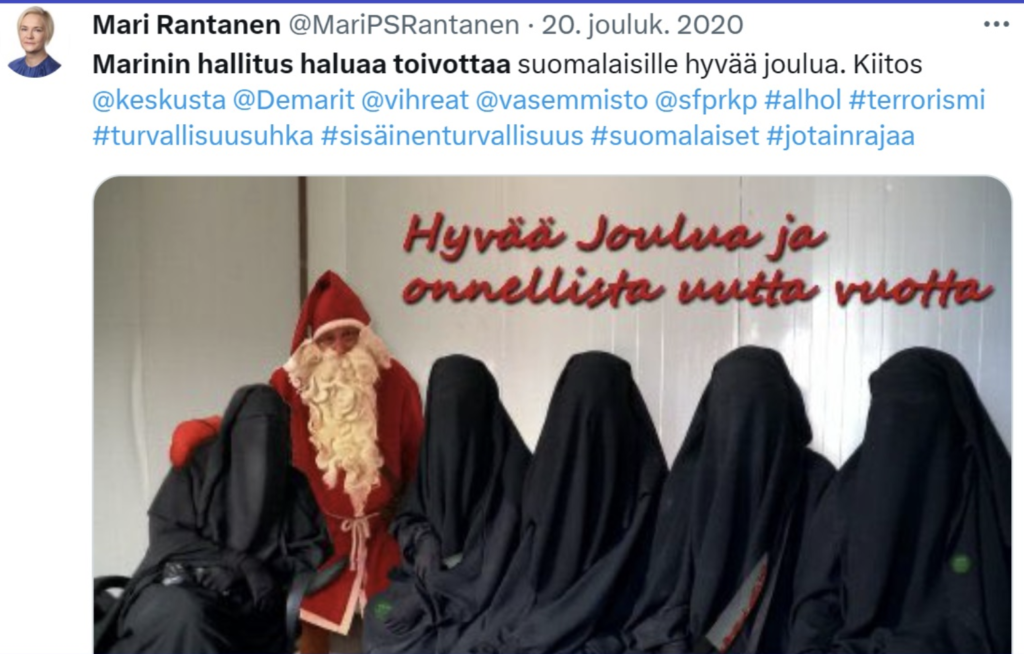
Before Rantanen was minister, she would send Islamophobic messages to then Prime Minister Sanna Marin. “Marin’s government wishes Finns a Merry Christmas,” she wrote. Source: X (formerly Twitter).
There are a number of worrying signs that Finland’s democracy and social welfare state are under threat. The threat does not come from abroad but from inside Finland thanks to the Perussuomalaiset (PS)* and National Coalition Party (Kokoomus).
Apart from disenfranchising migrants with strict laws that will make life harder for the country’s most vulnerable groups, Petteri Orpo’s government plans to weaken labor laws like the right to strike, and even the PS has been accused recently of trying to censor the media.
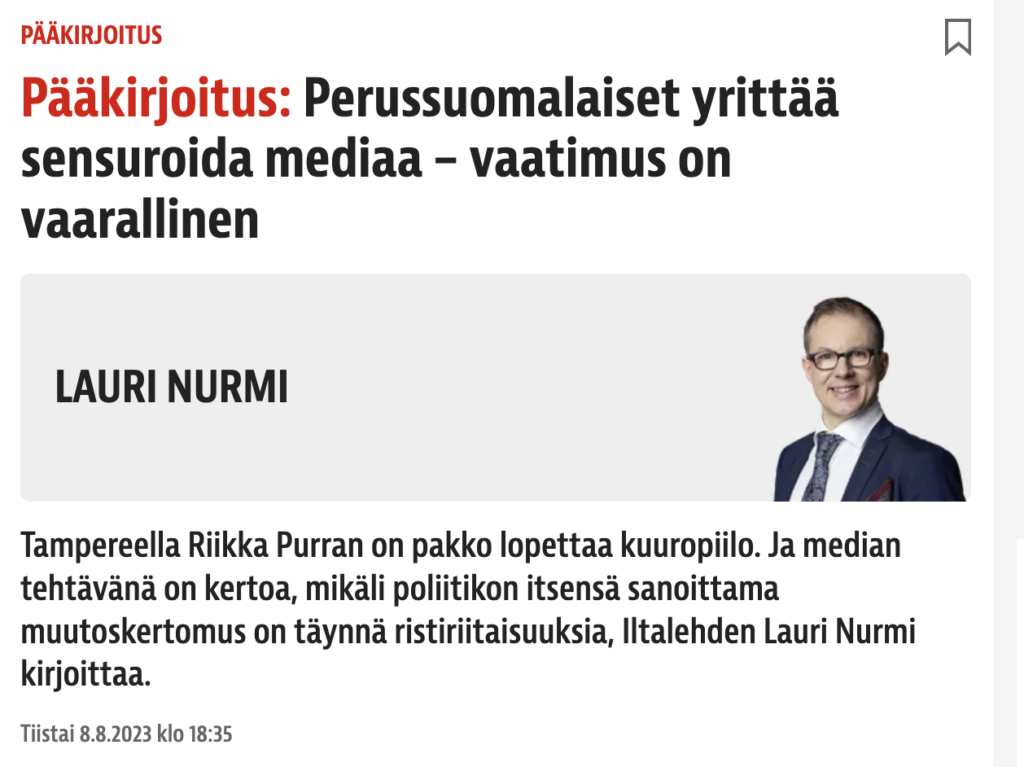
Lauri Nurmi wrote “The Unofficial Biography of Jussi Halla-aho in 2020. He claims in an Iltalehti editorial that the PS has made a dangerous move by trying to censor the media. Source: Iltalehti
Nurmi writes: “The [PS congress] invitation to the media ends with a special request: ‘We appeal to all the editors to please leave the archaeological political hacking in your offices coat racks and focus on the decisions made at our congress and political policies.’ The Perussuomalaiset [party] is trying to censor the media and limit what questions they can ask [at the congress]. The invitation from the PS could be seen as obstructive. The demand by it is unprecedented and dangerous in Finnish political journalism, but the reason for making [such a request] is obvious.”
It’s clear that the party is not happy with the scandals originating from racist and far-right posts by ministers like Riikka Purra, Wille Rydman and Vilhelm Junnila, who was forced to resign. Instead of blaming themselves, they place the blame on the media.
Moreover, the government plans to weaken worker rights and unions and take away basic health care from undocumented pregnant women and their children.
Inhumane would be a too weak word to describe the new government’s policies.
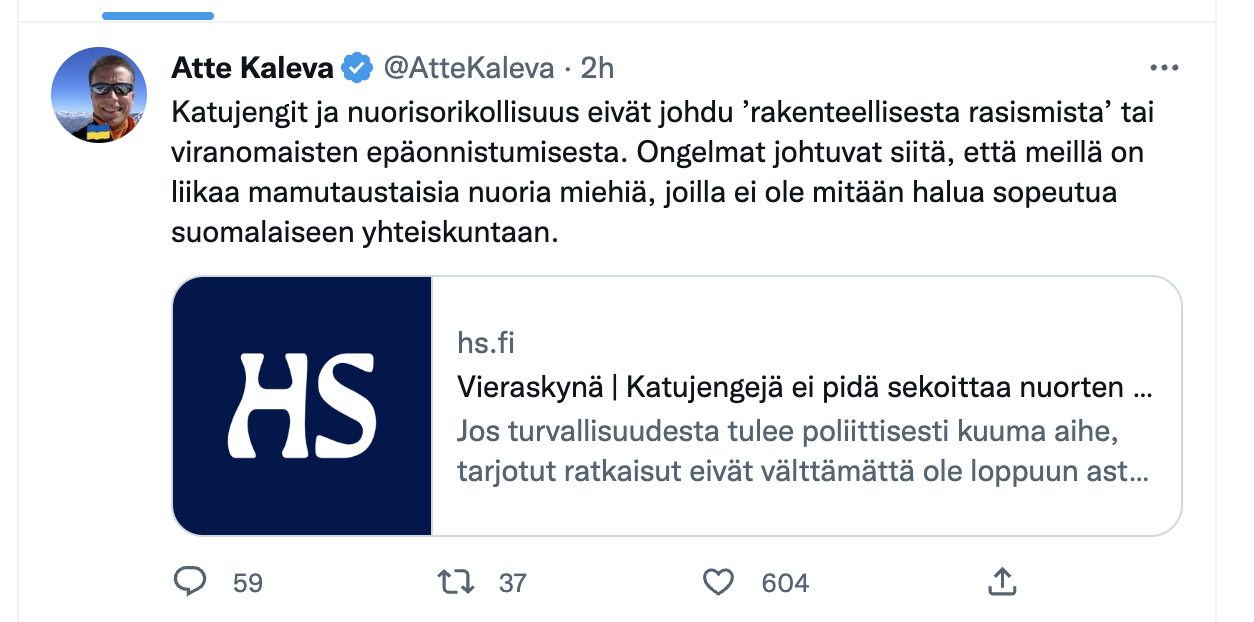
Parliamentary elections are in April. How can I tell? When National Coalition Party (Kokoomus) politicians like MP Atte Kaleva spread lies and populist soundbites about migrants.
Kaleva has a tough time stomaching criticism, and usually, his answers are knee-jerk reactions.
One of these is when he charged Professor Panu Ratikiainen with defamation because he called him a racist.
Did the media notice? No.
There was one, however: Seiska, the lowest gossip journalism you can find in Finland.
Can you take him, MP Kaleva, seriously? Do his words carry any weight?
Not an ounce but he can surely pile it high and deep with his anti-immigration tirades.
MP Kaleva calls migrants or so-called “people with foreign background,” mamus. Mamu is the Finnish n-word for migrant.
Helsingin Sanomat published (paywall) Sunday an interview with Riikka Purra, the chairperson of the anti-immigration Perussuomalaiset (PS)* party. Helsingin Sanomat‘s veteran reporter, Marko Junkkari, did the interview.
In general, Junkkari did a good job in handling Purra’s comments with facts and in no place in the interview did the PS chairperson dominate the interview with her answers, which did not convince.
The story’s headline, “Always the same topic,” sits well with the story. Like her predecessor Jussi Halla-aho, migration is the PS’ pet topic.
In the story, it becomes clear that Junkkari dominates the topic and is not afraid to ask Purra some uncomfortable questions. However, one matter that bothered me about the story was the use of the term “migrant.” It was used too generally, and Junkkari could have asked the PS chairperson to specify what types of migrants she refers to.
I doubt that Purra refers to white German migrants in Finland when speaking of migrants.
It is such an important topic for the party that it grew from a minor to a major party in parliament. The PS is the first party in modern Finnish history to use migration as a rallying cry for voters.
Even if Purra promised the party would expand to other topics, nothing has happened on this front.
I wonder if National Coalition Party (Kokoomus) MP Wille Rydman has ever heard of Florida Republican Congressman Matt Gaetz, who is under investigation for sexually abusing minors, among other crimes? Helsingin Sanomat exposed in a story Rydman of inappropriate behavior and abusing sexually minors Sunday.
Like Gaetz, Rydman is in hot water and denies all charges against him.
Apart from being unofficially christened as the Jussi Halla-aho by some Kokoomus MPs, it is ironic that such a politician warns Finns of the dangers of the crimes of asylum seekers, which include rape, is suspected of the same crimes.
Former Perussuomalaiset (PS)* chairperson Jussi Halla-aho was convicted in 2012 for ethnic agitation and breaching the sanctity of religion. In his blog writings, he hoped that migrants rape certain MPs.
One of the far-right conspiracy theories spread by Rydman is the great replacement theory, which warns that Muslims and people of color will take over Europe and whites will become a minority.
A campaign poster for the 2011 parliamentary election, where Rydman claims, among other matters, that Finland should only accept the number of migrants it can adapt. In the ad, Mukhtar Abid, a social worker, states, ” This is why I, a Helsinki Social Democrat, will vote for Kokoomus’ Wille Rydman.” I sent Abib a message to ask him what he thought about the scandal and if Rydman was the right person to back in 2011. He has not responded to my message. Source: Migrant Tales
Apart from the hypocrisy of Finnish exceptionalism and that of Kokoomus’, it is surprising how little the party did to get to the bottom of these alleged crimes committed by Rydman.
Writes Helsingin Sanomat: “The women who were in contact with Rydman say he acted inappropriately and was sexually explicit in his words, behaved in a threatening way and forced them [to consume] alcohol. Some of the women were minors when Rydman approached them.”
Kokoomus chairperson Petter Orpo had heard about the allegations against Rydman in winter when journalists were investigating Rydman.
There is an old saying that goes something like this: I was a liberal in youth so I would not be a fascist in old age.
What motivates a politician to twist and exaggerate facts to stigmatize migrants? National Coalition Party (Kokoomus) MP Heikki Vestman’s speech in parliament Wednesday is a prime example of how some politicians spread Islamophobia to attract attention and gain power.
His unsubstantiated talking points motivated me to write an email to him, which he has not yet responded to.
Moreover, the MP uses code to tell us what groups he is targetting. The term “asylum seeker” usually means Muslim.
“When I heard your speech and rationale Wednesday (20 October), I wondered how a young, apparently intelligent person could house such opinionated and unsubstantiated claims about migrants. If you are honest, would you want to [live and] grow up in a country where this type of discourse is ongoing by politicians seeking power and attention? Read some history and check out how the Finns were labeled in Sweden during the 1960s and 1970s.
Does the phrase “en finne igen” ring a bell?
After North America, the greatest number of Finnish immigrants, or about half a million people, moved to Sweden. In the 1960s and 1970s, Finns had a terrible reputation in the neighboring country. Whenever a crime occurred, Swedes usually responded, “it must be a Finn,” en finne igen.
Here is a question to Vestman: Why are you picking and bullying vulnerable groups of people who cannot defend themselves from your attacks?
National Coalition Party anti-immigration MP Heikki Vestman. Source: Kokoomus
Below are some unsubstantiated claims (that I translated and paraphrased) from Vestman’s speech. He was against loosening family reunification guidelines because the minors, whom he sadly referred to as “anchor babies,” could become a national security threat.
Vestman should know that having a family is a human right.
A group of present and former asylum seekers decided to hold an indefinite demonstration in front of Helsinki’s Finnish Immigration Service’s (Migri) on Thursday for better rights and security in Finland.
Walid Sahib, one of the persons taking part in the demonstration, said that the most important matter is to raise awareness for the plight of undocumented migrants and others in limbo waiting for decisions on their asylum applications.
“There are many [thousands] people with no permission in Finland and [others] waiting for four years for their residence permits,” said Sahib. “It is a very difficult situation.”
Demonstrators outside the Finnish Immigration Service offices in Helsinki. Photo: By demonstrators.Sahib said that there is no time limit to the demonstration. The last demonstration held by Iraqi and Afghan asylum seekers at the Helsinki Railway Square lasted for 140 days.Another shorter hunger-strike demonstration was held in Helsinki in 2017.Photo: By demonstrators.
In 2016, the right-wing government of Prime Minister Juha Sipilä tightened Finland’s immigration law and did away with residence permits on humanitarian grounds. This change in the law forced the number of undocumented migrants to rise from a few hundred to a few thousand.
Then Social Democrat MP Nasima Razmyar, who is today Helsinki deputy mayor for culture and leisure, voted in 2016 to end residence permits on humanitarian grounds.
Razmyar is herself a former asylum seeker from Afghanistan.
Other migrant rights were eroded by Sipilä’s government as Amnesty International points out below.
Read the full Amnesty International Report 2017/18 here.
I would like to extend my support for these brave migrants for demonstrating for their rights. In today’s hostile environment of Finland, it is an effective way of raising your voice and invite public concern to your cause.
TheAlma Median EU election compass shows that (85/234) MEP candidates of the Perussuomalaiset* and National Coalition Party as the most eager to allow migrants drown in the Mediterranean. Even a neutral, or no opinion answer, is problematic. Does it mean that you are quiet and look the other way when people drown?
EU election compass 13/20 question: “Is it the obligation of the EU to save all those migrants who attempt to come to Europe and who are at risk of drowning in the Mediterranean?”
Who are these MEP candidates, who don’t care if a person drowns in the Mediterranean?
Here is a story about a person who almost died when crossing the Mediterranean.
Children also drown in the Mediterranean. On the left is Alan Kurdi and on the right a little girl. During 2014-2019 there were a total of 18,328 people (2019 410, 2018 2,299, 2017 3,139, 2016 5,143, 2015 5,054, 2014 3,283) died who attempted to cross the Mediterranean to Europe. Here is the link.
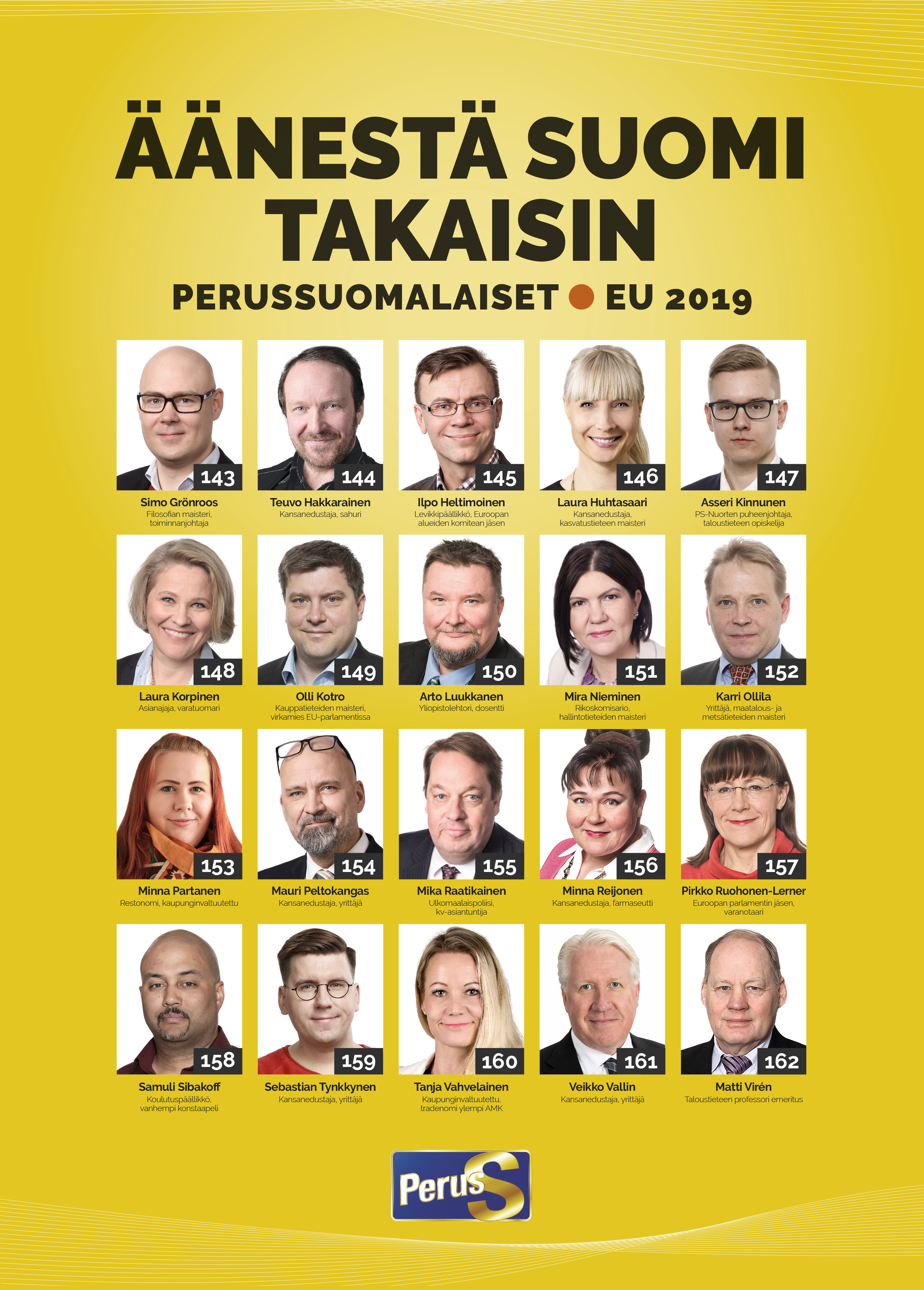
Here is Migrant Tales’ shameful “let them drown” list of Finnish MEP candidates:
One picture on the left shows how migrant children in the United States are being separated and incarcerated. On the right, is a picture taken in Finland last year of a minor looking out the window at the Joutseno immigration removal center.
One of Finland’s most anti-immigration governments, which has brought the hostile environment to our shores, can claim with a poker face while it incarcerates minors it does not separate children from their parents.
But then we have unaccompanied minors who are incarcerated in Finland never mind the child protection authorities that ethnically profile migrant families.
The United States versus Finland. What is the difference? See the video on the right here, and the one on the left here. The picture of the girl on the right was locked up with seven of her brothers and sisters at the Joutseno immigration removal center. The family was released in 2017 from detention, and all its members have a temporary residence permit in Finland.